Clan Maxwell
also Clan Maxwell
Caerlaverock and the Solway shore, the great Border clan of the south-west.
- Origin
- Ayrshire & Galloway, Scotland
- Motto
- Reviresco
- Famous bearer
- John, 8th Lord Maxwell (c.1553–1593), warden of the West March
- Register
- Scottish clan
The Maxwell arms, crest badge, tartan and country

Crest badgeClan member crest badge - Clan MaxwellMostEpic · CC BY-SA 4.0 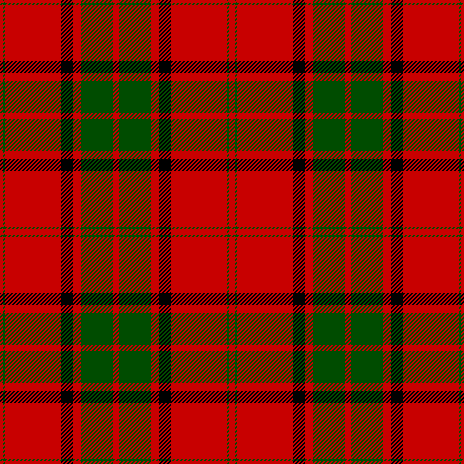
TartanMaxwell tartan (Vestiarium Scoticum)As printed in the Vestiarium Scoticum, 1842, a collection whose claimed medieval source was never produced, and which is now generally held to be a forgery. Families adopted its patterns anyway, and wear them still.Celtus · CC BY 2.5 
Coat of armsMaxwell of Nithsdale armsBorne by the Nithsdale line, one branch of the name rather than all of it.Wikimandia · CC BY-SA 4.0 
Coat of armsMaxwell of Caerlaverock armsBorne by the Caerlaverock line, one branch of the name rather than all of it.Wikimandia · CC BY-SA 4.0

.png)


- Crest badge: The chief's crest inside a belt and buckle: the badge a clansman wears to show whose following he is in.
- Tartan: The checked cloth the family is known by.
- Coat of arms: Granted to an individual and inherited down that one documented line. These are the arms of particular families of the name, not of everyone who shares the surname.
What is the Maxwell clan tartan?
One Maxwell sett is recorded, and it is the swatch above (the plate printed in the Vestiarium Scoticum in 1842). The Vestiarium claimed to copy a medieval manuscript that was never produced, and is now generally held to be a forgery; families adopted its patterns anyway, and wear them still. A sett is the block of coloured bands the cloth is built from, repeated in both directions; the whole plaid is that one square enlarged.
Maxwell is a Lowland name, and Lowland families did not wear Highland dress; the 1746 proscription that broke the tradition in the north took nothing from them, because there was nothing there to take. The Maxwell sett is a 19th-century assignment, made when tartan stopped being Highland and became Scottish and fixed by the Bannockburn weavers’ pattern books, the royal visit to Edinburgh in 1822, and the Vestiarium Scoticum of 1842. Nobody polices any of it. Wearing the Maxwell sett declares allegiance to the name, not descent from any particular line of it.
CoreHistoric reach
The seat of Clan Maxwell
Seat vacantChief
No one leads the Clan Maxwell community yet. When the movement opens, you can stand for its leadership, or help elect whoever does.
Current mission
No shared goal set yet. Once Clan Maxwell has leadership, it sets the public focus: a restoration, a gathering, a real-world project that helps its own.
The Maxwell clan is being rebuilt. Join the waiting list for the movement today, and you help decide who leads it and what it does.
Help rebuild the Maxwell clan →Motto
Reviresco
“I flourish again”
What does the Maxwell name mean?
From Mackeswell, 'Maccus's Well', the well of Maccus, an Anglo-Scandinavian thane who held lands on the Tweed near Kelso in the 11th century. The Maxwell chiefs descend from Sir John Maxwell, sheriff of Roxburgh, whose son Sir Aymer Maxwell (d. 1265) was Justiciar of Galloway and the first holder of Caerlaverock Castle on the Solway shore. Caerlaverock, the great triangular fortress on the moss south of Dumfries, was the Maxwell stronghold for nearly four centuries and is the visual identity of the clan to this day.
The history of Clan Maxwell
Maccus's well on the Tweed
The name is a place before it is a family. It was written Mackeswell in 1144, the well or spring of Maccus, Magnus in Old Norse, an Anglo-Scandinavian thane said to have lived in the reign of David I, whose pool lay in the River Tweed near Kelso in the Borders. The second element is the Old English well[a]. Scottish Gaelic renders the surname MacSuail. In Ulster the same spelling covers a different line entirely, where Maxwell was in some cases adopted as an alternate form of the Irish surname Miskell.
The Border house descends from Sir John Maxwell, Chamberlain of Scotland, who died without issue and was succeeded by his younger brother Aymer. Sir Aymer Maxwell, who died in 1265, was Justiciar of Galloway and the first of the name to hold Caerlaverock on the Solway shore. From Aymer's sons sprang the branches that filled the south-west and the Clyde (Monreith, Pollok, Calderwood, Buittle, Munches), which is why one surname ended up attached to a dozen castles between the Tweed and the Firth.
Eustace Maxwell changes sides at Bannockburn
Sir Herbert Maxwell's name stands on the Ragman Rolls of 1296, among the Scots who swore fealty to Edward I of England. His son Eustace held Caerlaverock as a vassal of the English king and then abandoned that allegiance to follow Robert the Bruce to Bannockburn, a change of side that kept the castle in Maxwell hands once the English cause collapsed.
Caerlaverock is a rarity: a triangular castle, moated, first raised in the 13th century on the moss south of Dumfries. The English besieged it in 1300, an assault thought worth commemorating in a contemporary heraldic poem, and the fortress was demolished and rebuilt more than once without ever losing its three-sided plan. It remained the seat of the Maxwell chief for close to four hundred years, and it is still the image the name summons.
A Lord of Parliament, and the dead at Flodden
Eustace's descendant, another Sir Herbert, was created Lord Maxwell about 1440 and took a seat as a Lord of Parliament; the Maxwells of Monreith descend from his second son and were made baronets in 1681. In 1449 the same Herbert, Lord Maxwell, built Mearns Castle on a rocky knoll at Newton Mearns south of Glasgow under a royal warrant: a four-storey rectangular tower thirty feet by forty, its walls ten feet thick, rubble masonry below and well-cut ashlar above, a join that suggests it rose on the footings of something older.
John Maxwell, 4th Lord Maxwell, was killed at Flodden in 1513. The fifth Lord intrigued with Henry VII of England, and in 1526 brought the Maxwells out for Archibald Douglas, 6th Earl of Angus at the Battle of Melrose, where they beat the forces of Sir Walter Scott. James V had nonetheless made him Warden of the Marches by 1542, and in that same year he was taken prisoner at Solway Moss. The wardenship of the West March stayed with the family, and with it the running quarrel with the Johnstones of Annandale.
A peel above the Calder, a tower under the reservoir
The Calderwood branch built its peel tower on a precipice above the Rotten Calder Water in East Kilbride in the early-to-mid fifteenth century, on lands that charter rolls show were broken up during the Wars of Independence and later gathered to the Maxwells. It stood until several days of storm brought it down in 1773, and survives only in a mid-eighteenth-century drawing; the estate went to the Scottish Co-operative Wholesale Society in 1904 for soft fruit, oats and dairy, and the buildings were demolished between about 1943 and 1951.
The same branch took Stanely, the ancient seat of the Danzielstons, in the early 15th century and raised an L-shaped tower on an island in a marsh at the foot of the Gleniffer Braes south of Paisley: four storeys of roughly squared local freestone, a rectangular block with a square jamb added in a second phase. The Maxwells sold it in 1629 to Lady Ross of Hawhead. Since 1837 the Paisley Water Company's reservoir has half-drowned it, and it can be seen on its narrow promontory only when the water is drained.
On the Annan, Sir John Maxwell came into Hoddom in the mid-16th century by marrying the heiress Agnes, Lady Herries, and probably built the tower house there. The following year the English under Lord Scrope attacked it and blew the tower up. Hoddom passed out of the family to Sir Richard Murray, to the Earl of Southesk in 1653, and to the Sharpes in 1690.
The single word carved over the door at Trailtrow
In 1565 John Maxwell, 4th Lord Herries, put up a watch tower on Trailtrow Hill, six miles north-west of Annan, on the high ground above the Hoddom lands he already held. One word, "Repentance", is cut above its entrance. Bishop Pococke recorded the tradition that Maxwell, who had committed great ravages against Queen Mary, built it in a spirit of penance; and the tower is a very rare survival of its kind, a mid-sixteenth-century watch station still standing on its conical, 350-foot hill.
The hill had carried a beacon since 1448, when William Douglas, 8th Earl of Douglas, wrote it into a border-defence regulation: "for cuming of ane Inglis oist in Scotland, ther sal ane baill be brynt on Trailtrow hill". The fire pan was kept alight for as long as English troops remained on Scottish ground, watching the Solway. The Maxwells held the tower until about 1627, when the sixth Lord Herries sold it along with Hoddom to Sir Richard Murray of Cockpool. Thomas Carlyle lived at the farm nearby from May 1825 to May 1826.
Philip II, Lochmaben, and the block at Edinburgh
John Maxwell, seventh Lord, stayed Catholic through the Reformation and was named in plot after plot to restore Mary, Queen of Scots. After her execution in 1587 and the defeat of the Armada he kept writing to Philip II of Spain in search of backing for a Catholic rising, and in 1588 he held Lochmaben Castle against the crown, meaning to overthrow the Protestant monarchy. In June 1592 Francis Stewart, 5th Earl of Bothwell (said to have got in dressed as a woman) infiltrated and captured that castle from its keeper Sir John Carmichael during a rising against James VI.
Lochmaben had been fought over long before the Maxwells: taken from the English after a nine-day siege by Archibald Douglas in February 1383/4 and razed, rebuilt under James IV, who played cards there with Lord Dacre in August 1504, and besieged by Regent Arran in November 1545 because Lord Maxwell had let English troops garrison his castles during the Rough Wooing. Mary, Queen of Scots and Lord Darnley came to it in October 1565 at the close of the Chaseabout Raid.
The lord who inherited the Johnstone feud inherited a second quarrel with the Douglases over the Earldom of Morton, which he claimed as his own inheritance, and was jailed in Edinburgh Castle for it in 1607. He escaped, shot Sir James Johnstone in the back at a meeting held "under trust", and fled to France. Convicted of treason in his absence and sentenced to death, he returned to Scotland in 1612, was arrested, and was beheaded at Edinburgh on 21 May 1613. His brother Robert took the title and was created Earl of Nithsdale in 1620.
1640, and Winifred's serving woman
The Earls of Nithsdale raised an elegant classical range inside Caerlaverock's medieval walls, and then lost the place: it fell for the last time to a Covenanter siege in 1640 and was abandoned. The same war finished the family's other great charge. Threave, the Black Douglas island fortress in the River Dee that James II had stormed in 1455, became a royal castle whose keeping was granted in the 16th century as a hereditary responsibility to the Lords Maxwell; in 1640 its royalist garrison was besieged by Covenanters in the Bishops' Wars, and the castle was partially dismantled.
The fifth Earl of Nithsdale came out as a Jacobite, was taken at the Battle of Preston in 1715, sentenced to death and held in the Tower of London. His wife Winifred got him out disguised as a serving woman; the couple reached Rome, and the earl died there in 1744. The Buittle branch felt the same weather. Their motte on the River Urr, once the primary seat of the Lords of Galloway, was slighted in 1595, and by the mid-eighteenth century the Maxwells had moved to Munches House, Jacobite associations as much as fashion behind the shift. The ruin stayed with the Maxwells of Munches until 1984, when Peter Maxwell QC, a Balliol man himself, gave it to Balliol College, Oxford.
Haggs, Pollok and the shipyards at Newark
In the late 16th century Newark Castle, on the south shore of the Clyde where the firth narrows, was inherited by Sir Patrick Maxwell, a powerful friend of James VI and a man notorious for murdering two members of a rival family and for beating his wife, who left him after bearing sixteen children. Under him the late medieval tower grew into a three-storey Renaissance mansion, the old block linked by short wings to a crow-stepped north range. Once dredging opened the Clyde to Glasgow, Port Glasgow's shipyards pressed in around the walls; Ferguson Shipbuilders, the last yard on the lower Clyde, still stands just to its west.
In 1585 the Glasgow Maxwells built Haggs Castle to replace the 14th-century Laigh Castle to its west: an L-plan tower of four storeys banded with cable-moulded string courses and moulded corbels, carved over the door, and pierced with square and round gun loops. A covenanting family, they were fined for nonconformist activity and were spared payment only by the change of government at the revolution of 1688. Haggs, built as the Maxwells' main residence, was later given over as a jointure house for the lord's widow, was abandoned in 1753 when Pollok House was completed, and was bought by Glasgow Corporation in 1972 for the Museum of Childhood.
In 1757 the Maxwells of Pollok bought Crookston Castle from the 2nd Duke of Montrose, the irregular X-plan Stewart tower that is the only medieval castle left in Glasgow. Sir John Stirling-Maxwell of Pollok was a co-founder of the National Trust for Scotland. In the Borders, Traquair, claimed as the oldest continually inhabited house in Scotland, passed in 1875 to Henry Constable Maxwell, a cousin of the Stuarts, and its present laird is Catherine Maxwell Stuart, 21st Lady of Traquair, born in 1964. The name also travelled: Lilly Maxwell became the first woman to vote in Britain in 1867, Constantia Maxwell (1886–1962) was an Irish historian, and Gavin Maxwell (1914–1969) a Scottish naturalist.
The tartan ribbon and the four equations
James Clerk Maxwell was born at 14 India Street in Edinburgh on 13 June 1831, the only child of John Clerk Maxwell, an advocate, and Frances Cay. He was raised on the family estate of Glenlair in Kirkcudbrightshire, running its burns and Galloway hills until his father took him to the Edinburgh Academy in 1841. A country boy with a soft Galloway accent, he was carrying off the Academy's mathematical and English-verse medals within two years, and at fourteen submitted his first paper to the Royal Society of Edinburgh, on drawing ovals with pins and a length of string.
He matriculated at Edinburgh at sixteen, went on to Peterhouse and then Trinity College, Cambridge, graduated Second Wrangler in 1854 and won a Trinity fellowship. On Physical Lines of Force followed in 1861 and 1862, A Dynamical Theory of the Electromagnetic Field in 1865, and from Coulomb, Ampère, Gauss and Faraday he built one mathematical structure that yielded, as a consequence, the fact that an electromagnetic disturbance crosses space at the speed of light. He returned to Glenlair in 1865 to write the Treatise on Electricity and Magnetism of 1873, the book from which Heinrich Hertz made the first artificial radio waves in 1887.
At a Royal Institution lecture on 17 May 1861 he projected an image of a tartan ribbon assembled from three photographs taken through red, green and blue filters: the first colour photograph, and the principle behind every colour image made since. He proved in 1859 that the rings of Saturn must be made of particles, and with Boltzmann founded statistical mechanics on the distribution of molecular speeds that carries his name. In 1871 he became the first Cavendish Professor of Experimental Physics at Cambridge and designed and equipped the Cavendish Laboratory. He died at Cambridge in 1879 and lies in Parton Kirkyard, near Glenlair.
Champions of the Maxwell name
The bearers whose lives are inseparable from this surname. Each has their own page, biography, achievements, geography, connection to the family.
Castles the Maxwell held
Strongholds this name held for a decade or more, look one up, or rebuild it to explore.
- Caerlaverock Castle
Maxwell stronghold from the 13th century until the siege of 1640.
- Traquair House
Passed in 1875 to Henry Constable Maxwell, a cousin of the Stuarts.
- Lochmaben Castle
In Maxwell hands in the 16th century; Lord Maxwell held the castle against the crown in 1588.
- Crookston Castle
Held by the Maxwells of Pollok from 1757.
- Newark Castle
Inherited by Sir Patrick Maxwell in the late 16th century, when the tower house was expanded into a Renaissance mansion.
- Hoddom Castle
Sir John Maxwell acquired Hoddom in the mid-16th century by marriage to the heiress Agnes, Lady Herries, and probably built the tower.
- Haggs Castle
Built in 1585 as the Maxwells' main residence, replacing their Laigh Castle; abandoned in 1753 on the completion of Pollok House.
- Ethie Castle
Passed through the hands of the de Maxwell family before coming to Cardinal David Beaton.
- Buittle Castle
The Maxwells of Buittle held the castle by the 16th century; the motte remained with the Maxwells of Munches until gifted to Balliol College, Oxford in 1984.
- Stanely Castle
The Maxwells of Calderwood held Stanely from the early 15th century until they sold it in 1629.
- Threave Castle
The Lords Maxwell held hereditary responsibility for Threave from the 16th century, after it became a royal castle.
- Repentance Tower
Built by John Maxwell, 4th Lord Herries, in 1565; held by the Maxwells until c.1627.
- Mearns Castle
Built by Herbert, Lord Maxwell under a royal warrant of 1449 and held until James VI required the fifth Lord to deliver it up to the crown; bought again by Sir George Maxwell of Nether Mearns in the mid-17th century.
- Calderwood Castle
Held by the Maxwells from the fifteenth century, when the family most likely built the original peel tower.
The castles of the homeland
The great strongholds of the homeland, look one up, see what it looked like in its prime, and recreate it to explore.
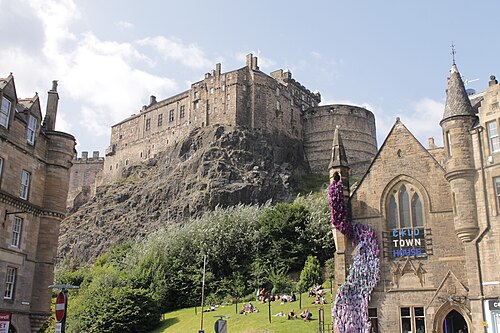 Edinburgh CastleRestored · prime 1520
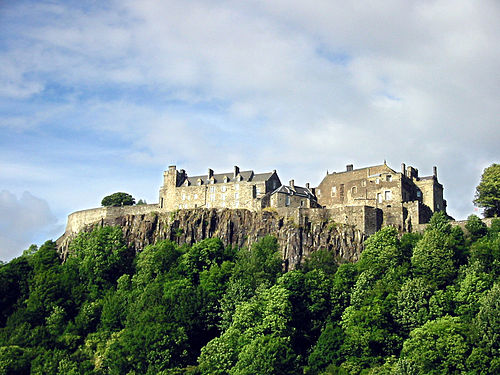 Stirling CastleRestored · prime 1542
 Glamis CastleStill standing · prime 1900
All castles in Scotland → · Strongest castles in Scotland → · Castles of Europe
Play As Your Clan
Hold a real castle against whatever you choose to send at it, take a ship out in her own service years, or stand at the shoulder of someone the record remembers. The chronicler sets the scene; the deeds are yours.
Notable bearers of the Maxwell name
- John, 8th Lord Maxwell (c.1553–1593), warden of the West March
- James Clerk Maxwell (1831–1879), physicist, electromagnetic field theory
- Sir John Stirling-Maxwell (1866–1929), co-founder of the National Trust for Scotland
- Robert Maxwell (1923–1991), media tycoon