O'Carolan
also Carolan, Ó Cearbhalláin
The blind harper, the bridge between Gaelic bardic and European baroque.
- Origin
- Leinster, Ireland
- Famous bearer
- Turlough O'Carolan (1670–1738), Gaelic harper-composer
- Register
- Irish family
Where the O'Carolan name comes from
CoreHistoric reach
The seat of O'Carolan
Seat vacantChief
No one leads the O'Carolan community yet. When the movement opens, you can stand for its leadership, or help elect whoever does.
Current mission
No shared goal set yet. Once O'Carolan has leadership, it sets the public focus: a restoration, a gathering, a real-world project that helps its own.
The O'Carolan clan is being rebuilt. Join the waiting list for the movement today, and you help decide who leads it and what it does.
Help rebuild the O'Carolan clan →What does the O'Carolan name mean?
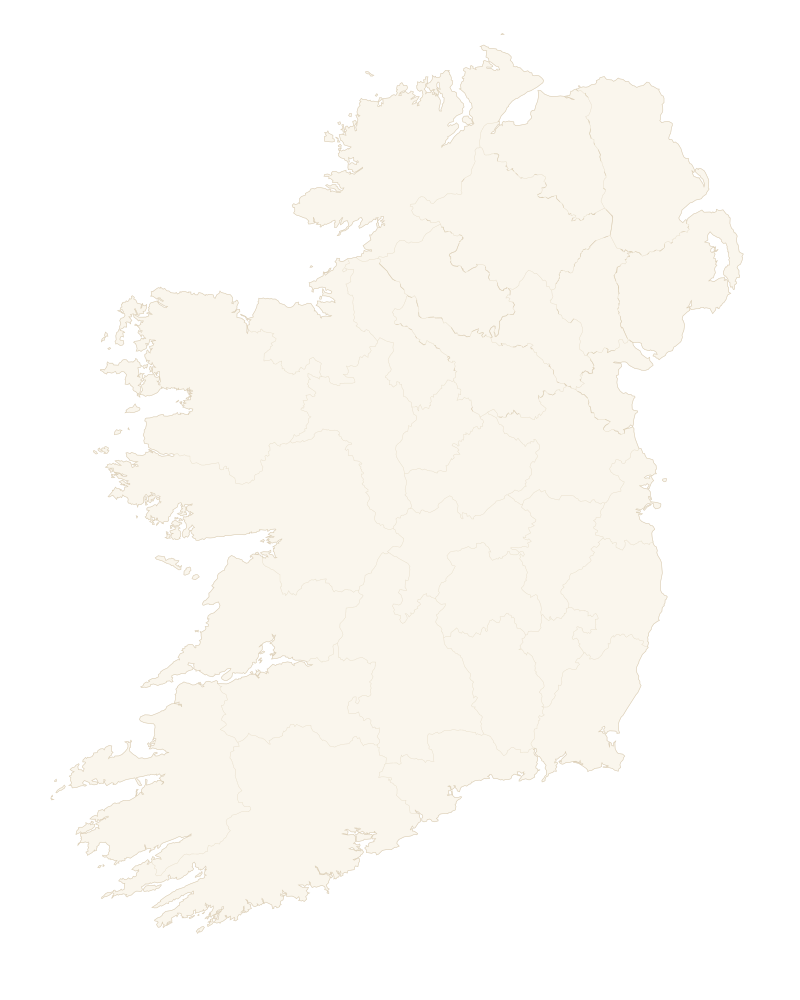
From Ó Cearbhalláin, descendant of Cearbhallán (a diminutive of Cearbhall, valiant in battle). The Ó Cearbhalláin were a Gaelic family of the eastern midlands, originally seated in the Brefney country (modern Cavan-Leitrim), with branches in north Meath. The Anglicised Carolan and the apostrophe form O'Carolan both descend from the same patronymic; the surname is uncommon and almost entirely associated with the single foundational bearer.
The history of O'Carolan
Cearbhallán, and a surname that belongs to one man
The name is Ó Cearbhalláin, descendant of Cearbhallán, and Cearbhallán is itself a diminutive of Cearbhall, a personal name usually read as valiant in battle. Anglicisation blurred the shape of it. The prefixes Mac and Ó were routinely dropped when Gaelic names were put into English, and distinct originals collapsed into a single spelling. Carolan and O'Carolan are the two English faces of the one Gaelic patronymic, and the surname is uncommon: it is almost entirely associated with the single bearer who made it.
The Ó Cearbhalláin were a family of the eastern midlands, seated in the Brefney country of modern Cavan and Leitrim with branches into north Meath. Carolan's great-grandfather, Shane Grana O'Carrolan, was chieftain of his sept in 1607, the family reckoned a branch of the Mac Brádaigh sept of County Cavan. Their estates were forfeited in the civil wars, and in 1684 what was left of the household went west out of Meath. That forfeiture is the hinge of everything after it: a chieftain's descendants arrived in Roscommon as employees.
The blacksmith's son who was given a horse and a guide
Turlough O'Carolan was born at Nobber in County Meath in 1670, where his father was a blacksmith. The move of 1684 came at the invitation of the MacDermot Roe family of Alderford House at Ballyfarnon in County Roscommon, and there his father took work with them. Mrs MacDermott Roe gave the boy an education, and what she noticed first was not music but poetry. He attended a school for the blind at Cruisetown, and one of his earliest compositions was for Brigid Cruise, the schoolmaster's teenage daughter, with whom he was infatuated. Her name is still on the tune.
Smallpox took his sight at eighteen. Mrs MacDermott Roe's answer was to apprentice him to a good harper, and at twenty-one he was given a horse and a guide and sent out to travel Ireland and compose songs for patrons. That is the description of a trade, not a gesture of charity: a blind man who could carry a repertoire in his head and name a household in a tune had one of the few professions open to him, and the horse and guide were its capital equipment.
Three nights at the house, and a tune for the head of it
For almost fifty years he journeyed from one end of Ireland to the other, composing and performing as he went. The bargain was understood on both sides: in return for a song written in honour of a wealthy patron, the harper was welcomed as an honoured guest on the estate, taking his three nights of bed and board and a gold guinea before moving on. Weddings and funerals were sometimes put off until he could get there to play. A musician whose arrival could reschedule a burial was not an entertainer at the edge of a household; he was part of how it marked its own occasions.
The circuit ran through the surviving gentry of a country that had just changed hands, and he drew no line between the Gaelic houses and the Anglo-Irish ones that had displaced them: the MacDermott Roes of Alderford, the O'Connors of Belanagare, the Maguires of Tempo, the Burkes of Glinsk, and at the southern limit of his run the Powers and Butlers of Kilkenny. His tunes are a register of who was still keeping a house worth playing in.
Planxty, a word for a tribute to a merry host
Many of his songs are designated planxties, an obscure word Carolan appears to have invented, or at least popularised, to mean a tribute to a merry host. He needed a word for a form that was his own, and it outlived him so thoroughly that it is now simply a category in Irish music. Planxty George Brabazon, Planxty Colonel Irwin, Fanny Power, Eleanor Plunkett, Blind Mary: the titles are people, almost never places, because the tune was the receipt for the hospitality.
His method was to compose the tune first as he rode, then add the words. Irish was the majority language of Ireland in his lifetime and he did not speak English well; he composed exactly one song in English, Carolan's Devotion. About a third of his surviving music has Irish lyrics that come down to us, though those words are largely unknown to musicians today, who have pulled the repertoire across into the jigs and reels of modern traditional playing.
Mary Maguire and the cottage at Mohill
In 1720, at fifty, he married Mary Maguire. Their first home was a cottage near the town then called Manachain, now Mohill in County Leitrim, and they had seven children there, six daughters and one son. Mary died in 1733. He died on 25 March 1738 and was buried in the MacDermott Roe crypt at Kilronan near Ballyfarnon, back with the family that had schooled him, apprenticed him and equipped him.
The music does not sit in one style. Some of it carries the continental classical writing he heard in the great houses; other pieces, Farewell to Music above all, reflect a much older manner of Gaelic harping. He was not a composer in the classical sense, which has not stopped him being called Ireland's national composer.
The ten harpers who came to Belfast in 1792
Harpers in the old Irish tradition were still living as late as 1792, when ten of them came to the Belfast Harp Festival, among them Arthur O'Neill, Patrick Quin and Donnchadh Ó hÁmsaigh. Ó hÁmsaigh played some of Carolan's music and disliked it, on the grounds that it was too modern. That one verdict places him more exactly than any amount of praise: to the last men of the old school he was the innovation, not the inheritance.
Belfast in 1792 also saved him. Most of his compositions were never published or even written down in his lifetime; they survived in the repertoires of fiddlers, pipers and the last of the old harper-singers, and were collected from the late eighteenth century onward, beginning largely with Edward Bunting and his assistants in 1792. Only a small sampling reached print while he lived, among the earliest in Neale's Collection of the Most Celebrated Irish Tunes, Dublin, 1724.
Counting the tunes, and the manuscript found in Scotland
Because his career is only partly documented, the record around the music is a mess of alternate and wrong titles, tunes claimed for him that are not his, and writers who invented facts or repeated unfounded stories. Bunting called the Fairy Queen a very ancient air that seemed to be the original of Carolan's, and said Carolan had not meant it for words: the words are not ancient, and they fit the music he wrote for them perfectly. Donal O'Sullivan (1893-1973) settled the question, identifying 214 compositions in his Carolan of 1958.
The count was not final. A manuscript compiled in Scotland in 1816 by the MacLean-Clephane sisters surfaced in 1983, carrying five further pieces credited to him: Athlone, Banks of the Shannon, Farewell to Lough Neaghe, Irish Galloway Tom and The Lamentation of Ireland. Nobody has yet disputed the attributions. Caitríona Rowsome's edition of 2011 runs to 226 harp settings and was the first to set every surviving Carolan lyric against its air.
From Seán Ó Riada to the Foot Guards and a crater on Mercury
The modern life of the tunes starts in 1967, when Seán Ó Riada and Ceoltóirí Chualann recorded Carolan's Concerto and two other pieces. Hundreds of recordings have followed, by The Chieftains, Planxty, Clannad and Patrick Ball, and by players reaching outside their own patch for one tune: Steeleye Span took Sheebeg and Sheemore, John Renbourn the Lament for Owen Roe O'Neill. O'Neill's Music of Ireland of 1903 is still in print and still carries over sixty of his airs. Guitarists retune to play him, dropping into DADGAD so the open strings ring like a harp, and Carolan's Concerto serves the Foot Guards as a neutral slow march at the Trooping of the Colour.
The commemoration is spread across the counties that made him. Oisín Kelly's bronze of him at the harp went up on the Market Square at Mohill on 10 August 1986, unveiled by Patrick Hillery, President of Ireland; the O'Carolan Harp Festival was first held at his birthplace of Nobber in 1988, and a statue followed there in 2002; the festival and summer school at Keadue keeps his name in the Roscommon he worked from. Beyond that there is O'Carolan Road in Dublin 8, Carolan Corner in south Belfast, his face on the Series B fifty pound note of Ireland, and, since 2015, a crater on Mercury called Carolan.
Champions of the O'Carolan name
The bearers whose lives are inseparable from this surname. Each has their own page, biography, achievements, geography, connection to the family.
The castles of the homeland
The great strongholds of the homeland, look one up, see what it looked like in its prime, and recreate it to explore.
 Ashford Castle, County MayoRestored · prime 1880
 Manderley CastleRestored · prime 1840
 Dublin CastleRestored · prime 1790
All castles in Ireland → · Strongest castles in Ireland → · Castles of Europe
Play As Your Clan
Hold a real castle against whatever you choose to send at it, take a ship out in her own service years, or stand at the shoulder of someone the record remembers. The chronicler sets the scene; the deeds are yours.
Notable bearers of the O'Carolan name
- Turlough O'Carolan (1670–1738), Gaelic harper-composer