Clan Burns
also Burness, Burnes
By the burn, the small-stream surname the poet made into Scotland's own.
- Origin
- Ayrshire & Galloway, Scotland
- Famous bearer
- Robert Burns (1759 to 1796), Scotland's national poet (Auld Lang Syne, Tam o' Shanter, A Red, Red Rose)
- Register
- Scottish clan
Where the Burns name comes from
CoreHistoric reach
The seat of Clan Burns
Seat vacantChief
No one leads the Clan Burns community yet. When the movement opens, you can stand for its leadership, or help elect whoever does.
Current mission
No shared goal set yet. Once Clan Burns has leadership, it sets the public focus: a restoration, a gathering, a real-world project that helps its own.
The Burns clan is being rebuilt. Join the waiting list for the movement today, and you help decide who leads it and what it does.
Help rebuild the Burns clan →What does the Burns name mean?
Locative, from the Old English burna and the Scots burn, a small running stream. The Burns family of Robert Burns the poet was originally spelled Burness or Burnes; the elder Burns line in Kincardineshire used the longer form until Robert's father William Burness moved south to Ayrshire in the 1750s. Robert dropped the genitive 's' in 1786 around the Kilmarnock edition of his poems, fixing the standard modern spelling of the surname to Burns. The Lowland Scots Burns is densest in Ayrshire and the south-west, where every parish carried at least one small Burns tenant-farming family.
The history of Clan Burns
A burn is a stream, and the name means the man who lived by one
Burns is a locative name, and its meaning has never been in doubt. It comes from the Old English burna and its Scots descendant burn, a small running stream, and it began as a topographic byname for an individual who lived beside one. There is no founder to trace and no single kindred to descend from: in a country where every glen and brae had its burn, the same plain description was applied independently to hundreds of unrelated men, in parish after parish, until it stuck to their sons.
A second road leads to the same modern spelling. Burns is also a variant of the surname Burnhouse, a habitational name built from the elements burn and house, and in other cases it began as a nickname meaning burn house. Those forms are on record early: Burnis appears in 1526 from the place name, and the nickname form Brenhus in 1275 and again in 1286, well before the byname had hardened into anything a family passed down.
That hardening is a datable thing. By 1400 most English families, and those of Lowland Scotland with them, had adopted hereditary surnames. Before that a man was of the burn because he lived at one; after it, his grandchildren were Burns whether they still farmed the water or had moved twenty miles away.
Why the water decided where a family lived
To understand why so many families ended up named for a stream, it helps to know what a stream was worth. In the open-field countryside of medieval Europe the arable ground was cut into narrow strips across two or three great fields, with common pasture, waste and woodland beyond, and a tenant family needed at least ten acres to live off the land at all. Running water was the one thing that could not be redistributed. On the manor of Elton the lord held two water mills for grinding grain, a fulling mill for finishing cloth, and a millpond: the burn ground the meal and dressed the cloth for everyone within walking distance.
So a burn was not scenery. It was the boundary that told one holding from the next, the power that turned the mill, the water for the beasts, and the reason a house stood where it did rather than a quarter-mile up the brae. Nor was land held evenly: about half the adults on a manor held no land at all. Saying a man lived at the burn told you exactly which door to knock on.
Scotland's Lowland farm touns worked the same logic in their own idiom, and the surname map still shows it. Burns is densest in Ayrshire and thins outwards through Lanarkshire, the Borders and the Edinburgh hinterland: the country of small tenant farms in the south-west, where nearly every parish carried at least one modest Burns family working somebody else's ground.
Burness, Burnes, Burns: the spelling settled in 1786
The name a diaspora reader types into a search box today is a short form, and it was still competing with longer ones in the eighteenth century. In the north-east, in Kincardineshire, the elder line of the family wrote itself Burness and Burnes and kept the longer form in the records right through the seventeen-hundreds. The shortened Burns is the standard spelling across the Scottish census from the early nineteenth century onwards, but that was a finish, not a start.
The change has a date and a reason. William Burness, a Kincardineshire man, moved south to Ayrshire in the 1750s. His eldest son dropped the genitive s in 1786, around the Kilmarnock edition of his poems, and the form he used then is the form the world uses now. It is an unusual thing for a surname: most spellings drift, this one was fixed by a decision, at a moment, by a man whose name was about to be printed a great many times.
For anyone tracing a line, that is a practical warning as much as a curiosity. A Burns family that vanishes from the record before about 1780 has often not vanished at all: it is filed under Burness or Burnes, and older north-eastern registers should be searched under all three.
More than one road ends at the same six letters
Burns is not a single family and the sources are frank about it. Alongside the Scots stream-name and the Burnhouse habitational form, the surname is also an anglicised form of the Irish Ó Broin, meaning descendant of Bran, a wholly separate Irish line that arrived at the same English spelling by translation rather than descent. And in the United States, Burns has served as an Americanised form of the Jewish surname Bernstein, from the German bernstein, amber, carried west by families out of German-speaking Europe.
None of this diminishes any of them; it simply means the name is a meeting point rather than a bloodline. Two Burns families from opposite ends of Ayrshire are no more likely to share an ancestor than two families called Hill, and an American Burns may be tracing back to Ayrshire, to Ó Broin country, or to a central European household that changed its name at the dock. The honest starting point is the parish record, not the surname.
The Alloway ploughman who became Scotland's voice
Robert Burns was born at Alloway in Ayrshire in 1759, the son of the tenant farmer William Burness, and he died in 1796 at thirty-seven. In that short working life he produced the body of Scots-language verse and song that became the central literary inheritance of modern Scotland. His Poems, Chiefly in the Scottish Dialect, printed at Kilmarnock in 1786, made him the national poet within months of publication: a tenant farmer's son carried there on poems written in the language of his own kitchen.
His years at Ellisland Farm in Dumfriesshire from 1788 produced Auld Lang Syne and Tam o' Shanter. Quieter, and arguably larger, was the work he did from 1787 until his death collecting and editing Scottish song for James Johnson's Scots Musical Museum and George Thomson's Select Scottish Airs. Much of the Scottish folk-song corpus the modern world inherits survives because a working farmer spent his last decade writing it down and mending it.
He was not the only Burns of that household to matter locally. His younger brother Gilbert Burns, born in 1760 and living until 1827, farmed in Ayrshire and later in East Lothian, and it is through that generation of brothers and their children that the family's own line continues.
The twenty-fifth of January, kept for two hundred years
Very few surnames anywhere in Europe have a date on the calendar. Burns does. In 1801, five years after the poet's death, nine of his Ayrshire friends met at the cottage at Alloway to eat and remember him, and the Burns supper has been kept continuously ever since, on the twenty-fifth of January, his birthday. It has been a continuous institution of Scottish and diaspora life ever since, kept as reliably abroad as in Ayrshire.
The organisation followed the tradition. The Burns Federation was founded at Kilmarnock in 1885 and today coordinates more than three hundred Burns Clubs around the world. And the poet's 1788 reworking of an older Scots song became the anthem the whole English-speaking world sings at midnight on the last night of the year, carried out from Scotland by the broadcast tradition that Guy Lombardo established from 1929.
That is the pride in the name, and it is worth stating plainly to anyone who carries it. A diaspora reader who can name no other Scottish poet knows the words to Auld Lang Syne. The Burns family genealogy has been studied continuously since 1796, and direct descendants live today in the United States, Canada and Australia through the family's late-eighteenth and nineteenth-century emigration.
No chief, no clan tartan, and what the tartan trade did about that
Burns has no chief recognised by the Court of the Lord Lyon, and under Scots law that matters more than most souvenir shops admit. A clan or family is a legally recognised noble incorporation only once it has an officially recognised chief; a name group without one has no equivalent standing, whatever it is called. The Highland-clan-versus-Lowland-family distinction is itself a nineteenth-century convention (an Act of the Scottish Parliament of 1587 spoke of the chiefs and chieftains of all clans, on the highlands as on the borders alike), but it is recognition, not geography, that confers the status.
Where a name has no clan of its own, the sept list steps in, and its history should be known before it is trusted. There is no official list of clan septs; what a clan claims is left to the clan. Modern sept lists date largely from the nineteenth century, when clan societies and tartan manufacturers set out to capitalise on the enthusiasm for all things Scottish and drew up lists linking as many surnames as possible to a particular clan, regardless of whether any historical connection existed. Common surnames were swept in wholesale: Miller and Millar were made a sept of Clan MacFarlane, Taylor of Clan Cameron, Mason of Clan Sinclair; and the same sept name is often claimed by more than one clan.
The tartan carries the same caution. Historically the setts belonged to districts, not surnames: weavers in a locality produced the patterns favoured there, and the families prominent in that district came to be identified with the cloth. The tidy modern picture of one clan, one tartan, one territory was promulgated in the nineteenth century, largely in the wake of Sir Walter Scott. So if you find Burns listed as a sept of some great Highland name, treat it as a commercial claim of that era unless someone shows you the connection. Burns never needed to borrow another family's cloth to be worth carrying.
Historic Places, Rebuilt
Explore the streets and seats the Burns name knew, rebuilt with AI as they stood in history.
The castles of the homeland
The great strongholds of the homeland, look one up, see what it looked like in its prime, and recreate it to explore.
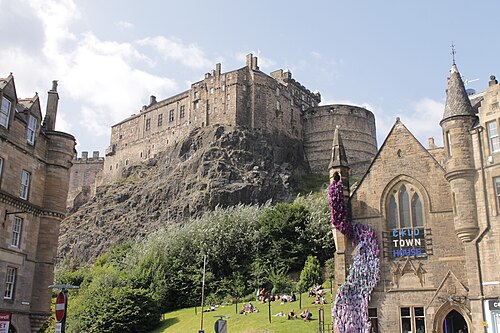 Edinburgh CastleRestored · prime 1520
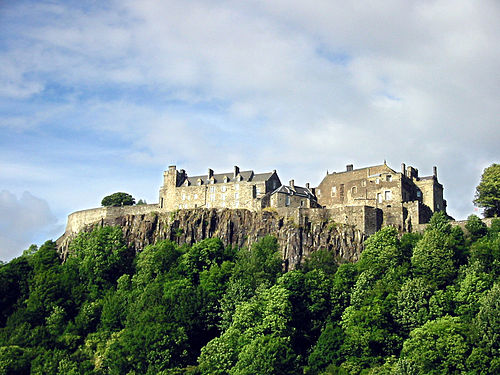 Stirling CastleRestored · prime 1542
 Glamis CastleStill standing · prime 1900
All castles in Scotland → · Strongest castles in Scotland → · Castles of Europe
Play As Your Clan
Hold a real castle against whatever you choose to send at it, take a ship out in her own service years, or stand at the shoulder of someone the record remembers. The chronicler sets the scene; the deeds are yours.
Notable bearers of the Burns name
- Robert Burns (1759 to 1796), Scotland's national poet (Auld Lang Syne, Tam o' Shanter, A Red, Red Rose)
- Gilbert Burns (1760 to 1827), the poet's younger brother, Ayrshire and East Lothian farmer