Clan Muir
also Clan Muir, Mure, Moir
Dweller by the moor, the Mures of Rowallan.
- Origin
- Ayrshire & Galloway, Scotland
- Motto
- Durum patientia frango
- Famous bearer
- John Muir (1838–1914), naturalist, father of the US national parks
- Register
- Scottish clan
The Muir arms, crest badge, tartan and country

Crest badgeClan member crest badge - Clan MuirCeltus · CC BY-SA 3.0 
TartanMuir or More tartanCeltus · CC BY-SA 2.5 
Coat of armsMuir of Muir armsBorne by the Muir line, one branch of the name rather than all of it.Czar Brodie · CC BY-SA 3.0


- Crest badge: The chief's crest inside a belt and buckle: the badge a clansman wears to show whose following he is in.
- Tartan: The checked cloth the family is known by.
- Coat of arms: Granted to an individual and inherited down that one documented line. These are the arms of particular families of the name, not of everyone who shares the surname.
What is the Muir clan tartan?
One Muir sett is recorded, and it is the swatch above. A sett is the block of coloured bands the cloth is built from, repeated in both directions; the whole plaid is that one square enlarged.
Muir is a Lowland name, and Lowland families did not wear Highland dress; the 1746 proscription that broke the tradition in the north took nothing from them, because there was nothing there to take. The Muir sett is a 19th-century assignment, made when tartan stopped being Highland and became Scottish and fixed by the Bannockburn weavers’ pattern books, the royal visit to Edinburgh in 1822, and the Vestiarium Scoticum of 1842. Nobody polices any of it. Wearing the Muir sett declares allegiance to the name, not descent from any particular line of it.
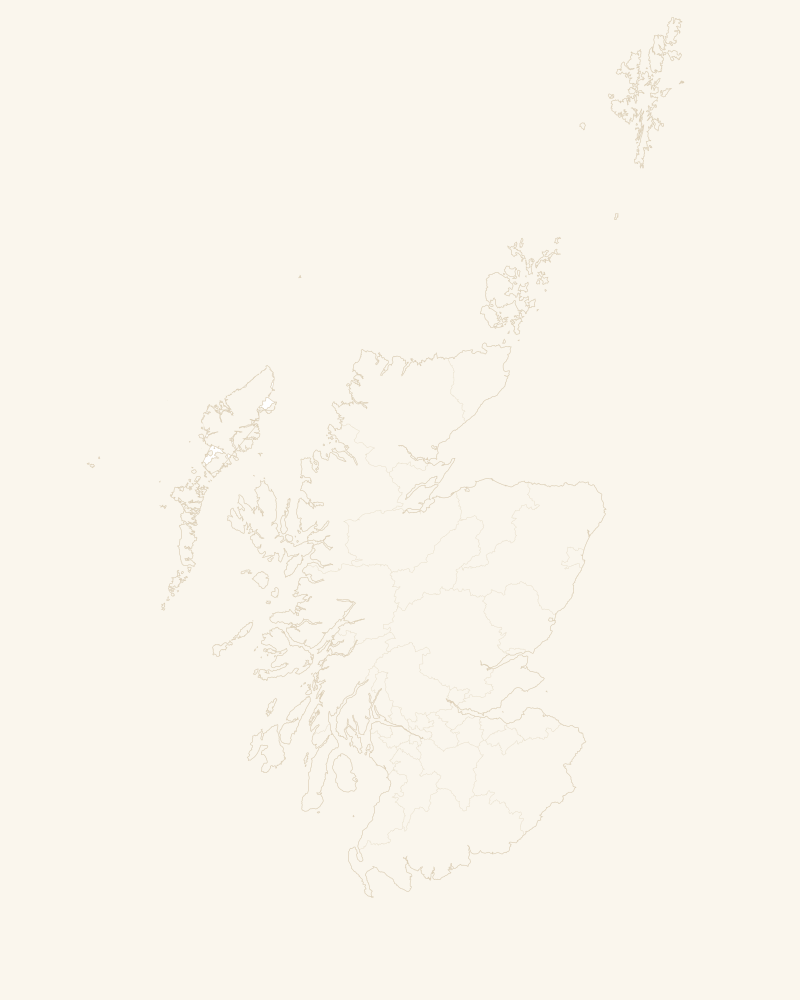
CoreHistoric reach
The seat of Clan Muir
Seat vacantChief
No one leads the Clan Muir community yet. When the movement opens, you can stand for its leadership, or help elect whoever does.
Current mission
No shared goal set yet. Once Clan Muir has leadership, it sets the public focus: a restoration, a gathering, a real-world project that helps its own.
The Muir clan is being rebuilt. Join the waiting list for the movement today, and you help decide who leads it and what it does.
Help rebuild the Muir clan →Motto
Durum patientia frango
“I overcome difficulty by patience”
What does the Muir name mean?
A topographic name from the Scots muir, 'moor' or heath, so a dweller by the moorland, with the older spelling Mure. The name is densest across the south-west Lowlands, Ayrshire, Renfrewshire and Lanarkshire, where the Mures of Rowallan near Kilmarnock were the chief family. Elizabeth Mure of Rowallan, first wife of Robert II, was ancestress of the royal Stewart line.
The history of Clan Muir
The moor at the door
Muir is a topographic name from the Scots muir, a moor or heath, so a byname for the man who lived beside one. The Scots form descends from the Middle English more, meaning moor or fen, and in the medieval record the family appears far more often as Mor, de la Mor, More and Mure than in the modern spelling. That older Mure form is the one the chief line carried, on charters and castle lintels, for centuries.
The name is thickest in the south-west Lowlands: Ayrshire above all, then Renfrewshire and Lanarkshire. Muir, Mure, More and Moore are one cluster in that country, and branches had reached eastern Scotland by the 15th century. The motto, Durum patientia frango, promises to break what is hard by patience; its near-twin, Duris non frangor, belonged to the Mures of Caldwell.
David de More, Polkelly, and the Ragman Rolls
The oldest of the name on record are the Mores of Polkelly, near Kilmarnock, and the first documented at Ayr is David de More, a witness to a charter of Alexander II between 1214 and 1249. Polkelly, not Rowallan, was the family's ancient property, and it stayed the seat they fell back on when things went badly elsewhere.
The next figure is Sir Gilchrist Mure (about 1200 to about 1280), remembered for his part at the Battle of Largs on 2 October 1263. Thirty-three years later, when Scottish landholders set their seals to the Ragman Rolls, three men of the name are listed as of the county of Ayr: Adam, Gilchrist and Reginald, or Ronald. Family tradition reads them as Sir Gilchrist's descendants on the strength of naming custom and locality rather than any surviving deed, and the roll carried three more of the name in Lanark and Dunbarton.
Others of the name did the sober legal work of the age. In 1291 Thomas de la More was named executor of the will of Dervorguilla de Balliol, mother of John Balliol, King of Scots; in 1295 Adam and William de la More sat as jurors on the lands of Lady Elena la Zuche in Cunningham. An Adam held lands at Ralston in Renfrewshire in 1315 and 1321, and an Adam witnessed charters of Robert the Bruce.
How Rowallan came to the Mures
Rowallan sits on the banks of the Carmel Water, on a low eminence the stream may once have run closer to, which is the likely sense of its old name, the Craig of Rowallan. How the Mures came by it is told two ways. In the first, Sir Gilchrist Mure was rewarded for Largs with the hand of the daughter and sole heir of Sir Walter Comyn, the match blessed by Alexander III. In the second, the Mures had held Rowallan from unknown antiquity, were turned out by Sir Walter Cuming, and were shut up in Polkelly until the king raised force enough to subdue him.
The second account sits badly with the calendar, since Walter Comyn is thought to have died at least five years before Largs was fought, and it is the first the family carried forward. Gilchrist left his mark in stone across Ayrshire: two chapels, one dedicated to Saint Laurence and one to Saint Michael, whose vestiges could still be made out in 1876, and the chapel at Kilmarnock known ever after as Mures Isle.
Elizabeth Mure and the root of the Stewart line
Elizabeth Mure, daughter of Sir Adam Mure of Rowallan and Janet Mure, is the reason a small Ayrshire house sits at the base of the Scottish royal descent. She was mistress and then wife to Robert Stewart, the High Steward, Guardian of Scotland and afterwards King Robert II, and she may have been born at Rowallan itself. She bore him nine children before 22 November 1347, the date their marriage was legitimised by papal dispensation, and she died before May 1355, so she never wore a crown.
Her children did. Through them the Stewart succession runs, and through her daughter Jean, whose marriage to John Lyon created the title Thane of Glamis, the line is traceable forward to King Charles III. That is an unusual thing for a family of Ayrshire lairds to say.
Sark, the Rud, and the field at Pinkie
The Mure heirs turned out for Scotland's wars with grim regularity. Sir Robert Mure may have been among the slain at the Battle of Sark in October 1448. His namesake was known as the Rud of Rowallane, an archaic Scots word the man defined precisely: large in stature, very strong and quick with his fists. In his lifetime a protracted feud ran between Rowallan and the house of Ardoch, later Craufurdland.
A century on, Sir Mungo Mure was credited with significant improvements to the castle. He was killed at the Battle of Pinkie in September 1547.
The 1562 front and the psalm in Hebrew
The southern front of Rowallan, the face a visitor still meets, was put up about 1562 by John Mure of Rowallan and his lady, Marion Cuninghame of the Cuninghamhead family, and it is a piece of deliberate self-presentation. Over the main entrance the Royal Arms of Scotland are carved fully blazoned, and beside them sit the shields of the Cumin family from whom the Mures claimed descent.
Over the porch doorway runs something rarer: an inscription in Hebrew characters, taken from the Psalms, reading in English "The Lord is the portion of mine inheritance and of my cup." Hebrew lettering on a Scottish laird's house in 1562 says as much about the family's Reformation temper as the heraldry says about their pedigree.
Sir William Mure, the poet who mourned a king he opposed
Sir William Mure (1594-1657), Laird of Rowallan, was a writer, a politician and a soldier, and simple about none of it. He was an ardent covenanter and wrote a history of his own family; he served in Germany under Gustavus Adolphus; and he was wounded at Marston Moor in 1644. When Charles I was executed he opposed it outright and composed an elegy on the king's death, which is not the conduct of a man following a party line.
He was the sixteenth and last Mure of Rowallan. Among his descendants were Dr John Moore and Dr Moore's sons: Lieutenant-General Sir John Moore, Admiral Sir Graham Moore and Dr James Carrick Moore, the name having settled by then on the Moore spelling.
Rowallan then passed by marriage. One of Sir William's granddaughters married Sir James Campbell of Lawers, third son of the Earl of Loudoun, who thereby became Laird of Rowallan, and from about 1690 the estate was home to the Campbells of Loudoun. His son, Major-General James Mure Campbell of Rowallan (1726-86), carried the Mure name in his own and became fifth Earl of Loudoun in 1782.
Caldwell, Cloncaird and the cadet Mures
Sir Adam Mure's three younger brothers founded the branches that spread the name across the south-west. Mures settled at Caldwell, Aucheneil, Thornton, Glanderstoun, Treescraig, Auchendrane, Cloncaird, Craighead Park, Middleston, Spittleside and Brownhill, so that within a few generations the name was not one house but a connected group of lairdships.
Caldwell was the most durable. The Mures there, whose most ancient seat was Polkelly, were granted the lands of Ramshead, Biggart and Little Highgate about 1450. Their tower still stands on a knoll above the Lugton Water, square on plan, three storeys of coursed rubble with built-up gun-loops, probably 16th-century and thought to be the surviving fragment of a much larger courtyard castle quarried away for its stone. William Mure built a new mansion about 1712, and his son, known as Baron Mure, raised the Robert Adam-designed Caldwell House nearby.
Further south, Cloncaird Castle stands beside the Kelsie Burn near Kirkmichael, 16th-century at heart, its tower carrying an armorial panel dated 1585. Towards the close of that century it was in the possession of Walter Mure, of the Auchendrane family.
An armigerous name, and the sept lists it kept out of
Clan Muir is armigerous, which is to say it has arms but no chief sitting in the Lyon Court, and it claims no septs of its own. It has also spent two centuries being claimed by others: Muirs of Ayrshire have been named a possible sept of Clan Boyd, though no reliable source pins it down, More and Moore appear as a sept of Clan Leslie in Aberdeenshire, and the Mores of Drumcork are counted septs of Clan Grant with no evidence of a link to the south-western line.
That tangle is not an accident of the Middle Ages. Sept lists were largely drawn up in the 19th century, when clan societies and tartan manufacturers linked as many surnames as they could to a clan so that people without a clan name could feel entitled to a tartan. The Muir tartan stands in its own right, registered as the Muir/Moore tartan under the Clan/Family category, with a blue, black and green base and an unusual motif of three narrow red stripes twice over on the green square. The Register of Tartans dates the sett to 1 January 1880.
The name that travelled
The best-known Muir of all crossed the Atlantic. John Muir (1838-1914) was born at Dunbar in East Lothian, emigrated to the United States and became the founding voice of American conservation, co-founder of the Sierra Club and the moving spirit behind Yosemite and the national-park idea. Thomas Muir of Huntershill (1765-1799) was a Scottish political reformer, and Thomas Muir (1844-1934) a British mathematician.
Modern letters carry the name twice in one household: Edwin Muir (1887-1959), poet, novelist and translator, and his wife Willa Muir (1890-1970), novelist, essayist and translator in her own right. Frank Muir (1920-1998) made it a household name as a British comedian and Jean Muir (1928-1995) as a British fashion designer; Helen Muir (1920-2005) was a British biochemist and Alexander Muir (1830-1906) a Canadian songwriter, poet and school headmaster. In sport it runs from the Scottish athletes Nat Muir (born 1958) and Laura Muir (born 1993) to the skier Kirsty Muir (born 2004). For a name that began with a man who lived beside a moor, that is a long way from the Carmel Water.
Castles the Muir held
Strongholds this name held for a decade or more, look one up, or rebuild it to explore.
- Rowallan Castle
Medieval seat of the Mures of Rowallan; Elizabeth Mure, wife of the future Robert II, may have been born here.
- Caldwell Castle
Seat of the Mure family, granted neighbouring lands about 1450 and resident on the Caldwell estate until 1909.
- Cloncaird Castle
In the possession of Walter Mure, of the Auchendrane Mures, towards the close of the 16th century.
The castles of the homeland
The great strongholds of the homeland, look one up, see what it looked like in its prime, and recreate it to explore.
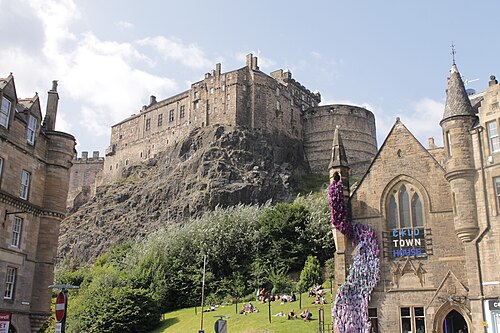 Edinburgh CastleRestored · prime 1520
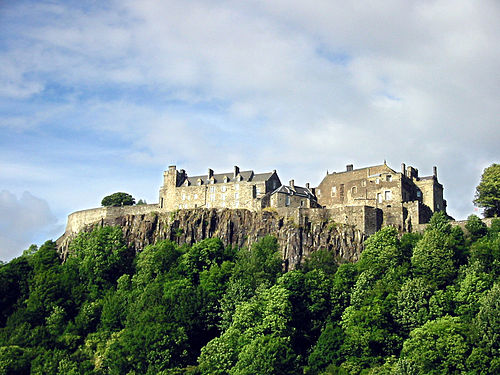 Stirling CastleRestored · prime 1542
 Glamis CastleStill standing · prime 1900
All castles in Scotland → · Strongest castles in Scotland → · Castles of Europe
Play As Your Clan
Hold a real castle against whatever you choose to send at it, take a ship out in her own service years, or stand at the shoulder of someone the record remembers. The chronicler sets the scene; the deeds are yours.
Notable bearers of the Muir name
- John Muir (1838–1914), naturalist, father of the US national parks
- Edwin Muir (1887–1959), poet and translator
- Elizabeth Mure of Rowallan, ancestress of the royal Stewarts