Scotland · Restored
Rowallan Castle
Rowallan Castle is a historic Scottish tower house on a low knoll beside the Carmel Water, with origins in the medieval period and major work of the 16th century. The surviving core is a compact, multi-storey stone castle with later domestic additions and enclosing walls, long associated with the Mure family and later owners. It remains standing and has been conserved and repurposed in recent decades under private ownership.
Its prime
1562
Today
Restored
As it stood in 1562
What Rowallan Castle looked like in its prime.
A compact rectangular stone tower-house built of warm brown and grey rubble with ashlar dressings, dominated by a symmetrical southern front featuring two round drum towers with conical slate roofs flanking a central arched entrance reached by a broad external stone stair. White-framed windows puncture the masonry in regular courses; carved heraldic panels and an inscribed stone sit above the doorway. A low barmkin wall and fragments of curtain wall lie to the side, the whole set on a small grassy knoll in parkland.
Its story
The story of Rowallan Castle.
The Mures on the Craig of Rowallan
The original castle is thought to date back into the thirteenth century, built around a small knoll that once stood in a small loch or swampy ground fed by the Carmel Burn. The Carmel Water may at one time have run much closer to that low eminence, which would account for the old name Craig of Rowallan. The first Mure holder, Sir J. Gilchrist Mure, was buried in the Mure Aisle at Kilmarnock, and the nearby tower of Polkelly was held by the Mures too, until it passed by marriage to the Cunninghams of Cunninghamhead.
Rowallan was said to be the birthplace of Elizabeth Mure, who died before May 1355: mistress and then wife of Robert, High Steward of Scotland and Guardian of Scotland from 1338 to 1341 and again from October 1346, the man who became King Robert II. Tradition also brings James I of Scotland to the castle on his way from Edinburgh to England.
From Flodden to the Gateway Stone of 1616
John Mure of Rowallan was killed at the Battle of Flodden in 1513, the year in which the Rowallan estate took its present-day form. The southern front was raised about 1562 by John Mure of Rowallan and his lady, Marion Cuninghame of the Cuninghamhead family, and a marriage stone at the top of the wall records them: Jon.Mvr. M.Cvgm. Spvsis 1562. The Mure crest, a Moor's head, is sculptured near the family arms, possibly a play on the name, though it has also been read as a reference to some feat in the crusades against the Saracens.
Over the main entrance the Royal Arms of Scotland are carved fully blazoned, together with the shields of the Cumin family, from whom the Mures claim descent, and a stone above the ornamented gateway bears the date 1616. Over the porch doorway runs a rare inscription in Hebrew characters ("The Lord is the portion of mine inheritance and of my cup", Psalm XVI, verse 5) deciphered and translated by Doctor Bonar, moderator of the Free Church of Scotland. Sir John and Sir William Muir took great pleasure in raising the various parts of Rowallan, and a record was kept of the portions each completed.
Sir William Mure, the Auld Kirk and Alasdair Mac Colla
Sir William Mure wrote a history of his family and was an ardent covenanter, yet he opposed the execution of Charles I and composed an elegy on his death. Conventicles were not infrequently held within the house, and for this he fell under suspicion of the Government and was imprisoned on several occasions; part of the old castle is called the Auld Kirk in memory of those days, and the Rev. William Guthrie of Fenwick, whom he knew well, preached there more than once. He protected his tenantry as far as he could from the troopers scouring the countryside.
In the 1640s Alasdair Mac Colla was sent by Montrose to suppress support for the Covenanting cause. Based at Kilmarnock, he plundered the Ayrshire countryside for some days and then demanded financial penalties; Sir William Mure's penalty for preventing further plundering at Rowallan was 1,000 merks, much damage having already been done.
The Loudoun Campbells and the Corbett Barons
From about 1690 the estate was home to the Campbells of Loudoun, who held it into the nineteenth century. The Hearth Tax records of 1691 show twenty-two hearths in the castle, with eighteen other dwellings associated with it and its lands, and one room was called Lord Loudoun's sleeping apartment.
The 10th Countess of Loudoun was especially fond of Rowallan and spent considerable sums repairing the castle in the nineteenth century; without her efforts the building would not have survived. After the estate was bought by Archibald Corbett, the property developer and Liberal politician, a second castle in the grounds was modernised and the grounds relandscaped between 1902 and 1906 by Sir Robert Lorimer, the sixteenth- and seventeenth-century castle being retained. The 3rd Baron Rowallan later placed the old castle in the care of Historic Scotland.
From the Campbells' Return in 1989 to the 2015 Consent
Rowallan has been a Category A listed building since 14 April 1971, and in 1989 it returned to the Campbell family when Niall Campbell purchased it. It left Historic Scotland's care in 2015, after protracted legal wrangles and a controversial decision, and the tours once provided there are no longer available. In June 2015 Scheduled Monument Consent was granted for a change in the castle's use to guest accommodation, with conditions attached so that the work met a standard appropriate to a scheduled monument and could be monitored as it progressed. Once that change of use is complete, the designation as a listed building rather than a scheduled monument takes precedence, and conservation becomes a matter for the local authority.
Step inside
8 places to explore in 1562.
The record describes 8 distinct spots at Rowallan Castle, including 3 interiors: the 'auld kirk', old chapel chamber, lord loudoun's sleeping apartment, the 'woman's house', women's workroom. Create your own photoreal reconstruction and explore every one, more scenes means more rooms, more angles, and more of the place to stand in.
Build Your Own Castle
Recreate Rowallan Castle with AI to explore it.
The artist rebuilds it as it stood in 1562, a photoreal reconstruction that belongs to you alone. Pay with coins, no subscription needed.
Recreate this castle →Defend this castle →Whose castle
Clans who held Rowallan Castle.
The families that held Rowallan Castle for a decade or more across its history, follow a name to its clan.
Medieval seat of the Mures of Rowallan; Elizabeth Mure, wife of the future Robert II, may have been born here.
Held by the Boyle Earls of Glasgow.
Home of the Campbells of Loudoun from c.1690 into the 19th century; repurchased by Niall Campbell in 1989.
Corbett
Held by the Corbett Barons Rowallan.
From the archive
Rowallan Castle on paper: the measured plan and period views.
The survey plan and photographs below are the ground truth this page's reconstructions are checked against, drawn and photographed while the castle was still a working garrison. Every image is public-domain or openly licensed, with its source named.

Rowallan Castle, Kilmarnock, Scotland-LCCN2002695003
ca. 1890-1900 · Photochrom Prints Collection (via Wikimedia Commons)
Public domain
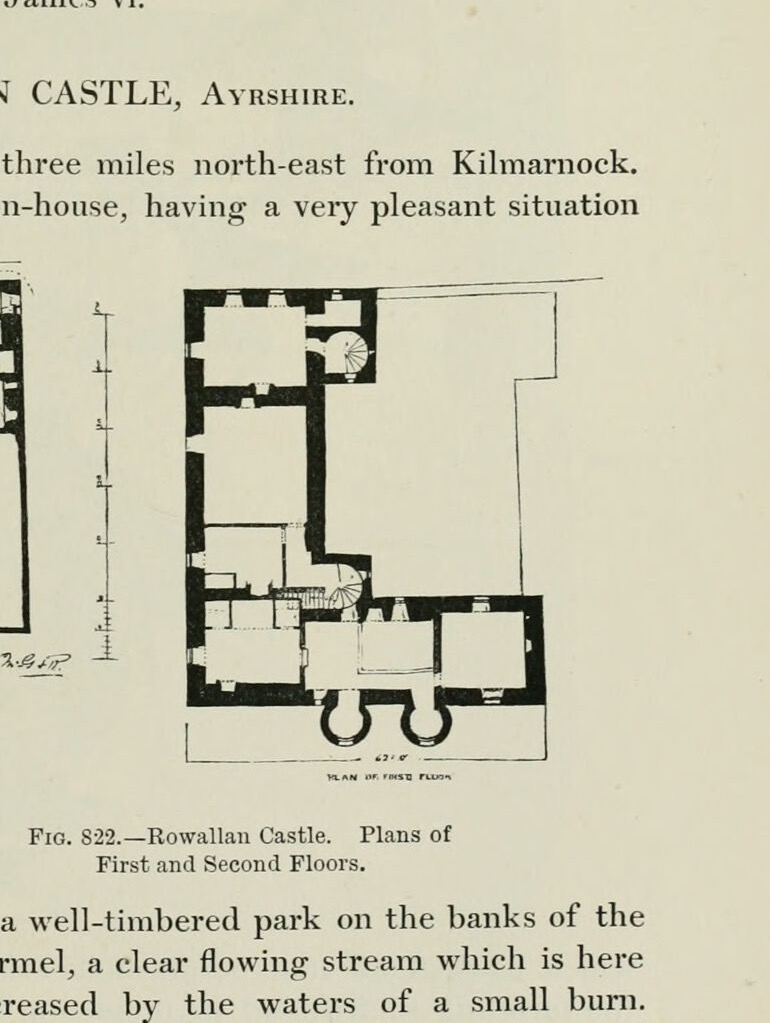
PLAN OF FLOOR AT COURTYARD LEVEL; Fig. 822. Rowallan Castle. Plans of First and Second Floors.
1887 · MacGibbon & Ross, vol. 2 (1887)
Public domain
PLAN OF FIRST FLOOR; Fig. 822. Rowallan Castle. Plans of First and Second Floors.
1887 · MacGibbon & Ross, vol. 2 (1887)
Public domain
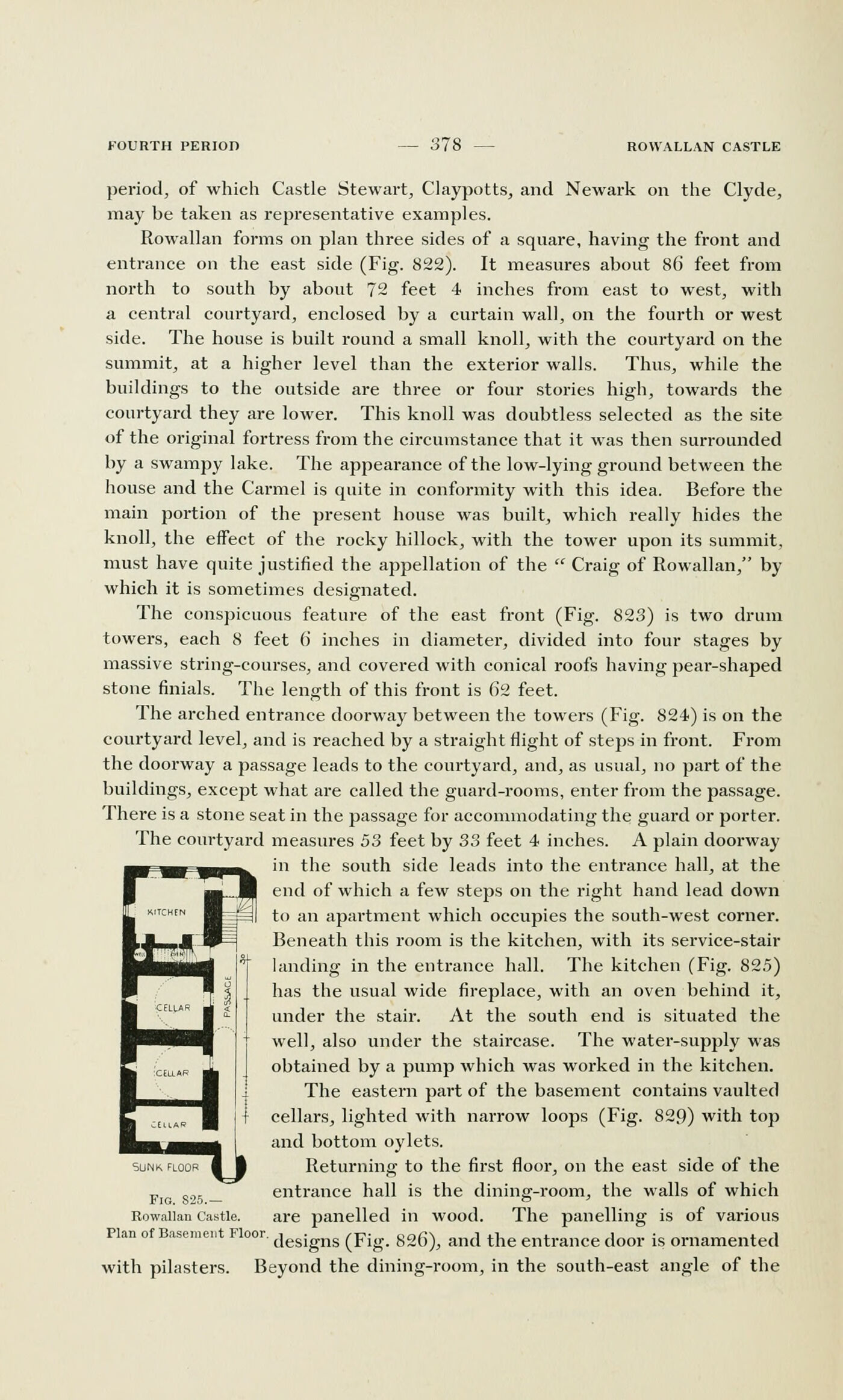
Fig. 825. Rowallan Castle. Plan of Basement Floor.
1887 · MacGibbon & Ross, vol. 2 (1887)
Public domain
Nearby