Clan Wallace
For liberty, the patriot's family.
- Origin
- Glasgow & Strathclyde, Scotland
- Motto
- Pro Libertate
- Famous bearer
- Sir William Wallace
- Register
- Scottish clan
The Wallace arms, crest badge, tartan and country

Crest badgeClan member crest badge - Clan WallaceCeltus · CC BY-SA 3.0 
TartanWallace tartan (Vestiarium Scoticum)As printed in the Vestiarium Scoticum, 1842, a collection whose claimed medieval source was never produced, and which is now generally held to be a forgery. Families adopted its patterns anyway, and wear them still.Celtus · CC BY 2.5 
Coat of armsWallacebadgeUnknown author Unknown author · Public domain 
Coat of armsWallace (of Sudbourne, Suffolk) ArmsBorne by the Sudbourne line, one branch of the name rather than all of it.Lobsterthermidor · CC BY-SA 3.0

.png)

_Arms.svg)
- Crest badge: The chief's crest inside a belt and buckle: the badge a clansman wears to show whose following he is in.
- Tartan: The checked cloth the family is known by.
- Coat of arms: Granted to an individual and inherited down that one documented line. These are the arms of particular families of the name, not of everyone who shares the surname.
What is the Wallace clan tartan?
One Wallace sett is recorded, and it is the swatch above (the plate printed in the Vestiarium Scoticum in 1842). The Vestiarium claimed to copy a medieval manuscript that was never produced, and is now generally held to be a forgery; families adopted its patterns anyway, and wear them still. A sett is the block of coloured bands the cloth is built from, repeated in both directions; the whole plaid is that one square enlarged.
Wallace is a Lowland name, and Lowland families did not wear Highland dress; the 1746 proscription that broke the tradition in the north took nothing from them, because there was nothing there to take. The Wallace sett is a 19th-century assignment, made when tartan stopped being Highland and became Scottish and fixed by the Bannockburn weavers’ pattern books, the royal visit to Edinburgh in 1822, and the Vestiarium Scoticum of 1842. Nobody polices any of it. Wearing the Wallace sett declares allegiance to the name, not descent from any particular line of it.
The seat of Clan Wallace
Seat vacantChief
No one leads the Clan Wallace community yet. When the movement opens, you can stand for its leadership, or help elect whoever does.
Current mission
No shared goal set yet. Once Clan Wallace has leadership, it sets the public focus: a restoration, a gathering, a real-world project that helps its own.
The Wallace clan is being rebuilt. Join the waiting list for the movement today, and you help decide who leads it and what it does.
Help rebuild the Wallace clan →Motto
Pro Libertate
“For liberty”
What does the Wallace name mean?
From Old French 'Waleis', 'Welshman' or, in Scottish context, a Briton of Strathclyde. The first recorded use is Richard Walensis in 1160.
The history of Clan Wallace
The name that meant the Welshman
Wallace is one of the few Scottish surnames that began life as a label for an outsider. It comes from the Anglo-Norman French Waleis, a northern variant of Gualeis, meaning simply 'Welshman'; the word appears in that sense in Wace's Brut, and as the adjective gualeis, 'Welsh'. Behind the French lies Old Low Franconian Walhisk, 'foreigner', 'Celt', 'Roman', cognate with the Old English waelisc that gave England the word Welsh. Every layer of the name says the same thing about the man who first carried it: he was not one of us.
That matters more in Scotland than it would anywhere else, because of who the word was being applied to. The Kingdom of Strathclyde, centred on the Clyde and Glasgow, was a British kingdom (part of the Hen Ogledd, the Old North) and its people spoke Cumbric, a Brittonic language closely related to Welsh and entirely distinct from the Gaelic of the Scots and from the Lothian speech that became Scots. To a Gaelic-speaking neighbour, a Cumbric-speaking Strathclyde Briton was a Wallace: a Welshman in his own country, in the land his ancestors had held for centuries.
There is a second explanation and the sources do not settle between them. The alternative is that the first Wallaces were incomers from Wales or the Welsh Marches who came north in the twelfth century under Norman patronage, a reading supported by the tradition that traces the family to Oswestry, a town on the Welsh border. Both readings converge on the same word and the same conclusion. The family that produced Scotland's national hero was named for not belonging, and the modern spelling still carries it. Wallis, Wallas, Walls, Vallance, Valance and the Gaelic Uallas are all the same name in different mouths.
The clan motto is Pro Libertate: 'For liberty'. It is one of the few Scottish mottoes that a reader needs no context to understand, and one of the few that a family earned rather than commissioned.
Richard Wallace and the Steward's grant in Kyle
The family enters the written record through the great twelfth-century reorganisation of southern Scotland. David I was actively importing Norman and Breton followers and settling them on southern land, and in 1136 he appointed Walter FitzAlan his Steward, the office that would eventually give Scotland the Stewart kings. FitzAlan received lands in Ayrshire, and among the followers who came north with him to improve their fortunes was Richard Wallace, said to have come from Oswestry on the Welsh border.
Richard settled on the Steward's Ayrshire lands and was granted his own estate in Kyle. He held lands at Kilmarnock as a vassal of the High Steward of Scotland before 1160, and it is his appearance as Richard Walensis on a land charter of that year that gives the family its first securely dated document. His name is still on the map: Riccarton, Richard's town, four miles from Kilmarnock, where the Wallaces held a castle from the thirteenth century or earlier.
The line then divides in the way that decides everything afterwards. Richard's grandson was Adam Walays, and Adam had two sons. The elder succeeded to the family estates in Ayrshire. The younger, Malcolm Wallace, received Auchinbothie and Elderslie in Renfrewshire: a cadet's portion, a younger son's land, the sort of holding that produces knights of local standing and nothing more. It was from that junior Renfrewshire branch, not from the senior Ayrshire house, that the patriot came.
Whose son was William Wallace?
The most famous Scotsman of the Middle Ages has a disputed father, and honest history has to say so. The long-standing account makes him the son of Malcolm Wallace of Elderslie. Malcolm appears in the Ragman Rolls of 1296, the register of Scots who submitted to Edward I of England after the fall of Berwick and Dunbar, paying his allegiance like almost everyone else of any standing in the country. Later he was one of the few who refused to submit, and he and his son Andrew were executed for it. On that reading the patriot grew up in a household that had already paid for refusal once.
The competing account rests on a physical object. William Wallace's own seal, rediscovered in 1999, identifies him as the son of Alan Wallace of Ayrshire, and an Alan Wallace also appears in the Ragman Roll of 1296, described as a crown tenant of Ayrshire. In March 1999 Dr Fiona Watson published A Report into Sir William Wallace's Connections with Ayrshire and concluded that Sir William Wallace was a younger son of Alan Wallace, a crown tenant in Ayrshire. A seal is the man's own testimony about himself, which is why the Ayrshire case is strong; but the Elderslie tradition is old, and the two have not been reconciled.
His birthplace is equally contested. Tradition puts it at Elderslie in Renfrewshire around 1270, at the property known as Wallace's Buildings, which the family held from the thirteenth century until about 1850; other places have also been proposed. The buildings themselves are gone, demolished, and what remains is a grassy mound and a monument. What is not in doubt is his standing: a younger son of a knightly family of the second rank, with no earldom, no great following and no claim on anybody's obedience. Everything he later commanded, he was given by men who chose to follow him.
The bridge at Stirling, 11 September 1297
By the summer of 1297 Scotland had no king in it. John Balliol was in the Tower of London, the Stone of Scone had been carted to Westminster, and Edward I had set his sheriffs in the burghs with his treasurer Hugh Cressingham over the whole country. Wallace was an outlaw with a price on his head after killing the English sheriff of Lanark. In the north, Andrew de Moray, a knight's son from the Black Isle, was taking the castles back one at a time. By August the two forces had joined, and by Moray's own word the captaincy went to Wallace, because the country knew his name.
On 11 September the English army of John de Warenne, Earl of Surrey, began crossing the Forth below Abbey Craig on a wooden bridge two horsemen wide. Sir Richard Lundie, a Scots knight in English service, had offered Surrey a ford upstream where sixty horse could cross abreast. Surrey refused him. Cressingham pressed the crossing against the advice of the English knights, because the treasurer wanted the campaign cheap and closed. The Scots on the slope above simply watched the bridge fill.
When roughly a third of the English host was across and the rest was jammed behind it, the schiltrons came down and closed on the neck of the marsh where the bridge met the bank. The vanguard was cut from the bridge before it could face about. Cressingham was killed on the marsh; the Chronicle of Lanercost records that a strip of his skin was afterwards made into a sword-belt, which is either true or is the chronicler's hatred of him talking, and at seven centuries' distance the two are not easily separated. Armoured men went into the Forth and did not come up. Surrey ordered the bridge fired with his own men still on it and rode for Berwick. Some five thousand foot and a hundred knights were lost before sundown.
The importance is not the casualty list. On this island it had been taken for granted that trained horse broke levied foot as a matter of course; after 11 September 1297 that proposition needed arguing, and within a generation, at Bannockburn, it had to be abandoned altogether. Andrew de Moray was carried off the marsh with a wound in the chest. In October a letter went from Haddington to the merchants of Lübeck and Hamburg telling them Scotland was recovered and open for trade, sealed over both names: Andreas de Moravia et Willelmus Wallensis, leaders of the army of the kingdom of Scotland. Moray was dead of the wound by November. Wallace was knighted within the month and made Guardian of Scotland in King John's name.
Falkirk, the embassies, and Smithfield
Berwick fell that autumn and the northern English counties were raided through the winter. Then in July 1298 Edward came north himself, and at Falkirk Wallace was beaten by weight of numbers. He resigned the Guardianship. What he did next is the part of his life that the films leave out: he went abroad as an envoy, to the court of Philip of France and on to Rome, to argue Scotland's case in the chanceries of Europe: a guerrilla captain turned diplomat, pressing the legal argument that the kingdom still existed. Then he came home to seven more years of riding and hiding, burning the granaries the English garrisons depended on, raiding by night across the Tweed, while the Scottish magnates came in one by one and made their peace. The bishops of St Andrews and Glasgow swore. Bruce swore. Comyn swore. Wallace never did.
On 3 August 1305 he was taken in his sleep in a house outside Glasgow by men of Sir John Menteith, a Scot in English pay; a stone at Robroyston marks the place. The irons went on and the road south ran through Carlisle and down the spine of England by stages, the prisoner shown at the market towns. He reached London on 22 August and was lodged for the night in the Fenchurch Street house of a citizen named William de Leyrer. He was about thirty-five.
He was brought into Westminster Hall in irons on the morning of 23 August 1305, before Peter Mallory and four other justices, with a garland of green oak leaves set on his head, a joke about an old prophecy that a Scotsman would one day be crowned king in that hall. The indictment called him traitor to his sworn lord, and folded sacrilege and the burning of churches in among the murders so that the punishment could be doubled. He refused to plead. He answered instead that he could not be a traitor to a king to whom he had never sworn allegiance, and that he was not, and never had been, a subject of Edward of England. The verdict was coming either way; the refusal changed what the verdict meant, because it made the killing a thing done to a foreigner by a foreign king.
The sentence was drawn for treason, hanged for murder, cut down alive and disembowelled for sacrilege, beheaded as an outlaw, and quartered, the parts sent to Newcastle, Berwick, Stirling and Perth, against the four corners of the country he was said to have pretended to govern. It was carried out at Smithfield that day, four miles' drag from Westminster. His head was set on London Bridge, the first put there for that purpose, beginning a fashion that lasted three hundred years. The Lanercost chronicler set down the details precisely because the details were meant to deter, and they deterred nobody: by 1314 the army sent north to relieve Stirling Castle was broken in an afternoon at Bannockburn, and in 1320 the barons of Scotland wrote to the Pope from Arbroath that they fought non propter gloriam, divitias aut honores, sed propter libertatem solummodo: not for glory, riches or honours, but for liberty alone. That is the clan motto, in the high register of the chancery. No quarter of his body was ever recovered for burial.
Blind Harry, the tartans, and the septs that never were
Most of what the world thinks it knows about William Wallace comes from a poem written a century and a half after his death. Blind Harry's fifteenth-century verse life is the source of the familiar scenes, and the family itself commissioned the collecting: the Wallaces of Riccarton, then at Craigie Castle in Ayrshire, had Blind Harry gather and record the stories about the patriot there. That makes Craigie the birthplace of the legend as distinct from the man. It also means Harry is evidence about how fifteenth-century Scotland wanted to remember Wallace, and not evidence for what Wallace did. Where the poem and the record disagree, the poem is a witness to the legend only.
The same caution applies to the trappings. The great sword displayed as Wallace's at the National Wallace Monument above Stirling is probably not his. The three Wallace tartans (Red, Green and Blue, each sold in modern, ancient and weathered shades) were all invented in relatively recent times, like almost every clan tartan on the market. None of this diminishes the man. It just separates him from the merchandise.
Clan Wallace is unusual in one respect that deserves saying plainly. It has no sept families at all: just Wallace, by the decision of the chief. That is a deliberate refusal of a nineteenth-century industry. Sept lists were largely drawn up in that century by clan societies and tartan manufacturers hoping to capitalise on the enthusiasm for all things Scottish, linking as many surnames as possible to a clan regardless of any historical connection (Miller made a sept of MacFarlane, Taylor of Cameron, Mason of Sinclair), so that anyone without a clan name could feel entitled to a tartan. Wallace declined to play. If your name is Wallace, Wallis, Wallas or one of the older spellings, you are in; if it is not, the clan will not pretend otherwise. It is a small integrity, and it is in keeping.
Craigie, Carnell and the long Ayrshire afterlife
The family did not end with the patriot; it went on holding Ayrshire for six hundred years. The senior branch of the clan descends from the Wallaces of Craigie, who came into that estate late in the fourteenth century by marriage to the heiress of Sir John Lindsay of Craigie. John Wallace of Riccarton took the castle about 1371. Craigie Castle, a hall house and castle four miles south of Kilmarnock dating from the thirteenth century, was the family's seat until they abandoned it around 1600 and moved to Newton in Ayr. Its ruins stand today. Elsewhere in the same country Sir Duncan Wallace, Sheriff of Ayr, built Sundrum Castle in the fourteenth century; the Wallaces of Sundrum held Caprington from 1385 to 1400; the Wallaces of Elderslie were the recorded owners of Auchenbathie Tower in 1398, and that Auchenbothie line died out around 1650.
They fought where the country fought. In October 1449 Sir John Wallace of Craigie was a commander at the Scottish victory over the English at the Battle of Sark. William Wallace of Carnell, near Kilmarnock, was killed at Flodden in 1513 with so much of the Scottish nobility. In the seventeenth century the family split along the lines the whole country split along: James Wallace served as a captain under General Robert Monro when he occupied the Gordon stronghold of Huntly Castle in 1640, while Sir Hugh Wallace, a royalist, raised a regiment for King Charles against Cromwell. In 1669 Hugh Wallace of Craigie was created a Baronet of Nova Scotia under Sir William Alexander of Menstrie's scheme to promote that colony as a Scottish venture.
The Covenanting strain runs strongest at Auchans, held by the Wallaces of Dundonald from 1527, whose last family occupant was Colonel James Wallace, the leader of the Pentland Rising of 1666: the Covenanters' march on Edinburgh, and one more Wallace commanding men against the government of the day. Dundonald Castle itself the family held from the 1530s until debt forced its sale in 1632. Later Ayrshire holdings track the family's quieter, wealthier centuries: Craigie House near Ayr, a three-storey mansion built by the Wallaces of Craigie in 1730 and passed to the Campbells in 1782; Busbie Castle, held through General Sir James Wallace, who died in 1867, to William Wallace of Busbie and Cloncaird; Cloncaird Castle, held by the Wallaces of Cairnhill from 1843 until it was sold in 1905.
The name since: Wallis, Wallas, and the thirty-sixth chief
Under its variant spellings the name kept turning up wherever a first principle was being worked out. In 1657 the mathematician John Wallis published Arithmetica Infinitorum, the first work to handle the concept of infinity mathematically, clearing the ground for the calculus and the binomial theorem; the infinity symbol is his. In 1821 Thomas Wallace, vice-president of the British Board of Trade, cut the duties long imposed on Baltic timber, a technical-sounding act that announced the end of the mercantile system England had run since it first planted colonies. The sociologist Graham Wallas was an early leader of the Fabian Society alongside George Bernard Shaw, arguing for the peaceful and democratic permeation of British politics with socialist and collectivist ideas. Sir Richard Wallace assembled one of the great private collections of painting, sculpture and eighteenth-century French furniture and left it to the British public on his death in 1897; it is the Wallace Collection still.
The clan's champion of the modern era is Alfred Russel Wallace, the self-taught, Welsh-born naturalist of Border-Wallace descent who worked out evolution by natural selection independently of Darwin, from his own field study of the flora and fauna of South America and the East Indies, and posted the theory to Darwin from the Indonesian archipelago in 1858. The two papers were read together that year. The faunal boundary he identified between Asian and Australian ecologies is called the Wallace Line. He is a genuinely Wallace kind of figure: no money, no institution, no patron, and a conclusion he would not soften.
Closer to home the name belongs to Jock Wallace, the soldier turned goalkeeper who became Rangers' great motivator, winning two domestic Trebles and breaking Celtic's grip on the Scottish game, and who carried the patriot's name with the ferocity people expected of it.
The chiefship is unbroken. Andrew Robert Wallace is the 36th Chief of Clan Wallace, son of Ian Francis Wallace of that Ilk, the 35th Chief, who died on 14 May 2016 aged eighty-nine and who had succeeded his brother Lieutenant-Colonel Malcolm Robert Wallace in December 1990. Andrew was born in February 1964, five hundred yards from the spot in London where William Wallace was put to death; born in England to an English mother, he maintains that he is decidedly Scottish. Seven centuries on, a Wallace is still standing in London insisting on which country he belongs to.
Champions of the Wallace name
The bearers whose lives are inseparable from this surname. Each has their own page, biography, achievements, geography, connection to the family.
- Alfred Russel Wallace
The self-taught Welsh-born naturalist of Border-Wallace descent who independently discovered evolution by natural selection from a hammock in the Indonesian archipelago and posted his theory to Darwin in 1858.
- Jock Wallace
The soldier-goalkeeper who became Rangers' great motivator, winning two domestic Trebles and breaking Celtic's grip, and carried the patriot name of Wallace with ferocious heart.
Historic Places, Rebuilt
Explore the streets and seats the Wallace name knew, rebuilt with AI as they stood in history.
Castles the Wallace held
Strongholds this name held for a decade or more, look one up, or rebuild it to explore.
- Dundonald Castle
Held by the Wallaces from the 1530s until debt forced its sale in 1632.
- Featherstone Castle
Held from about 1789 by James Wallace; Lord Wallace bequeathed the estate to his nephew, who took the name Hope-Wallace.
- Sundrum Castle
Built in the 14th century for Sir Duncan Wallace, Sheriff of Ayr.
- Craigie Castle
Passed by marriage to John Wallace of Riccarton about 1371.
- Auchenbathie Tower
Held by the Wallaces of Elderslie, recorded owners in 1398; the Auchenbothie Wallace line died out around 1650.
- Busbie Castle
Passed through General Sir James Wallace (d. 1867) to William Wallace of Busbie and Cloncaird.
- Caprington Castle
The Wallaces of Sundrum owned the property from 1385 until 1400.
- Auchans Castle
Held by the Wallaces of Dundonald from 1527; Colonel James Wallace, leader of the 1666 Pentland rising, was the last of the family to occupy it.
- Cloncaird Castle
Held by the Wallaces of Cairnhill from 1843 until sold in 1905.
- Cessnock Castle
Owned by the Wallace family, in the succession of owners between the Campbells and 1946.
The castles of the homeland
The great strongholds of the homeland, look one up, see what it looked like in its prime, and recreate it to explore.
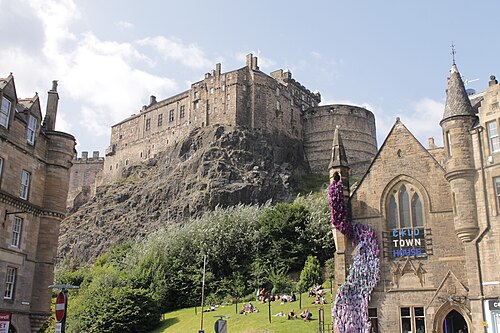 Edinburgh CastleRestored · prime 1520
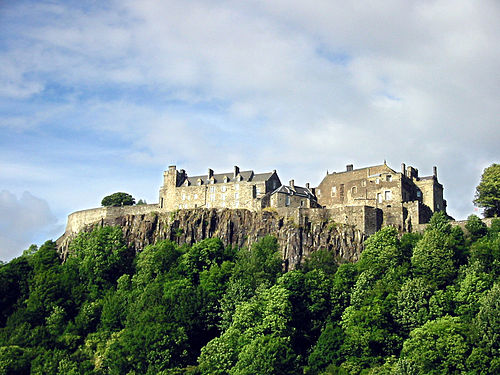 Stirling CastleRestored · prime 1542
 Glamis CastleStill standing · prime 1900
All castles in Scotland → · Strongest castles in Scotland → · Castles of Europe
Play As Your Clan
Hold a real castle against whatever you choose to send at it, take a ship out in her own service years, or stand at the shoulder of someone the record remembers. The chronicler sets the scene; the deeds are yours.
Notable bearers of the Wallace name
- Sir William Wallace
Stories of Clan Wallace
Stirling Bridge
1297On the morning of 11 September 1297, the English army of John de Warenne and Hugh Cressingham began crossing the Forth at Stirling on a wooden bridge two horsemen wide. The Scottish patriot army on the high ground above the river held its position and watched. Its commanders were William Wallace, the outlaw turned national leader, and Andrew de Moray, who would die of wounds taken that day. The Scottish question had no precedent for what they were about to do: Highland and Lowland infantry had not been thought capable of breaking trained knights in the field. By sunset that question had its answer.
Read the story →
Execution at Smithfield
1305In August 1305, after seven years of guerrilla war and near-misses, William Wallace was betrayed in Glasgow by Sir John Menteith, taken in chains across the Border, paraded through the south of England, and brought into Westminster Hall to be tried for treason. Edward I had personally insisted on the trial. A garland of laurel was placed on his head in mockery of an old prophecy that said a Scot would one day be crowned king in London. He refused to plead. The court convicted him in absence of his own defence. The four-mile drag from Westminster to Smithfield, and what they did to him there, was set down in the chronicle of Lanercost in language meant to deter.
Read the story →