Clan Erskine
Earls of Mar, and 'Bobbing John', who led the '15.
- Origin
- Glasgow & Strathclyde, Scotland
- Motto
- Je Pense Plus
- Famous bearer
- John Erskine, 'Bobbing John', leader of the 1715 Jacobite Rising
- Register
- Scottish clan
The Erskine arms, crest badge, tartan and country

Crest badgeErskine crestTomasz Steifer, Gdansk · CC BY 2.5 
TartanErskine tartanMicheletb · CC BY-SA 4.0 
TartanErskine (Black and White) tartanMicheletb · CC BY-SA 4.0 
Coat of armsErskine armsNewm30 · CC BY-SA 4.0 
Coat of armsArms of Erskine of AlvaBorne by the Alva line, one branch of the name rather than all of it.MostEpic · CC BY-SA 4.0


_tartan.png)


- Crest badge: The chief's crest inside a belt and buckle: the badge a clansman wears to show whose following he is in.
- Tartan: The checked cloth the family is known by.
- Coat of arms: Granted to an individual and inherited down that one documented line. These are the arms of particular families of the name, not of everyone who shares the surname.
What is the Erskine clan tartan?
Two Erskine setts are shown above. They are not rival claims to be picked between; they are different records, and different weaves, of the same family cloth. A sett is the block of coloured bands the cloth is built from, repeated in both directions; the whole plaid is that one square enlarged.
Erskine is a Lowland name, and Lowland families did not wear Highland dress; the 1746 proscription that broke the tradition in the north took nothing from them, because there was nothing there to take. The Erskine sett is a 19th-century assignment, made when tartan stopped being Highland and became Scottish and fixed by the Bannockburn weavers’ pattern books, the royal visit to Edinburgh in 1822, and the Vestiarium Scoticum of 1842. Nobody polices any of it. Wearing the Erskine sett declares allegiance to the name, not descent from any particular line of it.
The seat of Clan Erskine
Seat vacantChief
No one leads the Clan Erskine community yet. When the movement opens, you can stand for its leadership, or help elect whoever does.
Current mission
No shared goal set yet. Once Clan Erskine has leadership, it sets the public focus: a restoration, a gathering, a real-world project that helps its own.
The Erskine clan is being rebuilt. Join the waiting list for the movement today, and you help decide who leads it and what it does.
Help rebuild the Erskine clan →Motto
Je Pense Plus
“I think more”
What does the Erskine name mean?
From the lands of Erskine in Renfrewshire, just south of the River Clyde, held by Henry de Erskine in the reign of Alexander II.
The history of Clan Erskine
Green rising ground on the south bank of the Clyde
The name is a place before it is a family. Erskine is a district south of the River Clyde in Renfrew, and the barony there named the men who held it rather than the other way round. The reading usually offered for the word is an ancient or Old British phrase for green rising ground, and it is offered with a hedge; the family's own account is confident about the ground and cautious about the syllables.
What is documented is not a meaning but a holding. Henry de Erskine was proprietor of the barony as early as the reign of Alexander II, and in about 1226 he stood witness to a charter by the Earl of Lennox granting the patronage and tithes of Rosneath to Paisley Abbey. That slight survival is a precise one: it puts Henry inside the circle a Clyde-side earl trusted while he was disposing of church revenue.
The shape of the name explains the mechanics. A territorial surname is made by fixing "de", of or from, in front of an estate, a device the feudal nobility adopted first and lesser ranks copied later. That makes Erskine a Lowland name out of the charter world rather than a Highland patronymic, and a Scottish clan was made up of everyone living on the chief's ground, so the name never required descent from the chief's own body.
The Ragman Rolls, two daughters, and the keepership of Stirling
John de Irskyn was among the Scottish nobles who submitted to Edward I of England and set his name to the Ragman Rolls of 1296. For a great magnate that submission was a political catastrophe; for a Renfrewshire baron it was closer to bookkeeping. Nothing in the family's later standing turns on 1296. It turns on what his son arranged for his daughters.
That son, another Sir John de Irskyn, had three of them. The eldest married Thomas Bruce, brother of King Robert the Bruce. The second married Walter, High Steward of Scotland. In two matches the Erskines were bound to the house that held the throne and to the house that would inherit it, and the family's sudden altitude in the fourteenth century needs no other explanation. They married into the first rank of Scotland, then made themselves indispensable to it.
Sir Robert de Erskine is where the indispensability shows. David II gave him the keepership of Stirling Castle, the hinge of the kingdom and the one fortress no king could leave with a doubtful man. In 1350 he was appointed Chamberlain of Scotland, holding the office until 1357, and justiciar north of the Forth: the crown's revenue and its courts in one pair of hands. He was among the nobles who settled the succession on Robert II in 1371.
The earldom of Mar the crown would not hand over
To understand the quarrel that followed, start with Kildrummy. Gilbert de Moravia probably built it in the mid-thirteenth century, shield-shaped in plan, with a twin-towered gatehouse and a French-style keep called the Snow Tower, and it became the seat of the Earls of Mar. It stood siege in 1306 in defence of Robert the Bruce's family, and again in 1335, when Christina Bruce held off David of Strathbogie until Sir Andrew Murray relieved her.
In 1403 and 1404 Alexander Stewart murdered Sir Malcolm Drummond, took his widow Isabel Douglas, Countess of Mar, by force, and on the strength of that marriage claimed Kildrummy and the earldom. When Stewart died in the mid-fifteenth century Sir Robert Erskine, created Lord Erskine, claimed the title back through his own descent from the Countess of Mar. The king refused him: the earldom had reverted to the crown, he ruled, because its last male holder had been a Stewart.
It came a century later by gift rather than by right, when in 1565 Mary, Queen of Scots bestowed the earldom of Mar on the sixth Lord Erskine, descended from Elyne, daughter of Gratney, seventh Earl of Mar. The ambiguity never closed. Two lines of Mar run in parallel and both are recognised: the Erskine chiefs hold the seventh creation of 1565, deemed by the House of Lords in 1875, while a separate Countess of Mar, chief of Clan Mar, descends from the first creation of 1404.
Alloa Tower, and five generations who raised the king's children
Alloa is the family's fixed point and also its neatest disagreement. The clan's own history credits Alexander Erskine, third Lord Erskine, with constructing the tower in 1497 as the seat of the chiefs for the next three hundred years; the building record puts it in the early fourteenth century, one of a line of fortifications defending the north shore of the Firth of Forth, and raised to four or five levels only in the fifteenth.
The likeliest reconciliation is that 1497 marks a rebuilding, not a founding. Either way it is one of the earliest and largest Scottish tower houses, its walls immensely thick and its original timber roof and battlements still in place, and it is where the family's real office was carried out. Despite the refusal of Mar, five successive generations of Erskines had the keeping of royal children, beginning with the young James IV; the fifth Lord Erskine was tutor to James V.
Mary, Queen of Scots spent the first five years of her life around Alloa and Stirling Castle, in Erskine keeping, and she came back as an adult: she visited John, Lord Erskine and his wife Annabell Murray at Alloa in June 1562 and again in May 1565. Guardianship, not the earldom, is the through-line of the family's fifteenth and sixteenth centuries. Titles could be refused and later granted; the habit of putting the heir to Scotland into Erskine hands survived those five generations.
From the Raid of Ruthven to the Lord High Treasurer
In 1582 the habit of holding kings curdled. The seventh Lord Erskine took part in the Raid of Ruthven, which placed the young James VI in the hands of an extremist faction of Protestant nobility for nearly a year, and he went into exile for it. The recovery is the telling part: he was restored to favour, and in 1616 the king who had been his captive made him Lord High Treasurer of Scotland.
The same years saw the family gathering fortresses. In 1615 John Erskine, twentieth Earl of Mar, was made governor of Edinburgh Castle. In 1613 Sir Thomas Erskine had bought Kellie Castle in Fife, an old house held by the Northumbrian Siwards by 1266 and by the Oliphants for 250 years after 1360. James stayed at Kellie in 1617 on his only visit to Scotland after the Union of the Crowns, and in 1619 he made Erskine Earl of Kellie.
Kellie went to a younger son of the chiefly line, and it put an Erskine into the ordinary judicial machinery of Fife rather than the court. Alexander Erskine, third Earl of Kellie, sat as an investigator in the 1666 case of Margaret Guthrie, an accused witch from Carnbee. The Kellie earldom ran separately for more than two centuries before being united with Mar in 1835.
Braemar against the Farquharsons, Kilsyth for the king
The seventeenth-century Erskines pushed north and built to hold what they took. John Erskine, nineteenth Earl of Mar, acquired Corgarff Castle in 1626, and in 1628 the Earl of Mar built Braemar Castle, described as a hunting lodge and functioning as a counter to the rising power of the Farquharsons. A five-storey L-plan tower inside a star-shaped wall of six sharp-angled salients is a statement about who meant to run that glen.
The statement did not survive contact with the neighbours. Kildrummy had come to the Erskines from the Elphinstones, to whom James IV granted its keeping in 1507, and in 1645 it was Robert Farquharson of Invercauld who held Kildrummy for the Earl of Mar. The family that castle was built to check was, by 1645, garrisoning an Erskine fortress on the Erskine side.
In the same year Lord Erskine fought for the royalists at the Battle of Kilsyth. The family estates were forfeited for that support and restored by Charles II in 1660. This is the pattern worth holding before the next century: the Erskines had already lost everything once for backing a Stuart, and had it handed back by 1660.
Bobbing John raises the standard, and loses the lot
John Erskine, Earl of Mar, was called Bobbing John for changes of political allegiance that his own clan's history describes, drily, as being in accordance with the needs of survival, something not unknown to the Scottish nobility. He had been a supporter of the Union. When he attended court in London in 1714 and was not offered the post of Secretary of State for Scotland, he took it as an insult and went home.
He returned to his ancestral lands, raised the standard of James VIII, and called out his own clansmen along with all loyal supporters of the House of Stuart. He had soon gathered an army of more than ten thousand. On 13 November 1715 he led them against the Duke of Argyll at Sheriffmuir. The battle was inconclusive, though Argyll claimed the victory, and inconclusive was enough to finish the rising. Mar fled to France.
The bill was itemised across the family's map. His title and lands were forfeited, and in 1724 they were bought by another branch of the Erskines. Braemar went to the Crown as a garrison post, where soldiers cut graffiti into the Drawing Room shutters; "John Chestnut, Sergeant, 1797" is still legible there. Kildrummy was abandoned in 1716. The Jacobite title of Mar was set aside in 1824, when the Erskines were restored to the earldom itself.
Thomas Erskine, and nine days at the Old Bailey in 1794
Thomas Erskine was born at St Andrew Square in Edinburgh on 10 January 1750, third son of Henry David Erskine, tenth Earl of Buchan, and Agnes Steuart. The descent was ancient and the money was gone, which for a third son meant a career rather than an estate. He went to sea at fourteen as a midshipman, served four years in the Caribbean and the Mediterranean, transferred to the army in 1768, sold his commission in 1774, and was called to the bar in 1778.
Within a decade he was the foremost advocate in the English-speaking world, and he built that standing on the cases nobody wanted. He defended Lord George Gordon at his treason trial in 1781 and won an acquittal on the argument that the Gordon Riots had not amounted to a constructive levying of war against the King. In 1784 he took the seditious libel charge against William Davies Shipley, the Dean of St Asaph's case; that argument secured Fox's Libel Act of 1792, which gave the jury rather than the judge the right to decide both the fact and the law of a libel.
The central work came in 1794. Pitt's government charged Thomas Hardy, secretary of the London Corresponding Society, John Horne Tooke, philologist and reformer, and John Thelwall, the radical lecturer, with constructive treason over their reform petitions. Erskine led the defence at the Old Bailey through nine days of Hardy's trial in October, eight of Tooke's in November and four of Thelwall's in December. All three were acquitted.
He sat as Whig member for Portsmouth from 1783 to 1784 and again from 1790 to 1806. In February 1806 he was made Lord Chancellor of Great Britain in the Ministry of All the Talents under Grenville and created Baron Erskine of Restormel Castle the same day, holding the Great Seal until March 1807. He drafted the Cruelty to Animals Act of 1809, the first statute in English against cruelty to animals, and died at Almondell House in West Lothian in 1823.
Dun, Cardross and Linlathen: the branches that stayed put
The chiefly line's story is forfeiture and restoration; the branches supply the continuity. The House of Dun and the Dun estate were Erskine ground from 1375 until 1980, six centuries in one place, and John Erskine of Dun was a key figure in the Scottish Reformation. Nothing the chiefs did at Sheriffmuir touched it.
Others bought their way in. In 1700 Colonel John Erskine, son of David Erskine, fourth Lord Cardross, purchased the Tulliallan estate near Kincardine, an old L-plan castle that had passed from the Douglas earls to the Edmistons by gift in 1402 and then to the Blackadder lairds; the Erskines held it until Viscount Keith bought it in 1799. Near Culross in Fife they built a castellated mansion beside the medieval ruin of Dunimarle.
The last acquisition came with a condition attached. David Erskine bought Mains Castle in Dundee, seat of the Grahams of Fintry, from Robert Graham on terms that the Grahams keep the territorial title of Graham of Fintry and that the estate revert to its older name of Lumlathen or Linlathen. Shipley Gordon Stuart Erskine later sold it to James Key Caird, who gave castle and lands to the town council in 1913 as the site of a public park.
Champions of the Erskine name
The bearers whose lives are inseparable from this surname. Each has their own page, biography, achievements, geography, connection to the family.
Castles the Erskine held
Strongholds this name held for a decade or more, look one up, or rebuild it to explore.
- Braemar Castle
Built in 1628 by John Erskine, Earl of Mar; forfeited to the Crown after the earl led the 1715 Jacobite rising.
- Kellie Castle
Owned by the Erskines of Dirleton for much of the 17th century; Erskine was created Earl of Kellie in 1619.
- Old Tulliallan Castle
The estate was purchased in 1700 by Colonel John Erskine, son of David Erskine, 4th Lord Cardross.
- Mains Castle
Bought by David Erskine in the 19th century; Shipley Gordon Stuart Erskine later sold the estate.
- Alloa Tower
Medieval residence of the Erskine family, later Earls of Mar, from the early 14th century; the 6th Earl's Alloa House of 1710 incorporated the tower as its annexe.
- Kildrummy Castle
Held Kildrummy after the Elphinstones until its abandonment in 1716, following the failure of the Jacobite Rising of 1715.
- Dunimarle Castle
The Erskine family built the 18th-century mansion that stands beside the medieval ruin.
The castles of the homeland
The great strongholds of the homeland, look one up, see what it looked like in its prime, and recreate it to explore.
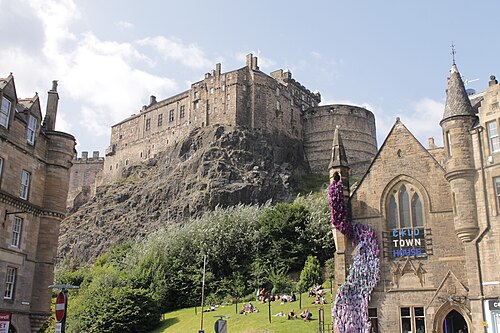 Edinburgh CastleRestored · prime 1520
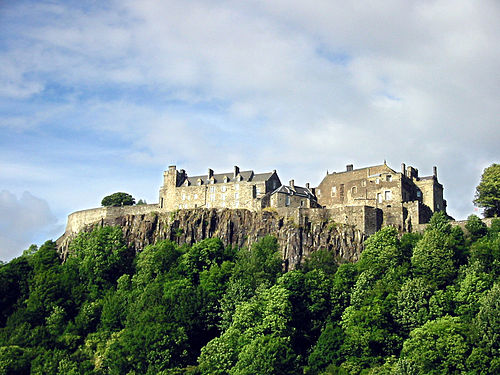 Stirling CastleRestored · prime 1542
 Glamis CastleStill standing · prime 1900
All castles in Scotland → · Strongest castles in Scotland → · Castles of Europe
Play As Your Clan
Hold a real castle against whatever you choose to send at it, take a ship out in her own service years, or stand at the shoulder of someone the record remembers. The chronicler sets the scene; the deeds are yours.
Notable bearers of the Erskine name
- John Erskine, 'Bobbing John', leader of the 1715 Jacobite Rising