Clan Malcolm
also MacCallum
Disciples of Columba, admirals and aimers-high.
- Origin
- Stirling & the Forth Valley, Scotland
- Motto
- In ardua petit
- Famous bearer
- Admiral Sir Pulteney Malcolm
- Register
- Scottish clan
The Malcolm arms, crest badge and country

Crest badgeClan member crest badge - Clan Malcolm (Maccalum)Celtus · CC BY-SA 3.0 
Coat of armsMalcolm of Poltalloch coat of armsBorne by the Poltalloch line, one branch of the name rather than all of it.Czar Brodie~commonswiki · CC BY-SA 4.0
.svg)

- Crest badge: The chief's crest inside a belt and buckle: the badge a clansman wears to show whose following he is in.
- Coat of arms: Granted to an individual and inherited down that one documented line. These are the arms of particular families of the name, not of everyone who shares the surname.
The seat of Clan Malcolm
Seat vacantChief
No one leads the Clan Malcolm community yet. When the movement opens, you can stand for its leadership, or help elect whoever does.
Current mission
No shared goal set yet. Once Clan Malcolm has leadership, it sets the public focus: a restoration, a gathering, a real-world project that helps its own.
The Malcolm clan is being rebuilt. Join the waiting list for the movement today, and you help decide who leads it and what it does.
Help rebuild the Malcolm clan →Motto
In ardua petit
“He aims at difficult things”
What does the Malcolm name mean?
From 'Maol Chalum', disciple of Columba. 'Maol' is Gaelic for 'shaven head' or 'monk', invoking the followers of St Columba on Iona.
The history of Clan Malcolm
The tonsure hidden inside the name
The Gaelic behind Malcolm is Maol Chaluim: maol, the shaven head, the crown-tonsure of a monk, bound to Calum, the Gaelic form of Columba, who founded the monastery on Iona. It belongs to the last productive layer of Goidelic name-building, the ecclesiastical compounds coined after Christianisation alongside Gille Chrìost, servant of Christ. The MacCallum form, Mac Ghille Chaluim, adds a generation and says son of the disciple of Columba; Malcolm keeps the devotee himself and drops the son.
The two are not simply the same word in different dress. The historian Ian Grimble challenged the assumption that they are interchangeable, pointing out that Colm was current wherever Celtic settlement reached, so a Maol Chaluim could be raised anywhere the saint was venerated with no tie whatever to Argyll. Malcolm surfaces as a heritable surname in Dunbartonshire and Stirlingshire in the 14th century, while the MacCallums had settled in Lorn towards the end of the 13th.
Craignish in 1414, and a charter for Poltalloch in 1562
The first office the kindred can be seen holding is a keepership. In 1414 Ronald MacCaullum of Corbarron was appointed constable of Craignish Castle. In Argyll under Campbell lordship that was the standard ladder: a lesser kindred kept a castle for a superior, and the trust converted into land.
It converted in May 1562, when Donald McGillespie Vich O'Challum received a charter of the lands of Poltalloch, in the parish of Kilmartin, from Duncan Campbell of Duntrune. The patronymic chain in the charter is the point: son of Gillespie, grandson of Callum, the surname still spelled out rather than inherited. Poltalloch became the seat and stayed it, and the family would eventually buy out the Duntrune Campbells who granted it.
The Gaelic Bible and the scythe at Ederline
The Reverend Archibald MacCallum translated parts of the Bible into Gaelic and in 1642 succeeded his cousin as fourth Laird of Poltalloch: a working minister at the head of the house.
His son Zachary was educated at the University of St Andrews and was known as a swordsman. Zachary held for the Marquess of Argyll, and in 1647 forces under Sir Alexander MacDonald caught him at Ederline. He killed seven men and had turned on Sir Alexander himself, who would have been the eighth that day, when a Maclean came at him from behind and killed him with a scythe.
Zachary's younger brother Duncan had a son, Neil MacCallum, who took service in the French navy and is said to have been the natural father of Louis-Joseph de Montcalm.
Balbedie, Lochore, and a Malcolm at Killiecrankie
The Fife Malcolms needed no Argyll connection at all. John Malcolm of Balbedie was chamberlain of Fife in the reign of Charles I, and his four sons scattered across the century's quarrels: Sir John Malcolm, created a Baronet of Nova Scotia; Alexander Malcolm, who sat as a judge with the title Lord Lochore; James Malcolm, who fought for John Graham, 1st Viscount Dundee, at Killiecrankie; and Michael.
Lochore Castle gave the judge his territorial style: a 14th-century keep and courtyard on an island in a loch, held by the Wardlaws of Torrie before it passed to the Malcolms of Balbedie. It is a ruin now, and it stood in the Fife of the Balbedie Malcolms, not in Argyll: the surname was running two independent courses long before anyone joined them.
1779: the chief who stopped being a MacCallum
In the late 18th century Dugald MacCallum, ninth of Poltalloch, changed his surname to Malcolm. The likeliest trigger is inheritance: the Malcolm estates came to him in 1779. Whatever the reasoning, the effect was constitutional. Clan MacCallum ceased to have a chief of that name, and the two kindreds were drawn together under one.
The direction of the swap is worth noting. Malcolm was the name of four Scottish kings, and a Lowland proprietor's name; MacCallum was an unmistakably Gaelic patronymic. The older form did not die (a MacCallum tartan is still woven beside Malcolm, Malcolm Dress and Malcolm Modern), but the chief's line and the estates went forward under the shorter word.
Buying both ends of Kilmartin Glen
Duntrune, on the north shore of Loch Crinan, was raised by the MacDougalls in the 13th century and later taken by the Campbells, who held it as the seat of the Campbells of Duntroon until they sold it to the Malcolms of Poltalloch in 1792. Its 13th-century curtain wall still encloses the 17th-century tower house, remodelled in 1830; it is reckoned the oldest continuously occupied castle on mainland Scotland, and is said to keep a phantom piper.
Carnasserie, further up the glen, came to them in the 19th century. It was begun in 1565 by John Carswell, Rector of Kilmartin and later titular Bishop of the Isles, with masons brought west from Stirling, and carries over its entrance the Gaelic motto DIA LE UA NDUIBHNE, God be with O'Duine. Garrisoned for Argyll during the Rising under Dugald MacTavish of Dunardry, it was destroyed and never rebuilt. Holding it and Duntrune made the Malcolms landlords of both ends of the glen.
Jamaica money, William Burn's house, and the evictions
Research by the Centre for the Study of the Legacies of British Slave-ownership sets out plainly where the Poltalloch fortune came from. Through the 18th and 19th centuries the family enlarged its wealth by slave trading and by owning plantations in Jamaica. Neill Malcolm, 12th of Poltalloch, held more than 2,000 enslaved people across eleven separate estates, opposed abolition, and claimed compensation from the Slave Compensation Commission in 1834.
The 12th accelerated his father's shift out of the trade and into British investment, redeploying slave-derived money into agrarian improvement at home, and is remembered in the Oxford Dictionary of National Biography as a paternalistic Scottish landlord. The same account records his son, the 13th, driving clearances and evictions from the Argyll estates. It was the 13th who commissioned Poltalloch House, built to William Burn's design from 1830 in an extreme show of that wealth. It stands ruinous.
Eskdale to the Qajar court at Tehran
John Malcolm was born at the tenant farm of Burnfoot in upper Eskdale, Dumfriesshire, on 2 May 1769, fourth of seventeen children of a Borders farmer of small means. A Royal Navy neighbour's East India Company patronage put him forward as a Madras cadet and he sailed on the Sulivan in 1782, twelve years and eleven months old. He fought through the Mysorean wars to Seringapatam in 1799 and taught himself Persian on the judgement that the Company's future across the western Indian Ocean would run on it.
He was right. Calcutta had identified Persia as the buffer against French and Russian designs, and Malcolm led three missions to the Qajar court at Tehran, in 1800, 1808 and 1810, which between them built the British diplomatic relationship with Persia and the British presence in the Gulf. Resident at Mysore from 1812, knighted in 1815, political officer at Pune through the Third Anglo-Maratha War, he came home in 1822 and wrote the History of Persia, the standard English reference for the next century. He was sworn Governor of Bombay in November 1827, sat briefly as MP for Launceston, and died in London on 30 May 1833, buried at St James's, Westminster.
A peerage that lasted six years, and a white terrier
John Wingfield Malcolm of Poltalloch was created Lord Malcolm in 1896 and died in 1902, when the peerage went extinct after six years. His brother took the estate, and the feudal style Malcolm of Poltalloch carried on with the chieftainship instead, which is how the family kept its designation after losing its title. Sir Ian Malcolm, the last of the line to sit in the Commons, remained an MP until 1919.
The oddest legacy is a dog. Colonel Edward Malcolm of Poltalloch, hunting in Argyllshire in the late 1800s, shot at what he took for a rabbit and found he had killed his favourite cairn terrier. He bred only white dogs afterwards, so that he would be able to see them. Combined with the Roseneath terriers of Campbell of Rosneath, the Poltalloch strain became the West Highland White Terrier, a name the colonel coined himself.
The chiefship is held by Ian Neill Lochnell Malcolm, 20th Laird of Poltalloch, who succeeded on the death of his father Robin in 2024, and Duntrune is still the chief's house.
Champions of the Malcolm name
The bearers whose lives are inseparable from this surname. Each has their own page, biography, achievements, geography, connection to the family.
Historic Places, Rebuilt
Explore the streets and seats the Malcolm name knew, rebuilt with AI as they stood in history.
Historic Places, Rebuilt · New
The Campbells of Glenorchy's stronghold on its island in Loch Awe, garrisoned under Ben Cruachan.
Historic Places, Rebuilt · New
The holy isle at its medieval height, the abbey, the high crosses and the kings' graves, under the Lordship of the Isles.
Castles the Malcolm held
Strongholds this name held for a decade or more, look one up, or rebuild it to explore.
- Duntrune Castle
Held by the Malcolms of Poltalloch since 1792; the current owner is chief of Clan Malcolm.
- Carnasserie Castle
The estate was sold in the 19th century to the Malcolms of Poltalloch.
The castles of the homeland
The great strongholds of the homeland, look one up, see what it looked like in its prime, and recreate it to explore.
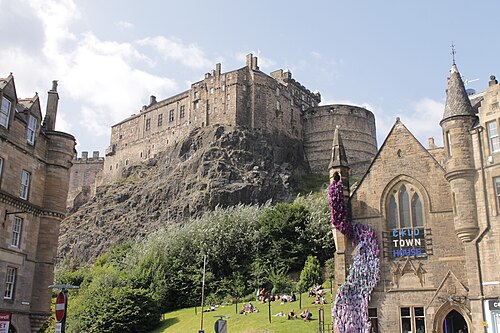 Edinburgh CastleRestored · prime 1520
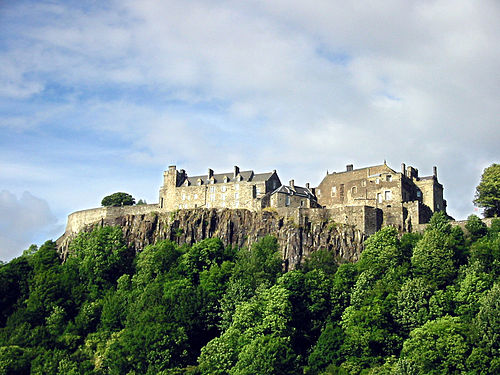 Stirling CastleRestored · prime 1542
 Glamis CastleStill standing · prime 1900
All castles in Scotland → · Strongest castles in Scotland → · Castles of Europe
Play As Your Clan
Hold a real castle against whatever you choose to send at it, take a ship out in her own service years, or stand at the shoulder of someone the record remembers. The chronicler sets the scene; the deeds are yours.
Notable bearers of the Malcolm name
- Admiral Sir Pulteney Malcolm