Clan MacQuarrie
also Macquarie
Of Ulva, and the Father of Australia.
- Origin
- Argyll & the West Coast, Scotland
- Motto
- Turris fortis mihi Deus
- Famous bearer
- Maj.-Gen. Lachlan Macquarie (1762–1824), 'Father of Australia'
- Register
- Scottish clan
The MacQuarrie crest badge, tartan and country

Crest badgeClan member crest badge - Clan MacquarrieCeltus · CC BY-SA 3.0 
TartanMacQuarrie tartan (J. Grant)Celtus · CC BY-SA 2.5 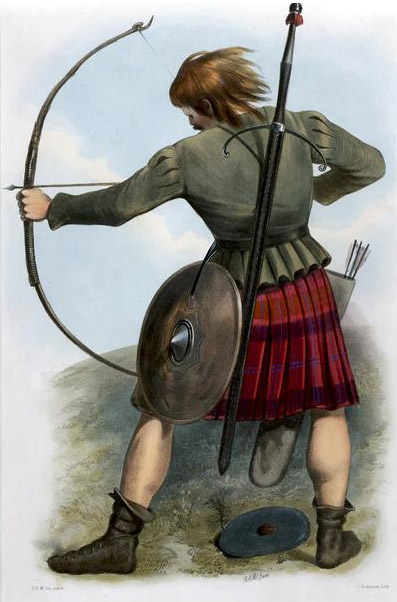
Clan plateMacquarrie (R. R. McIan)Robert Ronald McIan (1803-1856). · Public domain

.png)
.jpg)
- Crest badge: The chief's crest inside a belt and buckle: the badge a clansman wears to show whose following he is in.
- Tartan: The checked cloth the family is known by.
- Clan plate: Period portrait art of the clan, from the great 19th-century illustrated surveys.
What is the MacQuarrie clan tartan?
One MacQuarrie sett is recorded, and it is the swatch above. A sett is the block of coloured bands the cloth is built from, repeated in both directions; the whole plaid is that one square enlarged.
Almost no clan tartan is medieval. Highland dress was proscribed from 1746 until 1782, and when it returned it returned as ceremony rather than everyday cloth, so the surname-to-sett map was fixed after the break, by the Bannockburn weavers’ pattern books, the royal visit to Edinburgh in 1822, and the Vestiarium Scoticum of 1842. The MacQuarries wore tartan long before any of that. What the registers fixed was which one. Nobody polices any of it. Wearing the MacQuarrie sett declares allegiance to the name, not descent from any particular line of it.
The seat of Clan MacQuarrie
Seat vacantChief
No one leads the Clan MacQuarrie community yet. When the movement opens, you can stand for its leadership, or help elect whoever does.
Current mission
No shared goal set yet. Once Clan MacQuarrie has leadership, it sets the public focus: a restoration, a gathering, a real-world project that helps its own.
The MacQuarrie clan is being rebuilt. Join the waiting list for the movement today, and you help decide who leads it and what it does.
Help rebuild the MacQuarrie clan →Motto
Turris fortis mihi Deus
“God is to me a tower of strength”
What does the MacQuarrie name mean?
From Gaelic, possibly 'son of Guaire' (the proud or noble). Ancestral seat is the tiny Inner Hebridean island of Ulva.
The history of Clan MacQuarrie
Ulva, Staffa and Gometra: a chiefship measured in islands
The MacQuarrie country was small, wet and hard to take. The chiefs held Ulva in the Inner Hebrides, the neighbouring islands of Staffa and Gometra, and tracts of ground on the Isle of Mull behind them: a few square miles of rock, sea pasture and landing beach, held as followers of the Lords of the Isles. The clan counted itself one of the seven Siol Alpin kindreds descended from Kenneth MacAlpin, and a manuscript of 1450 sets its progenitor Guaire, the noble, beside his brothers Fingon, from whom the MacKinnons came, and Anrias, ancestor of the MacGregors.
The documentary record starts later, and starts with a death: John Macquarrie of Ulva, the first chief who can be named from record rather than genealogy, died in 1473. Before him the name appears only in the general muster of the Wars of Scottish Independence, among the West Highland men who came out for Robert the Bruce at Bannockburn in 1314.
Dunslaff's inheritance: independence by accident, 1493
John's son Dunslaff was chief when the Lordship of the Isles was forfeited. The overlordship that had ordered the Hebrides for a century stopped existing, and the MacQuarries (too small to be worth crushing, too rooted to be dislodged) came out of the wreck as an independent clan for the first time, hemmed in by the Macleans of Duart, whose power now filled Mull and who became their chief ally rather than their conqueror.
Independence in the Hebrides meant choosing whose war to join. The MacQuarries followed Maclean of Duart, and with the Macleans backed Domhnall Dubh's attempt to revive the Lordship at the opening of the sixteenth century. The rising failed, and in 1504 MacGorry of Ullowaa (the chief of Ulva, under an older spelling of both his name and his island) was summoned with the other island chiefs to answer to the Crown for the help he had given.
20 July 1651: Allan of Ulva and most of his followers at Inverkeithing
Allan Macquarrie of Ulva took his men south for Charles II and met John Lambert's English Parliamentarian army at Inverkeithing on 20 July 1651. The Scots line came apart before the fighting settled: many deserted the field, and the well-drilled New Model Army broke what was left of it. Allan was killed, and most of the men who had followed him from the islands were killed with him.
For a clan whose whole strength came off Ulva, Gometra and one corner of Mull, that was the fighting manhood of a territory, lost in one engagement far from the islands. The MacQuarries held Ulva afterwards, but never again appear in the record as a clan that could put a force in the field.
The last chief kept Dr Johnson dry, then sold the island
Lauchlan Macquarrie, sixteenth and last chief, was the man on Ulva in 1773 when Samuel Johnson and James Boswell came through on their Hebridean journey and were put up for the night. He was already deep with his creditors. The debts forced him to sell the patrimonial lands his family had held since the fifteenth century, and the chiefship became a title attached to nothing.
In 1778, at sixty-three, with the estate gone, he took a commission in the British Army and went out to the American Revolutionary War: a Hebridean chief beginning a soldier's career at an age when other men were burying their contemporaries. He died on 14 January 1818 at the age of 103. By his wife Alice Maclean, daughter of Donald Maclean, 5th Laird of Torloisk, he had eight children, four sons and four daughters; three of the sons went into the army and died without issue.
13 Ansdell Street, Liverpool: where the chiefly line came to rest
The one son who left descendants was the third, Donald, born about 1745 and commissioned in July 1761 as a junior ensign in the Fencible Men of Argyllshire. Discharged from the army, he did not go back to the islands. He moved to Liverpool, and on 28 October 1790 married Martha Lea at St Nicholas Church by the waterfront. They had one daughter.
A manuscript genealogy compiled while the last chief was still alive (found among the papers of Lt Colonel Charles MacQuarrie, and datable from its entries to between 28 March 1816 and 14 January 1818) records Donald simply as one who "follows the seafaring business". The Liverpool Directory for 1818 is blunter still: "a Mariner, of 13 Ansdell Street, Liverpool". He was buried in Liverpool on 10 June 1821, aged 75, and Martha on 16 December 1827, aged 71. Two generations carried the senior line from a Hebridean chiefship to a rented address in a shipping street.
The Thisbe sailed for Quebec in April 1824 and was never seen again
Donald's daughter Agnes MacQuarrie, granddaughter of the sixteenth chief, married Captain William Danson at Holy Trinity Church, Liverpool, on 28 January 1816. The Monthly Magazine noticed it in a line: "Capt. William Danson of Workington to Miss McQuarrie of Liverpool". Danson had commanded the Frances, a ship named for his mother, and afterwards the Thisbe of Liverpool.
On 6 April 1824 the Thisbe cleared Liverpool for Quebec with a valuable cargo consigned to Montreal, and never arrived. The Montreal Gazette of 24 September carried the only trace ever found: "A Jolly Boat with Thisbe of Liverpool on the stern, was picked up by the Margaret Ann, arrived at Miramichi, in longitude 36. The boat was bottom up." Danson, Agnes and four of their children were lost with the ship.
One child of that marriage survived: Thisbe Danson, born at sea and named for the vessel that later killed her family. Her descendants live in Lancashire, Cumbria and Pennsylvania, and the heir to the dormant chiefship of Clan MacQuarrie is among them. Nobody has claimed the chiefship in nearly two hundred years, so the clan runs as an active worldwide society with an empty chair at the head of it.
The Oskamull boy who bought the patrimony back
Lachlan Macquarie was born at Oskamull on Ulva on 31 January 1762, son of Lachlan Macquarie of Ulva and Margaret Maclaine of Lochbuie, a cadet family working a smaller croft on the same island the chiefs held. He was schooled at the parish school at Kilninian on Mull and took an ensign's commission at fifteen in the Royal Highland Emigrants, raised for service in Nova Scotia.
Thirty years of empire followed: Jamaica through the 1780s, India through the 1790s under Cornwallis at the siege of Seringapatam and under Wellesley in the Mysore wars, Egypt with Abercromby's force at Alexandria in 1801, then command of the 73rd Highlanders at Bombay. He came home in 1807 with a brevet colonelcy, a regiment and money of his own, and used it to buy back a large portion of the ancient patrimonial property.
On 16 July 1804 the Mull estate he assembled, Jarvisfield, was "christened" with both the last chief Lauchlan and his son Donald present, the displaced senior line standing on ground the cadet had repurchased. The two men were kin at one remove: the governor's mother and the last chief were half-cousins, sharing Lachlan MacQuarrie, the fourteenth chief, as grandfather by different wives. He used his commission list as a chief would have used a tack, obtaining a place in the 86th Regiment for Archibald MacQuarrie of Lagan-Ulva and bringing Charles MacQuarrie into the 77th as an ensign on 16 January 1792, when he was himself a captain in it.
A convict depot rebuilt, and a map that still carries the name
He took up the governorship of New South Wales at Sydney on 1 January 1810, sent out to replace William Bligh, whom the New South Wales Corps had deposed in the Rum Rebellion. He found about ten thousand people, two-thirds of them convicts and emancipists, held as a punitive depot by an officer class that ran the rum trade, and shipped the Corps home, garrisoning the colony with his own 73rd Highlanders instead.
What he built in the eleven and a half years that followed is still standing. The convict architect Francis Greenway designed his public buildings: St James's Church in King Street, Hyde Park Barracks, the Government House at Parramatta, the South Head lighthouse. William Cox drove the Great Western Road over the Blue Mountains in 1814. Bathurst, Liverpool, Windsor, Richmond, Castlereagh, Pitt Town and Wilberforce were founded; the Bank of New South Wales was chartered in 1817 and the colony's first census taken in 1820. His emancipist policy gave time-served convicts full civic rights and seated them beside free settlers at his own ceremonies.
He died at Duke Street, London, on 1 July 1824, and lies in the mausoleum he built on Mull under an epitaph reading "The Father of Australia". The name went onto Macquarie Street, where the New South Wales Parliament sits, and onto the Macquarie River, Lake Macquarie, Port Macquarie and Macquarie Island in the South Pacific. The coat of arms of the chiefs of the MacQuarries of Ulva is displayed at Macquarie University in his honour, a chiefless clan's arms, kept in the country its most famous son laid out.
Star Wars, Gibraltar, and a name scattered by anglicisation
Ralph McQuarrie (13 June 1929 – 3 March 2012), the American conceptual designer and illustrator, drew the look of the original Star Wars trilogy and won an Academy Award for his work; Christopher McQuarrie, born 25 October 1968, took another as a screenwriter before turning director. Sir Albert McQuarrie (1 January 1918 – 13 January 2016) sat as Conservative Member of Parliament for East Aberdeenshire from 1979 to 1983 and for Banff and Buchan from 1983 to 1987, was made a Freeman of the City of Gibraltar in 1982 and knighted in 1987.
Their shared surname is Gaelic mac Guaire, son of Guaire, and it survived into English by a great many roads that no longer look like each other. Clerks wrote it Makquhurrie and M'Quhirrich in Scots record, and migration carried it into Crary and McCreary, Wharrie and MacWharrie, Corry and McCurry, plain Quarry, and (through the Gaelic MacGuaire) into MacGuire and Maguire.
Champions of the MacQuarrie name
The bearers whose lives are inseparable from this surname. Each has their own page, biography, achievements, geography, connection to the family.
Historic Places, Rebuilt
Explore the streets and seats the MacQuarrie name knew, rebuilt with AI as they stood in history.
Historic Places, Rebuilt · New
The Campbells of Glenorchy's stronghold on its island in Loch Awe, garrisoned under Ben Cruachan.
Historic Places, Rebuilt · New
The holy isle at its medieval height, the abbey, the high crosses and the kings' graves, under the Lordship of the Isles.
The castles of the homeland
The great strongholds of the homeland, look one up, see what it looked like in its prime, and recreate it to explore.
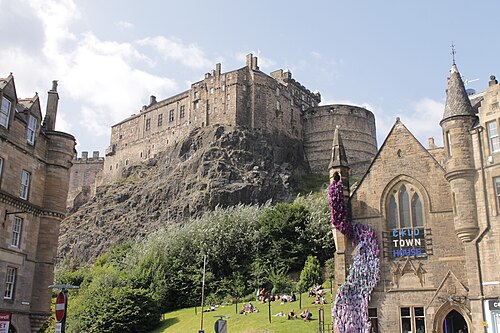 Edinburgh CastleRestored · prime 1520
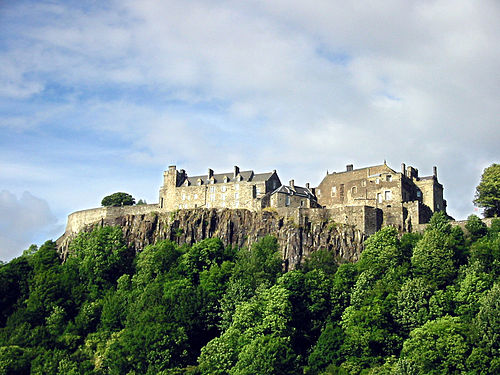 Stirling CastleRestored · prime 1542
 Glamis CastleStill standing · prime 1900
All castles in Scotland → · Strongest castles in Scotland → · Castles of Europe
Play As Your Clan
Hold a real castle against whatever you choose to send at it, take a ship out in her own service years, or stand at the shoulder of someone the record remembers. The chronicler sets the scene; the deeds are yours.
Notable bearers of the MacQuarrie name
- Maj.-Gen. Lachlan Macquarie (1762–1824), 'Father of Australia'