Clan MacDougall
also MacDougal, MacDugald
Heirs of Somerled, lords of Lorn.
- Origin
- Argyll & the West Coast, Scotland
- Motto
- Buaidh no bas
- Register
- Scottish clan
Ranked of all time
The 10 Oldest Clans in Scotland
The MacDougall arms, crest badge, tartan and country

Crest badgeClan member crest badge - Clan MacDougallCeltus · CC BY-SA 3.0 
TartanMacDougall tartanMicheletb · CC BY-SA 4.0 
TartanMacDougall - 1906 tartanThe pattern as it was recorded in 1906.Micheletb · CC BY-SA 4.0 
Coat of armsMacDougall of MacDougall armsBorne by the MacDougall line, one branch of the name rather than all of it.Czar Brodie · CC BY-SA 3.0 
Coat of armsArms of the House of MacDougallThe arms of the house itself: the main line, not one of its cadet branches.Euryrel · CC BY-SA 4.0


- Crest badge: The chief's crest inside a belt and buckle: the badge a clansman wears to show whose following he is in.
- Tartan: The checked cloth the family is known by.
- Coat of arms: Granted to an individual and inherited down that one documented line. These are the arms of particular families of the name, not of everyone who shares the surname.
What is the MacDougall clan tartan?
Two MacDougall setts are shown above, one of them the sett as it was recorded in 1906. They are not rival claims to be picked between; they are different records, and different weaves, of the same family cloth. A sett is the block of coloured bands the cloth is built from, repeated in both directions; the whole plaid is that one square enlarged.
Almost no clan tartan is medieval. Highland dress was proscribed from 1746 until 1782, and when it returned it returned as ceremony rather than everyday cloth, so the surname-to-sett map was fixed after the break, by the Bannockburn weavers’ pattern books, the royal visit to Edinburgh in 1822, and the Vestiarium Scoticum of 1842. The MacDougalls wore tartan long before any of that. What the registers fixed was which one. Nobody polices any of it. Wearing the MacDougall sett declares allegiance to the name, not descent from any particular line of it.
The seat of Clan MacDougall
Seat vacantChief
No one leads the Clan MacDougall community yet. When the movement opens, you can stand for its leadership, or help elect whoever does.
Current mission
No shared goal set yet. Once Clan MacDougall has leadership, it sets the public focus: a restoration, a gathering, a real-world project that helps its own.
The MacDougall clan is being rebuilt. Join the waiting list for the movement today, and you help decide who leads it and what it does.
Help rebuild the MacDougall clan →Motto
Buaidh no bas
“To conquer or die”
What does the MacDougall name mean?
Son of Dougal, from the eldest son of Somerled, King of the Hebrides. Dougal inherited Argyll, Lorn and the islands of Mull, Jura, Tiree and Lismore.
The history of Clan MacDougall
Dougall, eldest son of Somerled
The name is a patronymic and it points at one man. Somerled, the Norse-Gaelic warlord whose own name is the Gaelic Somhairle from the Norse Sumarlidr, was killed at the Battle of Renfrew in 1164. His eldest son was Dubgall - Dougall - and from him the kindred took both its surname and its claim: Clan MacDougall is the senior line of Somerled's descendants, a fact the Court of the Lord Lyon still recognises in the chiefship today. The Celtic first name Dougall, or Dugald, comes from the Gaelic dubh-gall, dark foreigner, a Gaelic word for the Norsemen among whom the family's own ancestors belonged.
After Somerled's death Dougall held most of Argyll together with the islands of Mull, Lismore, Jura, Tiree, Coll and others. This was not a tenancy but a kingship in miniature. Dougall's royal descent was acknowledged by the king of Norway, and he was styled King of the South Isles and Lord of Lorne. One of his sons appears to have been Ospakr-Hakon, the man Hakon Hakonarson, King of Norway, installed as King of the Isles in 1230, although the sources are not firm on the relationship and it is better read as probable than proven.
Dougall's son was Duncan, and Duncan's son was Ewan. Between them these two men turned a war-band inheritance into a territorial power with stone walls on it. By the thirteenth century the MacDougall chiefs, the original Lords of Argyll and later Lords of Lorne, were the most powerful clan in the Western Highlands - more powerful, at that point, than the Clan Donald descended from Somerled's younger son, and more powerful than the Campbells who would later take everything they had.
The castles Duncan and Ewan raised
Duncan and Ewan built to hold what Dougall had won, and the map of their building is the map of a sea lordship. On the mainland they raised Dunstaffnage Castle at the mouth of Loch Etive, Dunollie Castle above the bay at Oban, and Duntrune Castle. On the islands they built Aros Castle on Mull, Cairnburgh Castle out on the Treshnish Isles, Dunchonnel on the Garvellachs and Coeffin on Lismore. Duart on Mull was probably theirs too in the thirteenth century before it passed to the MacLeans in the fourteenth, and Mingary in Lochaber may mark the northern reach of the same expansion.
None of these are inland fortresses. They are set on headlands, skerries and sea lochs, because the MacDougall lordship was moved and fed and defended by galley. Cairnburgh, held by the family from at least 1249 to 1269, sits on a rock in the open Atlantic west of Mull; the chief's own seat at Dunollie stands on a crag that had been fortified since the days of the kings of Dal Riata in the sixth and seventh centuries, so the MacDougalls were not choosing a new site but occupying the oldest one in Lorn.
Duncan also founded Ardchattan Priory near Oban, and it is a measure of how deep the family's roots ran there that the MacDougall chiefs went on being buried in it until 1737 - more than four centuries after the forfeiture that was supposed to have ended them.
Ewan between two kings, 1263
Ewan held his islands from the king of Norway and his mainland from the king of Scotland, and that double homage is the sharpest thing about the MacDougall position on the western seaboard. It worked while the two crowns left each other alone. In 1263 it stopped working, when King Haakon IV of Norway arrived off the coast of Oban with a huge fleet to invade the west coast of Scotland and expected his island vassals to sail with him.
Ewan refused. He would not join the invasion, and old blood ties were strong enough that Haakon left him in peace rather than punish him. When the Battle of Largs followed, Ewan came in on the Scottish side and attacked part of the Norse fleet. The Norwegians were defeated, Haakon IV died later the same year, and three years after that the Treaty of Perth ceded the whole of the Hebrides to Scotland, with Scotland recognising Norwegian sovereignty over Shetland and Orkney in return.
The choice was correct and it paid. The MacDougalls came out of the Norwegian collapse as the leading power of the western seaboard, holding everything of one crown instead of splitting their loyalty between two. It is worth holding on to when the next generation is judged: this family knew perfectly well how to read a war. They read the following one differently, and that is where the story turns.
The Comyn marriage and the killing at Greyfriars
The MacDougalls' dominance in Argyll had already brought them up against the Clan Campbell. In 1294 John MacDougall of Argyll led the clan against the Campbells at the Battle of Red Ford, where Sir Colin Campbell was killed and both sides took considerable losses. That feud is the undertow beneath everything that comes after; when the MacDougalls fell, it was the Campbells who were handed what fell.
The marriage that decided the family's fate was to the Comyns, the greatest baronial house in Scotland. The sources do not agree on which generation made it: one account has the fourth chief marrying a sister of John Comyn II of Badenoch, the Black Comyn; the chiefly line as it is listed elsewhere has Alexander of Argyll, son of Eoghan, marrying a daughter of John I Comyn, Lord of Badenoch. Either way the effect is identical. The Lords of Lorne were tied by blood to the family whose chief, John Comyn III, the Red Comyn, had the better claim to the Scottish crown in the eyes of many.
In 1306 Robert the Bruce stabbed the Red Comyn to death in the church of the Greyfriars at Dumfries. That single act made a blood feud out of what had been a dynastic rivalry, and it put the MacDougalls on the far side of it. The bitter part is that they had supported William Wallace in the cause of Scottish independence. They now found themselves at war with the Bruces, whose cause was also Scottish independence. There was no side to change to. Kin-loyalty and national cause pointed in opposite directions, and the family chose kin.
Dalrigh, 1306, and the Brooch of Lorne
Shortly after his coronation at Scone, Bruce was driven west by the English into Argyll, trying to reach his Campbell allies. The MacDougalls caught him first. At the Battle of Dalrigh they surprised the new-made king and defeated him. He escaped with his life, but he left behind him a magnificent piece of Celtic jewellery torn from his person in the fighting, and it became one of the great treasures of the clan under the name the Brooch of Lorne.
It was kept at Dunollie Castle, and the chiefly line holds it at Dunollie still. There is no comparable object in the Highlands: not a relic of a victory the family went on to build a dynasty upon, but a souvenir of the one afternoon they nearly ended Robert the Bruce - and did not. Every year the brooch has spent in that house has been a year of living with the consequences of that failure. It is an unusual thing to keep on display, and the MacDougalls have never hidden it.
John MacDougall of Lorne, the man who led the ambush, is the clan's champion for a reason. He fought the winner of Scottish history to a standstill on his own ground, twice, with a fraction of the resources, and the only reason his name is not spoken alongside Wallace is that his enemy was not English.
The Pass of Brander and the forfeiture
Three years after Dalrigh, Bruce came back for them properly. In 1309 he led three thousand battle-hardened veterans into Argyll. John MacDougall of Lorne set an ambush for the royal army in the Pass of Brander, the narrow defile under Ben Cruachan where a smaller force ought to have been able to hold a larger one all day. It failed. At the Battle of the Pass of Brander the MacDougalls were beaten and driven from the field, and the king went on to besiege Dunstaffnage.
The lands were then forfeited by the Crown and given to the Campbells for their loyalty. Dunstaffnage became a royal castle with the Campbells as its keepers. Cairnburgh passed to the Crown in 1309, with the MacDougalls left on it merely as keepers of what had been their own. Aros was lost in the same settlement. The mechanism was Bruce's, and it was deliberate: he used feudal charters for land to bind clans to the Crown, and by that instrument the Clan MacDonald - descended from Somerled's younger line - were raised above the Clan MacDougall, the senior one. Two branches of one family, and the crown decided which was which.
The men themselves did not long outlive it. Alexander of Argyll, driven from Scotland by Bruce and his allies, died in 1310 or 1311, perhaps at Carlisle. His son John of Lorne, enemy of Bruce and of Bruce's ally Angus Og of Islay, was defeated, driven into exile, and died on pilgrimage to Canterbury in September 1317. The power of the MacDougalls was never regained.
John Gallda and the lands that came back
The line did not die, and the recovery is one of the quietest and most impressive things in the record. In the middle of the fourteenth century John Gallda MacDougall, grandson of the John who had fought Bruce, relocated from England back to Scotland, married a niece of the reigning King David II, and regained the ancestral lands in Lorne. Most of the mainland holdings were returned by royal charter from David II. A family that had been stripped and exiled inside one lifetime had talked and married its way back onto its own ground inside two.
It was not a full restoration. The lordship of Lorne itself eventually passed to the Stewarts after John Gallda's death, and the chiefly line continued instead through his son Allan. The MacDougalls were now one Argyll house among others rather than the power of the western seaboard, and they fought as such: in 1468 they were in the field against the Clan Stewart of Appin at the Battle of Stalc. Around 1320 the original fort at Castle Stalker had been raised while they were still Lords of Lorne, and the name of that battle is the sound of the family fighting over what had been theirs.
Building went on regardless. Gylen Castle on the south coast of Kerrera, a small tower house, was completed by Duncan MacDougall in 1582, on a site where Alexander II of Scotland may have died during his expedition to recover the Western Isles in the mid-thirteenth century.
Royalists, Covenanters and Jacobites
When the civil wars came in the seventeenth century the MacDougalls were generally royalists, and chief Alexander MacDougall led five hundred of his clansmen out for the king. After the defeat of the royalist commander James Graham, 1st Marquess of Montrose, a Covenanter army under David Leslie, Lord Newark, was sent into Argyll to deal with royalist supporters. Dunollie had already been attacked by Argyll, chief of Clan Campbell, in 1644; in 1647 Leslie's Covenanters besieged it, sacked it and burnt it, and torched Gylen along with it. The lands were restored after the Restoration of the monarchy in 1660.
In the Jacobite rising of 1715 the clan came out for the Stuarts again and fought at Sheriffmuir. Dunollie was attacked once more and the lands forfeited a second time; the chief was forced into exile, returned to Scotland to live as a fugitive, and was pardoned in 1727. The estate came back in 1745, and in 1746 the family built Dunollie House nearby, on a site that already had a house dating from about 1600, and abandoned the old castle on the crag.
The next chief, Alexander MacDougall, did not take part in the rising of 1745. His brother and a number of the clansmen did, and fought as Jacobites at Culloden in 1746. The fighting strength of the clan by then is given as two hundred men - a number worth setting beside the fleet and the eight castles of Ewan's day, because it measures exactly what four centuries on the losing side cost.
Still at Dunollie
The chiefship never broke. The chief of Clan MacDougall represents the senior line of Somerled's descendants, and the family is still at Dunollie, where the MacDougall of Dunollie Preservation Trust now cares for the ruined castle. The chief's arms - quarterly, first and fourth azure a lion rampant argent, second and third or a galley sails furled sable surmounted of a beacon gules - were matriculated in 1931 and are very close to arms cut on an eighteenth-century tombstone in the chiefs' own Kilbride burial ground, which is to say the design was theirs long before it was registered. Robin MacDougall, 32nd of MacDougall and Dunollie, succeeded his mother, Madam Morag Morley MacDougall, who died in February 2026.
Gylen Castle, still MacDougall property, was conserved in a project completed in 2006 and paid for in part by clan members from around the world - the descendants of people cleared, emigrated or simply gone, putting money back into a tower their ancestors lost the country around.
The motto is Buaidh no bas, to conquer or die, and there is no way to read it that is comfortable. The MacDougalls conquered first and then lost, and everything they are is shaped by the losing. That is a harder inheritance than a winner's and a more honest one. Pride in this name is not pride in a family that came out on top of Scottish history; it is pride in one that made its choice on kinship rather than advantage, paid the full price for it in land, in castles and in men, and is still standing on the same rock above Oban eight hundred years later with the brooch it took from the king who beat them.
Champions of the MacDougall name
The bearers whose lives are inseparable from this surname. Each has their own page, biography, achievements, geography, connection to the family.
Historic Places, Rebuilt
Explore the streets and seats the MacDougall name knew, rebuilt with AI as they stood in history.
Historic Places, Rebuilt · New
The galley of the Lords of the Isles under sail and oar through the Hebrides, the warship on a dozen clan crests, made real.
Historic Places, Rebuilt · New
The Campbells of Glenorchy's stronghold on its island in Loch Awe, garrisoned under Ben Cruachan.
Historic Places, Rebuilt · New
The holy isle at its medieval height, the abbey, the high crosses and the kings' graves, under the Lordship of the Isles.
Castles the MacDougall held
Strongholds this name held for a decade or more, look one up, or rebuild it to explore.
- Dunstaffnage Castle
Built by the MacDougall Lords of Lorn in the 13th century.
- Castle Stalker
Built the original fort around 1320, when the MacDougalls were Lords of Lorn.
- Duntrune Castle
Built by Clan MacDougall in the 13th century, alongside their stronghold of Dunollie.
- Dunollie Castle
Ancestral seat of the MacDougalls, Lords of Lorne, from the 12th century; the MacDougall of Dunollie Preservation Trust cares for the site today.
- Gylen Castle
Built by Clan MacDougall in 1582; clan members worldwide later helped fund its conservation, completed in 2006.
- Aros Castle
Probably built by one of the MacDougall lords of Lorn in the 13th century; forfeited when the family backed the losing side against Robert the Bruce.
- Cairnburgh Castle
Held by Clan MacDougall, descendants of Somerled through his son Dubgall, from at least 1249 to 1269.
The castles of the homeland
The great strongholds of the homeland, look one up, see what it looked like in its prime, and recreate it to explore.
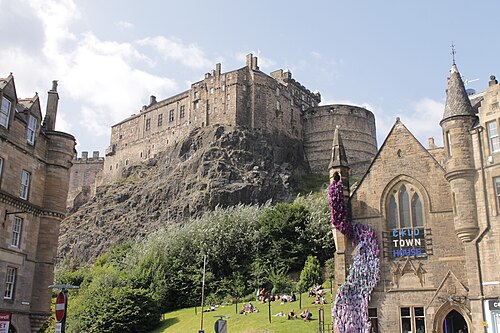 Edinburgh CastleRestored · prime 1520
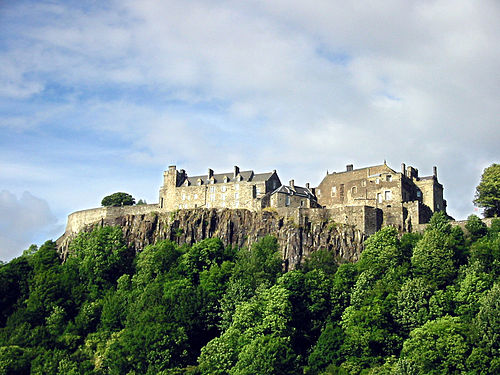 Stirling CastleRestored · prime 1542
 Glamis CastleStill standing · prime 1900
All castles in Scotland → · Strongest castles in Scotland → · Castles of Europe
Play As Your Clan
Hold a real castle against whatever you choose to send at it, take a ship out in her own service years, or stand at the shoulder of someone the record remembers. The chronicler sets the scene; the deeds are yours.