
Scotland · Ruin
Aros Castle
Aros Castle (also Dounarwyse Castle) is a ruined 13th-century hall-house and bailey on the Isle of Mull overlooking the Sound of Mull. The site preserves the stone hall-house and low remains of the surrounding bailey and associated buildings, together with a small stone galley landing to the east.
Its prime
1400
Today
Ruin
As it stood in 1400
What Aros Castle looked like in its prime.
A low, roofless 13th-century rectangular hall-house sits atop a grassy mound, its tall grey stone walls pierced by irregular window and door openings and overgrown with vegetation. In front and around it are the low stony foundations of a bailey and several short-arched outbuildings, some reduced to single collapsed arches. The masonry is dark grey local stone; the site faces east toward the Sound of Mull with open moorland and distant rounded hills across the water.
Its story
The story of Aros Castle.
A MacDougall Stronghold Above the Sound of Mull
Aros Castle stands near Salen on the Isle of Mull, a ruined thirteenth-century hall-house and bailey looking out over the Sound of Mull. It was probably built by one of the MacDougall lords of Lorn, and it was first a stronghold of Clan MacDougall.
Forfeiture, Angus Og and the Lords of the Isles, 14th–15th centuries
The MacDougalls backed the losing side in the dispute between Edward I and Robert de Bruys, and their lands were declared forfeit. King Robert gave the castle to Angus Og of Islay, Lord of the Isles, and Clan Donald. Documentary evidence from the late fourteenth century records it as Dounarwyse Castle in the possession of the Lords of the Isles, who used it as an occasional base through the late fourteenth and fifteenth centuries.
Clan Maclean, Lord Ochiltree and the Ruin of Aros, 1608–1991
Some centuries later the Lords of the Isles in their turn tried to conquer Scotland, and they too had their lands declared forfeit; this time Clan Maclean gained the castle at MacDonald expense. Lord Ochiltree entertained the island chiefs at Aros in 1608 before making them prisoners.
In 1688 the place was described as 'ruinous, old, useless and never of any strength', yet it seems to have been garrisoned by Argyll's troops in 1690. No evidence exists of any occupation in the eighteenth century or later. It has been a scheduled monument since 1991, the protection covering the thirteenth-century hall-house and bailey, traces of other buildings that may be of a later date, and a small stone-built galley landing east of the bailey.
Step inside
4 places to explore in 1400.
The record describes 4 distinct spots at Aros Castle, including 1 interior: interior of the 13th-century hall-house. Create your own photoreal reconstruction and explore every one, more scenes means more rooms, more angles, and more of the place to stand in.
Build Your Own Castle
Recreate Aros Castle with AI to explore it.
The artist rebuilds it as it stood in 1400, a photoreal reconstruction that belongs to you alone. Pay with coins, no subscription needed.
Recreate this castle →Defend this castle →Whose castle
Clans who held Aros Castle.
The families that held Aros Castle for a decade or more across its history, follow a name to its clan.
Probably built by one of the MacDougall lords of Lorn in the 13th century; forfeited when the family backed the losing side against Robert the Bruce.
Given by Robert the Bruce to Angus Og of Islay and Clan Donald; an occasional base of the Lords of the Isles through the 15th century.
Gained by Clan Maclean at MacDonald expense after the Lords of the Isles forfeited their lands.
From the archive
Aros Castle on paper: the measured plan and period views.
The survey plan and photographs below are the ground truth this page's reconstructions are checked against, drawn and photographed while the castle was still a working garrison. Every image is public-domain or openly licensed, with its source named.
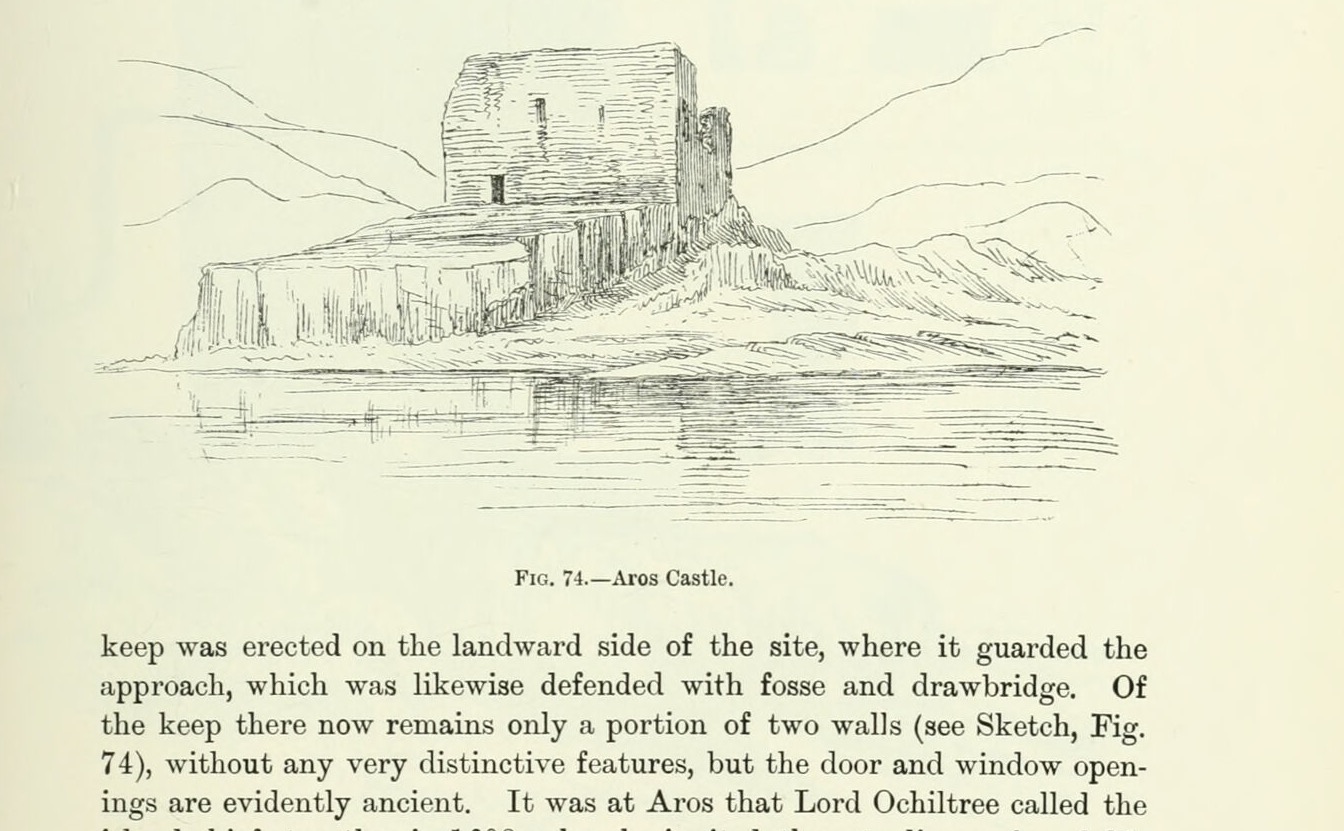
Fig. 74. Aros Castle.
1889 · MacGibbon & Ross, vol. 3 (1889)
Public domain


