Scotland · Ruin
Craignethan Castle
Craignethan Castle is a 16th-century Scottish fortification above a bend in the River Nethan, built as a compact artillery-conscious stronghold around a low central keep and enclosed courtyards. Though partially slighted in the late 16th century, its surviving keep, corner towers and outer court layout remain legible and were stabilised in later centuries; the site is now a scheduled monument managed by Historic Environment Scotland.
First raised
1500
Its prime
1545
Today
Ruin
As it stood in 1545
What Craignethan Castle looked like in its prime.
A low rectangular stone keep (approx. 21 by 16 m) sits within a rectangular walled inner courtyard; the keep rises two storeys plus attic under a double-gabled roof, its walls carried up to corbels for a parapet walk, with round corner bartizans and machicolations above the entrance. The inner curtain is reinforced by rectangular corner towers, the largest at the south-east (the "Kitchen Tower"). To the west a deep ditch and an outer court with service ranges and corner towers face out across steep, wooded slopes above the River Nethan.
Its story
The story of Craignethan Castle.
Finnart's Showcase, 1530-1542
The barony of Draffane, in which Craignethan lay, was a property of the Black Douglases until their forfeiture in 1455. The land was granted to the Hamilton family, and in 1530 James Hamilton, 1st Earl of Arran, gave it to his illegitimate son James Hamilton of Finnart. Finnart had travelled in Europe and had become an accomplished architect and military engineer; appointed King's Master of Works, he was responsible for the defences at Blackness Castle and for the renaissance facades of Linlithgow Palace. At Craignethan he set out to build a showcase for his talents in both domestic and military architecture. The result is recognised as an excellent early example of a sophisticated artillery fortification, although its defences were never fully tested, and Iain MacIvor writes that "Craignethan was the last private castle of high defensive capability built de novo in Scotland".
Steep slopes protect the site above a bend in the River Nethan on the south, north and east, but higher ground overlooks it from the west, so the defences were concentrated on that side: a west wall up to five metres thick, built to stand up to artillery bombardment, and beyond it a ditch 3.5 metres deep and nine metres wide. In the base of that ditch was a caponier, an enclosed tunnel with gunports from which the garrison could fire on anyone attempting to cross or bridge the ditch. It is a highly unusual feature in a Scottish castle: the only other known surviving caponiers in Scotland are at Blackness, also designed by Finnart, and a later one by Theodore Dury at Stirling.
Earlier royal favour did not save the builder. Hamilton was executed for treason in 1540 and his properties were forfeit to the crown. James V installed a garrison at Craignethan led by James and David Orrok, and sent his clock maker William Purves to dismantle Finnart's clock and take it to Edinburgh. Silverwork from the chapel was taken to Edinburgh as well and engraved by John Mosman with the arms of the king's infant eldest son, James, Duke of Rothesay. Two years later the family recovered the castle in the person of James Hamilton, 2nd Earl of Arran.
Regent Arran and the Darnley Marriage, 1542-1566
The 2nd Earl added a large outer courtyard to the west of the castle in the 1540s, less heavily defended than the inner but gunlooped along its west wall. He served as regent during Mary's infancy and became Duke of Châtellerault. His household books record his visits to Craignethan, among them stays in March 1543 and on 17 January 1548, and the food provided for them.
In 1565 Arran opposed Mary's second marriage to Lord Darnley and was forced to surrender his castles at Craignethan and Cadzow. He went into exile at Newcastle in England and surrendered Hamilton by the end of November 1565, when he promised to put Craignethan into the queen's hands. Several members of the family and their retainers, including Thomas Broun of Draffen, were forgiven on 2 January 1566 for having held the castles of "Hammiltoun and Draffen" in defiance of the royal order.
Mary, Langside and the Loss of the Keys, 1568
The situation reversed again after Mary's abdication. Arran aided her escape from Lochleven Castle and regained his castles, and Mary came to Craignethan for safety. Arran's son, Lord Claud Hamilton, is said to have entertained her at the castle on the night before the Battle of Langside in 1568. The battle, at which the Hamiltons fought the forces of Regent Moray, ended in defeat, and Mary was forced to flee to England. Craignethan and Cadzow were surrendered once more, and Moray came in person to the castle to receive the keys on 15 May 1568.
The Marian Civil War, 1568-1573
Lord Claud attempted to recover Craignethan by force that October, and in November his brother Lord John set about starving out Moray's soldiers inside it. The Hamiltons had the castle back by March. In 1570 Moray was shot at Linlithgow by James Hamilton of Bothwellhaugh, and when an English army assisting in the civil war went to Glasgow that May the Hamiltons withdrew to Craignethan. The Earl of Sussex was informed of the place's shortcomings: "Draffin, a strong house of the Duke's, but situate in a hole, so that it is commanded on every part, and has no ordnance."
In the same month Lord Sempill, by then a King's man, was captured and imprisoned in the castle. In August the English ambassador in Scotland, Thomas Randolph, heard that Regent Lennox hoped to get the Hamiltons out of their "den of Draffen"; Lennox planned to go into Clydesdale with the Earls of Mar and Glencairn and Lord Ochiltree, bringing artillery from Stirling Castle, but the expedition was postponed. There were allegations that the Craignethan garrison had destroyed crops and produce on the lands of Lemphlair and Braidwood belonging to the Lairds of Cunninghamhead and Glenbervie, as well as having taken Lord Sempill. A treaty between the King's and Queen's parties was signed in 1573.
From the Slighting of 1579 to State Care in 1949
By 1579 the Hamiltons were outlawed and Lord Claud had fled to France, the pretext being the killings of Regent Moray and Regent Lennox. The family prepared Hamilton, "Draffan" and Paisley for defence, and levies of troops were raised to capture Craignethan and Cadzow. By 15 May the royal artillery was approaching, and the garrisons of Hamilton and Craignethan offered to surrender on terms; the king's forces refused. The House of Hamilton surrendered on 19 May and the garrison of Craignethan abandoned the castle in the night, though David Moysie dates Craignethan's surrender to 18 May 1579 and Cadzow's to the following day. Claud's older brother the 3rd Earl of Arran, who had been confined at Craignethan since 1575, was taken to Linlithgow along with their younger brother David and their mother, while six soldiers of the Hamilton family who had defended the strongholds were taken to Stirling to stand trial for Moray's murder.
Craignethan was then slighted by royal authority under "young Sir James Hamilton of Libberton". The north-west tower was demolished and the massive west wall, the inner barmkin, was tumbled into the ditch, leaving the castle relatively defenceless; the ditch was not re-excavated until the 1960s. On 1 July 1592 Lord John Hamilton captured Archibald Wauchope of Niddrie and other rebel followers of the Earl of Bothwell at the meadow of Lesmahagow and shut them up here, and when James VI sent Sir John Carmichael, captain of the royal guard, to collect them, one of Hamilton's sons released them.
The Hamiltons regained the castle, but Duchess Anne sold it in 1659. The new owner, Andrew Hay, a covenanting laird, built himself a two-storey house in the south-west corner of the outer courtyard in 1665. Craignethan was sold in 1730 to Archibald Douglas, Duke of Douglas, and passed to his supposed collateral descendants, the Earls of Home, whose 12th earl stabilised the ruins in the late 19th century. Walter Scott, offered lifetime use of Hay's house after a morning excursion here in the autumn of 1799, wrote in 1829 that he "did not think on Craignethan in writing about Tillietudlem" in his novel Old Mortality, though he saw no objection to the public taste that had adopted it as "coming nearest to the ideal of the place". A Tillietudlem railway station followed on the Coalburn branch in 1876, and the houses built beside it became the hamlet of Tillietudlem. The 14th Earl of Home gave the property into state care in 1949. Scheduled since 1920, it is managed today by Historic Environment Scotland.
Step inside
10 places to explore in 1545.
The record describes 10 distinct spots at Craignethan Castle, including 4 interiors: dog‑leg gate passage through the north wall, hall within the keep, keep kitchen and service room and more. Create your own photoreal reconstruction and explore every one, more scenes means more rooms, more angles, and more of the place to stand in.
Build Your Own Castle
Recreate Craignethan Castle with AI to explore it.
The artist rebuilds it as it stood in 1545, a photoreal reconstruction that belongs to you alone. Pay with coins, no subscription needed.
Recreate this castle →Defend this castle →Whose castle
Clans who held Craignethan Castle.
The families that held Craignethan Castle for a decade or more across its history, follow a name to its clan.
Granted to the Hamiltons; given in 1530 by the 1st Earl of Arran to James Hamilton of Finnart, and held by the family through the Marian civil wars.
From the archive
Craignethan Castle on paper: the measured plan and period views.
The survey plan and photographs below are the ground truth this page's reconstructions are checked against, drawn and photographed while the castle was still a working garrison. Every image is public-domain or openly licensed, with its source named.
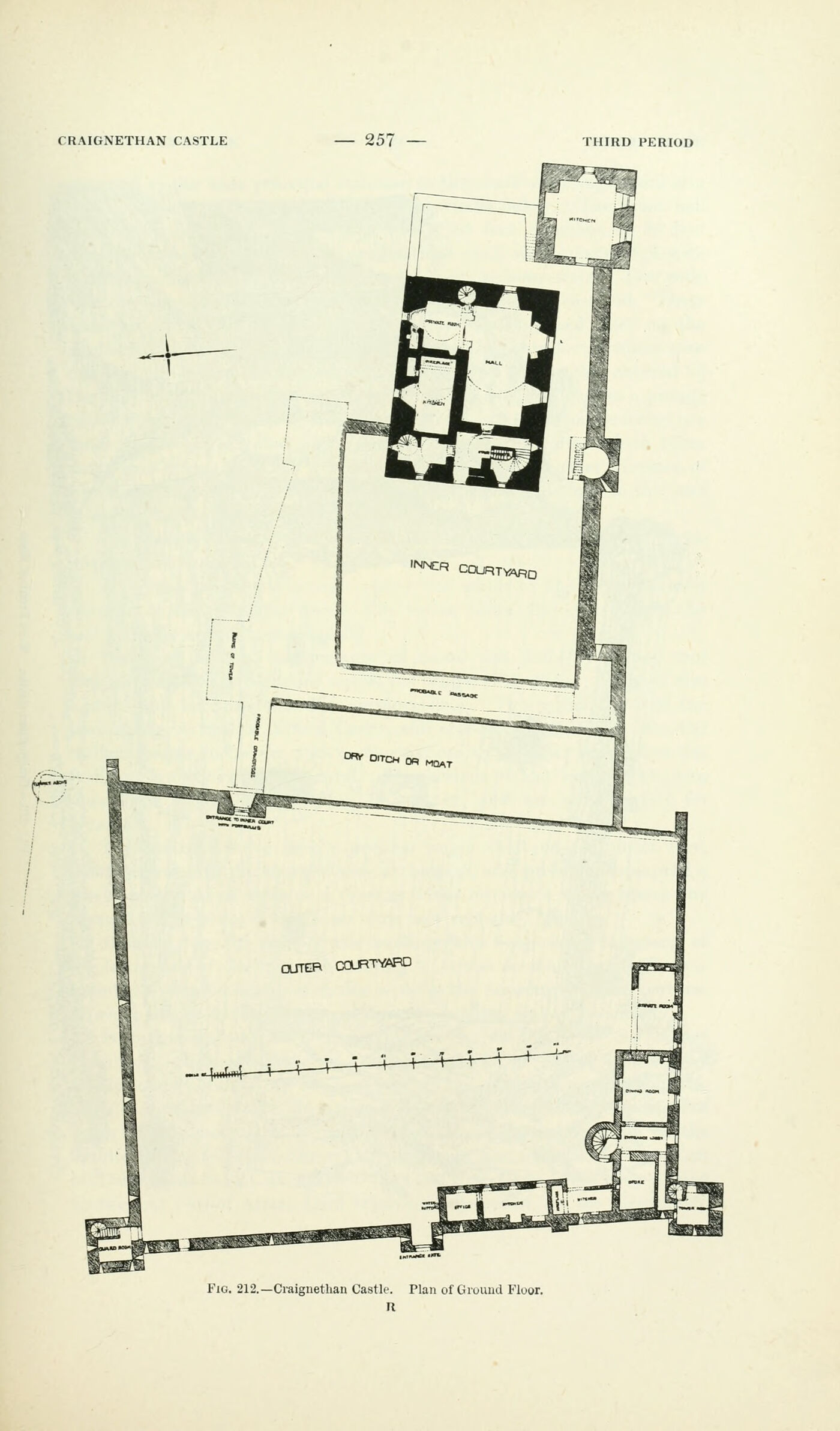
Fig. 212. Craignethan Castle. Plan of Ground Floor.
1887 · MacGibbon & Ross, Castellated and Domestic Architecture of Scotland, vol. 1 (1887)
Public domain
Nearby