Clan Hamilton
Dukes second only to the crown, and once heirs to it.
- Origin
- Glasgow & Strathclyde, Scotland
- Motto
- Through
- Famous bearer
- James Hamilton, 1st Duke of Hamilton (1606–1649)
- Register
- Scottish clan
Ranked of all time
The 10 Most Powerful Scottish Clans of All Time
The Hamilton arms, crest badge, tartan and country

Crest badgeClan member crest badge - Clan HamiltonCeltus · CC BY-SA 3.0 
TartanHamilton tartanMicheletb · CC BY-SA 4.0 
TartanHamilton Green Hunting tartanThe hunting sett: the same pattern in muted browns and greens, worn in the field where the brighter colours would show.Micheletb · CC BY-SA 4.0 
Coat of armsArms of HamiltonBorne by the Hamilton line, one branch of the name rather than all of it.Wikimandia · CC BY-SA 4.0 
Coat of armsArms of Hamilton of GrangeBorne by the Grange line, one branch of the name rather than all of it.Wikimandia · CC BY-SA 4.0


- Crest badge: The chief's crest inside a belt and buckle: the badge a clansman wears to show whose following he is in.
- Tartan: The checked cloth the family is known by.
- Coat of arms: Granted to an individual and inherited down that one documented line. These are the arms of particular families of the name, not of everyone who shares the surname.
What is the Hamilton clan tartan?
Two Hamilton setts are shown above, one of them the hunting sett, in muted browns and greens. They are not rival claims to be picked between; they are different records, and different weaves, of the same family cloth. A sett is the block of coloured bands the cloth is built from, repeated in both directions; the whole plaid is that one square enlarged.
Hamilton is a Lowland name, and Lowland families did not wear Highland dress; the 1746 proscription that broke the tradition in the north took nothing from them, because there was nothing there to take. The Hamilton sett is a 19th-century assignment, made when tartan stopped being Highland and became Scottish and fixed by the Bannockburn weavers’ pattern books, the royal visit to Edinburgh in 1822, and the Vestiarium Scoticum of 1842. Nobody polices any of it. Wearing the Hamilton sett declares allegiance to the name, not descent from any particular line of it.
The seat of Clan Hamilton
Seat vacantChief
No one leads the Clan Hamilton community yet. When the movement opens, you can stand for its leadership, or help elect whoever does.
Current mission
No shared goal set yet. Once Clan Hamilton has leadership, it sets the public focus: a restoration, a gathering, a real-world project that helps its own.
The Hamilton clan is being rebuilt. Join the waiting list for the movement today, and you help decide who leads it and what it does.
Help rebuild the Hamilton clan →Motto
Through
What does the Hamilton name mean?
Likely from a place name in Leicestershire (Hamel-dun) brought to Scotland in the 14th century. The Cadzow lands in Lanarkshire became the family's seat.
The history of Clan Hamilton
A witness at Paisley, and a name out of Hameldun
The first man of the name the records can hold is Walter fitz Gilbert of Hambledon, who appears about 1294 as a witness to a charter by James, High Steward of Scotland, in favour of the monks of Paisley. In 1296 his name is entered on the Homage Roll as Walter FitzGilbert of "Hameldone". Before him, in 1271, a Gilbert de Hameldun witnessed a charter confirming the gift of the church at Cragyn to Paisley Abbey; Gilbert married Isabella Randolph, daughter of Thomas Randolph of Strathdon, Chamberlain of Scotland, and his heir was Walter.
The name is a place name carried into Scotland, a Hamel-dun, and the family's oldest legend gives it a grand ancestry: descent from the House of Beaumont, a branch of which is said to have held the manor of Hamilton in Leicestershire, the three cinquefoils of the Hamilton shield offered as an echo of the single Beaumont cinquefoil. The case has been answered. That cinquefoil was borne by the Umfravilles of Northumberland too, who appear to have owned a place called Hamilton there, and the wardship of Gilbert de Umfraville, second Earl of Angus, passed about 1245 to Simon de Montfort, of Beaumont blood. That Gilbert may be all the legend ever rested on.
What made the name Scottish was not the etymology but the ground. Walter's lands appear to have lain originally in Renfrewshire, and the estate that became the family's own was Cadzow in Lanarkshire. The settlement was called Cadzow until 1455, when it was renamed in honour of James Hamilton, 1st Lord Hamilton. From that year the town, the family and the surname were one word.
Bothwell Castle, and what the Bruce paid for it
Walter fitz Gilbert held Bothwell Castle for the English crown during the First War of Scottish Independence. After Bannockburn in 1314 he gave refuge in it to the Earl of Hertford and other English escapees, then delivered both the fugitives and the castle to Edward Bruce. Robert the Bruce knighted him between 1315 and 1329 and granted him lands in Renfrewshire and the Lothians and Cadzow in Lanarkshire, Cadzow Castle with them, lands that had belonged to John Comyn. In 1323 Bruce also gave him Kinneil on the Forth, the family's principal seat in the east of Scotland thereafter.
His son Sir David fitz Walter, 2nd of Cadzow, kept faith with the next king. He fought for David II at the Battle of Neville's Cross in 1346, was captured there along with the king himself, and was not released until a substantial ransom had been paid. David's son, David Hamilton, 3rd of Cadzow (c.1333 to c.1392), was the first of the line to establish Hamilton as the family name. After him came Sir John Hamilton of Cadzow, 4th laird, dead before 1410, and James Hamilton of Cadzow, 5th laird, dead before 1441.
By the end of that century the house held ground on both sides of the country: Cadzow above the gorge of the Avon Water, Kinneil on the Forth, the Renfrewshire lands, and Preston in East Lothian, which came by marriage at the close of the fourteenth century and stayed with the family for three hundred years. Innerwick, on the edge of a precipitous glen above the Thornton Burn, was a stronghold of the Stewarts and of the Hamiltons; it was besieged in 1406 by Robert Stewart, Duke of Albany, to expel forces of the Earl of Northumberland, timber beams being bought for the assault.
Lord Hamilton marries a king's daughter
James Hamilton, 6th of Cadzow, was created a Lord of Parliament as Lord Hamilton on 3 July 1445. In early 1474 he married Mary Stewart, Countess of Arran, daughter of King James II and widow of Thomas Boyd, 1st Earl of Arran. He died in 1479.
His only legitimate son, James, 2nd Lord Hamilton (c.1475 to 1529), became a Privy Counsellor to James IV and helped arrange the king's marriage to Margaret, daughter of Henry VII of England. He was rewarded for it on 8 August 1503 with the earldom of Arran. The same year James IV granted Brodick Castle on the Isle of Arran to his uncle the 2nd Lord, beginning a hold on Arran that lasted until 1895. In July 1508 the king rode to Kinneil to see Lord Hamilton's horses.
The 1st Earl of Arran died at Kinneil in 1529. By then what his father's marriage had won was plain at court: the Hamiltons stood next in line to the Scottish crown.
Finnart's gunloops, and the Rough Wooing
Craignethan, raised above a bend in the River Nethan in the first half of the sixteenth century, is recognised as an excellent early example of sophisticated artillery fortification, in Iain MacIvor's words "the last private castle of high defensive capability built de novo in Scotland". The land was granted to the Hamiltons, and in 1530 James Hamilton, 1st Earl of Arran, gave it to his son James Hamilton of Finnart.
Finnart, who died in 1540, was a military engineer and architect, and the family's building programme in those years is largely his. Around 1530 he built the present Cadzow Castle above the Avon gorge, on ground that later became the hunting and pleasure grounds of the Hamilton Palace estate. In 1534 he took Strathaven Castle, on its rocky and partly artificial mound above the Powmillon Burn, and expanded its buildings.
The defences were not built for ornament. In the war of the Rough Wooing, Preston Tower was burnt by the Earl of Hertford on 16 May 1544, in the days after the burning of Edinburgh. James Hamilton of Innerwick was captured by the English and held for ransom by Ralph Eure, and in September 1547 Innerwick Castle, extended several times by then, was captured and destroyed by Edward Seymour, 1st Duke of Somerset.
Regent of Scotland, and a duke in France
James Hamilton, 2nd Earl of Arran (1515 to 1575), was Regent of Scotland between 1542 and 1554 and guardian of Mary, Queen of Scots, while she was still a child. He was heir to the throne, and he knew what that was worth: he proposed to marry his son to the young queen in order to secure the claim. The royal marriage never took place. Mary married the heir to the French throne instead, and Arran, who had figured prominently in the negotiations, was created Duc de Chatellerault in the peerage of France in 1548.
The French dukedom was forfeited in 1559 when he changed allegiance. In 1561 he was sent into exile for five years for openly opposing Mary's marriage to Henry Stuart, Lord Darnley. Napoleon III confirmed the Chatellerault title for the 12th Duke of Hamilton in the nineteenth century, though the legal effect of that confirmation is doubtful. It was in these years that Friar Mark Hamilton, a Scottish Dominican, wrote a history of the family.
His son James, 3rd Earl of Arran, was proposed as a husband for Queen Elizabeth I of England in 1561, which is the measure of how the Hamilton claim was read abroad. In 1562 the Earl of Bothwell came to Kinneil to make his peace with him, and a few days later, on Easter Day, the 3rd Earl went out of his bedchamber window using sheets as a rope. He was confined at Cadzow in April 1566 after four years in Edinburgh Castle. He resigned the earldom in 1581; in 1586 the Court of Session set the resignation aside and his honours were restored. He died in 1609.
The queen's party, and the wreck of Cadzow
The Hamiltons were the hard core of the party that stood by Mary, and it cost them their houses. The 2nd Earl was forced to surrender both Craignethan and Cadzow in 1565 after opposing the queen's marriage to Darnley. His son Lord Claud Hamilton is said to have entertained her at Craignethan on the night before the Battle of Langside in 1568. In the Marian civil war that followed, the family withdrew to Craignethan, whose weakness the Earl of Sussex had been told of plainly: "situate in a hole, so that it is commanded on every part". Lord Sempill was imprisoned there in 1570.
Retaliation fell on Cadzow. Forces of the Earl of Mar, regent for the young James VI, destroyed the castle in the late sixteenth century, and it was never a residence again. It was partially rebuilt in the eighteenth century as a folly in the duke's park, and the ruin stands today in Chatelherault Country Park, best seen from the Duke's Bridge across the Avon gorge. Craignethan was partially slighted in the late sixteenth century, though its keep, corner towers and outer court remain legible.
Men of the name served the queen in the ranks too: Alexander Hamilton of Innerwick, who appears in 1568, and Alexander Hamilton of Mirretoun, who died in 1579, both fought for Mary. The name held much of the Scottish church in the same century, John Hamilton, Archbishop of St Andrews (1512 to 1571), and James Hamilton, Bishop of Argyll, who died in 1580, among them. Against that establishment stands Patrick Hamilton (1504 to 1528), son of Patrick Hamilton of Kincavil, the proto-Reformation martyr at St Andrews.
The marquessate of 1599 and the dukedom of 1643
John Hamilton, who died in 1604, was appointed to administer the estates of his elder brother the 3rd Earl, and on 17 April 1599 was created Marquess of Hamilton, Earl of Arran and Lord Aven. Claud Hamilton (1546 to 1621) was created Lord Paisley in 1587 and later Lord Abercorn, and that branch prospered on its own account, advanced to an earldom and eventually, in 1868, to a dukedom. The name also rose through the law: Thomas Hamilton, 1st Earl of Haddington (1563 to 1637), Lord Advocate and judge, bought Barnbougle on the Firth of Forth from the Mowbrays in 1615.
James, 2nd Marquess of Hamilton (1589 to 1625), moved to England with James VI. He invested in the Somers Isles Company, an offshoot of the Virginia Company, and the parish of Hamilton in the Somers Isles, now Bermuda, is named for him. He succeeded as 4th Earl of Arran in 1609 and was created Earl of Cambridge and Baron Innerdale in the peerage of England on 16 June 1619. He served as Lord Chancellor of Scotland and was made keeper of both of the strategic royal castles, Edinburgh and Stirling.
His son James, 3rd Marquess, was a staunch supporter of Charles I, and on 12 April 1643 the king created him Duke of Hamilton, Marquess of Clydesdale, Earl of Arran and Cambridge, and Lord Aven and Innerdale. It is the senior dukedom in the peerage of Scotland apart from Rothesay, which the sovereign's eldest son holds, so the duke of Hamilton is premier peer of Scotland. The letters patent carried a special remainder that would matter more than anyone expected: to the grantee's heirs male, failing them to his brother's, and failing them to his eldest daughter and her heirs male.
Preston, Worcester, and the duchess who held it together
The 1st Duke led a royalist army into England and was defeated at the Battle of Preston in 1648 by Oliver Cromwell's Parliamentarians. He was executed at Whitehall in 1649, shortly before his king met the same fate. His brother William, 2nd Duke, created Earl of Lanark in 1639, was a brave soldier and was killed at the Battle of Worcester in 1651. The 1st Duke's son Charles, styled Earl of Arran, had died in childhood in 1640, and with the 2nd Duke's death there were no further heirs in the immediate male line.
The special remainder of 1643 then did its work, and the dukedom went to Anne, 3rd Duchess of Hamilton (c.1631 to 1716), the 1st Duke's elder daughter. She was a woman of great intellect who inherited estates heavily burdened with debt, and her right to succeed was challenged by her kinsman the Earl of Abercorn. In 1656 she married William Douglas, 1st Earl of Selkirk; he took the surname Hamilton and on 20 September 1660 was created Duke of Hamilton for life. Between 1684 and 1701 the two of them commissioned the great rebuilding of Hamilton Palace, and on 9 July 1698 she resigned all her titles in favour of her eldest son.
The wars had fallen on the lesser branches too. Preston Tower was burnt by Cromwell in 1650, with the loss of the family records, and one of that house, Robert Hamilton of Preston (1650 to 1701), was among the leaders of the Covenanters and a commander at Drumclog and Bothwell Brig. A generation later the family stood against the Union: James, 4th Duke (1658 to 1712), led the anti-union party before the Acts of Union 1707, and John Hamilton, 2nd Lord Belhaven and Stenton (1656 to 1708), was one of its sharpest critics. The 4th Duke was created Duke of Brandon in 1711, and the two dukedoms have been held together since.
Killyleagh, Hagaby and the Palatinate
In 1602 the Gaelic chieftain Con O'Neill of Clandeboye owned large tracts of North Down, Killyleagh among them. The castle, parts of which date back to 1180, has been in Hamilton hands since the early seventeenth century. James Hamilton, 1st Viscount Claneboye (c.1560 to 1644), was the Ulster-Scot landowner and settler at the head of that venture. His son, the 1st Earl of Clanbrassil, built the second tower; the 2nd Earl rebuilt the castle in 1666, and it is mostly his that stands, re-encased in the manner of a Loire chateau by Sir Charles Lanyon in the mid-nineteenth century. It remains the home of Gawn Rowan Hamilton.
Others of the name took Ulster land and office as well: George Hamilton of Greenlaw and Roscrea, an undertaker in the Plantation of Ulster; Gustav Hamilton, governor of Enniskillen, who died in 1691; and Gustavus Hamilton, 1st Viscount Boyne (1642 to 1723), soldier and politician. The Abercorn title began with James Hamilton, 1st Earl of Abercorn (1575 to 1618), a Scottish diplomat; the 1st Duke of Abercorn (1811 to 1885) twice served as Lord Lieutenant of Ireland, and the 3rd Duke (1869 to 1953) was the first governor of Northern Ireland.
From Ulster the name went further. Malcolm Hamilton, Archbishop of Cashel, had a first son, Hugh Hamilton, 1st Viscount of Glenawly, who soldiered in Swedish service and was made baron of Deserf. The archbishop's younger son, Captain John Hamilton of Monea, sent his own sons Malcolm and Hugo into Swedish service in 1655; they were created barons of Hagaby in 1689, and the younger Malcolm's son Gustaf David Hamilton (1699 to 1788) was made a count in 1751 and field marshal in 1765. John Jack Hamilton, born at Dromore in Kirkcudbright on 13 August 1640, joined the Scots Brigade and is the progenitor of the Dutch Hamiltons; John James Hamilton (1642 to 1717) went to Germany after the Glorious Revolution and served Philip William, Elector Palatine, and the last of his descendants was Maximilian von Hamilton, Bishop of Olomouc (1714 to 1776).
The Grange in Ayrshire, and the boy from Nevis
The Cambuskeith branch descended from Walter de Hamilton, who held lands in Edinburgh by a charter from Robert III granted between 1390 and 1406. Their Ayrshire house was Kerelaw in Stevenston, an old stronghold sacked and burned in 1488 by the 2nd Lord Montgomerie in the long feud between the Montgomeries and the Cunninghames. It was bought in 1655 by an Alexander Hamilton, who renamed it Grange. Three ruined walls of it survive, fenced off, at Stevenston.
James Alexander Hamilton was born in Ayrshire in 1718, fourth son of Laird Alexander Hamilton of Grange; his mother, Elizabeth Pollock, was the eldest daughter of Sir Robert Pollock, 1st Baronet of Pollock. With little prospect of an inheritance in Scotland he went out to the West Indies to be a merchant on the island of Saint Kitts. He and Rachel Faucette became the parents of Alexander Hamilton, born about 1755 on Nevis, and of an elder brother, James.
What the younger son had was his mind. As a teenage clerk in a trading house on St Croix he so impressed the local merchants and ministers that they raised a subscription to send him to North America to be educated; he reached New York about 1772, and the quarrel between the colonies and the crown took him at once. He raised an artillery company and served four years on George Washington's staff as his most trusted aide, and at the siege of Yorktown in October 1781 he led the night assault that took Redoubt Number Ten at bayonet point.
Peace turned him from soldier to founder. With James Madison and John Jay he wrote the Federalist Papers in defence of the new federal constitution, the majority of them himself, at speed, under a Roman pen-name; they are cited in the American courts still. As the first Secretary of the Treasury, from 1789, he had the federal government assume the war debts of the states, founded a national bank and built the revenue service from a blank sheet. His face is on the ten-dollar note.
Hamilton Palace, the coal beneath it, and Lennoxlove
From 1591 until the late nineteenth century the principal seat of the dukes was Hamilton Palace in Lanarkshire. The site had been in the family's possession since the thirteenth century, and a fourteenth-century tower house known as The Orchard, or the Castle of Hamilton, formed the core of the great rebuilding of the late 1500s, after which the house was called a palace. Alexander, 10th Duke, enlarged the north front after succeeding in 1819, and at its greatest extent, under the 10th and 11th dukes, it was one of the largest non-royal palaces in Europe.
The family's own coal destroyed it. The palace served as a convalescent hospital in the First World War, most of its contents and internal fittings were sold in late 1919 and the building itself in 1921, and it came down in stages between 1921 and 1932, after workings beneath it were found to have caused subsidence. The 13th Duke had built a shooting lodge at Dungavel near Strathaven in 1900 and made it his country seat in the late 1910s; the 14th Duke sold it to the National Coal Board in 1950. In 1946 he bought Lennoxlove House in East Lothian, and Lennoxlove is the seat of the dukes still.
Estates went out of the family in the same long retreat. William, 12th Duke, bequeathed Brodick Castle and its 102,000-acre estate, comprising most of the Isle of Arran, to his only child Lady Mary Hamilton in 1895. Lochranza, at the north end of Arran, had been Hamilton property by 1705, bought by the Duchess of Hamilton. Kinneil was saved from demolition only in 1936, when sixteenth-century mural paintings were found in its east wing.
The offices outlasted the houses. The duke of Hamilton and Brandon is hereditary keeper of the Palace of Holyroodhouse and, as Lord Abernethy, hereditary bearer of the Crown of Scotland: the 15th Duke bore it at the inauguration of the Scottish Parliament in 1999, the 16th at the State Opening of Parliament on 30 June 2011, and on 12 September 2022 the 16th Duke placed the crown upon the coffin of Queen Elizabeth II in St Giles' Cathedral.
Lairds, improvers, and the houses in between
Dalzell House on the north bank of the Clyde came to the family in 1645, when the Earl of Carnwath granted the estate to his nephew James Hamilton of Boggs, who added the south wing around 1649. The Lanarkshire coal boom enlarged the family's fortunes, and in the 1850s John Hamilton, a Liberal politician later ennobled as Baron Hamilton of Dalzell, commissioned a major remodelling by R. W. Billings; Gladstone, in whose government he served, visited on several occasions, and the Prince and Princess of Wales came in 1888.
In Ayrshire, Sundrum by the Water of Coyle passed from the Cathcarts to the Hamiltons about 1750 and was held until 1917, John Hamilton wrapping the medieval keep in a mansion in the 1790s. Redhouse in East Lothian came by the marriage of Jeane, daughter of John Layng, Keeper of the Signet, to Sir Andrew Hamilton in 1608; Sir Andrew, a Senator of the College of Justice who died in 1634, applied to the Scottish Parliament for the title Lord Redhouse. Duncraig, on Loch Carron, was bought in the 1920s by Sir Daniel Hamilton and his wife Margaret, who meant it for education in the local community and left it to the local council.
Quaternions, and what else the name made
William Rowan Hamilton was born at 36 Dominick Street in Dublin on 3 August 1805, fourth child of Archibald Hamilton, a Dublin solicitor, and Sarah Hutton. He was raised from the age of three by his uncle James Hamilton, curate of Trim in County Meath and a phenomenal linguist, under whom he had Latin, Greek and Hebrew by ten and Persian, Arabic and Sanskrit by thirteen. He took every undergraduate prize at Trinity College Dublin, and on 16 June 1827, before he had taken his degree, was elected Royal Astronomer of Ireland. He was knighted in 1835.
On the afternoon of Monday 16 October 1843, walking the Royal Canal towpath from the Dunsink Observatory into Dublin with his wife Helen, the problem he had worked at for thirteen years resolved itself in his head: a four-dimensional algebra of one real and three imaginary components, obtained by abandoning the rule that ab equals ba. He stopped at the Brougham Bridge and cut the equation into the stonework with his pen-knife. Quaternions were the first non-commutative number system in mathematics; every three-dimensional rotation calculated today in computer graphics, robotics and spacecraft attitude control runs on them.
His other great work was quieter and reached further. The two papers On a General Method in Dynamics, in the Philosophical Transactions of the Royal Society for 1834 and 1835, rewrote the equations of classical motion around a single function, the total energy of a system in position and momentum variables. Their full weight became clear about seventy years later, when Schrodinger, Heisenberg and Dirac built the foundational equations of quantum mechanics on the Hamiltonian between 1925 and 1928. He was President of the Royal Irish Academy from 1837 to 1846 and died at Dunsink on 2 September 1865.
The name did a great deal else. It built: David Hamilton (1768 to 1843) and Thomas Hamilton (1784 to 1858) were Scottish architects. It wrote: Janet Hamilton (1795 to 1873), the Scottish poet, and Elizabeth Hamilton (1756 or 1758 to 1816), the Scottish writer. It founded things: Alexander Hamilton (1739 to 1802) was a co-founder of the Royal Society of Edinburgh, James Stevenson-Hamilton (1867 to 1957) the founder of the Kruger National Park in South Africa, and George Hamilton (1788 to 1836) the founder of Hamilton in Ontario, while Hamilton in New Zealand is named for the naval officer John Fane Charles Hamilton (1829 to 1864). Ian Hamilton QC (1925 to 2022) was the Scottish advocate who recovered the Stone of Destiny.
How much of all this is one family is now a matter of evidence as well as tradition. The Hamilton DNA Project, with hundreds of participants including a close relative of the current Duke of Abercorn, has shown that the branches descending from Sir James Hamilton, 5th Laird of Cadzow, progenitor of both the Abercorn and the Hamilton ducal lines, share the Y-DNA haplogroup I-Z63, pointing to a common ancestor who lived about 750 years ago.
Champions of the Hamilton name
The bearers whose lives are inseparable from this surname. Each has their own page, biography, achievements, geography, connection to the family.
- Alexander Hamilton
The orphan from Nevis of Scottish blood who stormed the last redoubt at Yorktown, wrote the great case for the American constitution, and built the financial system of the new republic out of nothing.
- Sir William Rowan Hamilton
The Dublin-born Royal Astronomer of Ireland whose 1834 to 1835 papers on Hamiltonian mechanics reframed the foundations of classical physics, and whose discovery of the quaternion algebra on the Brougham Bridge over the Royal Canal on the sixteenth of October 1843 founded modern algebraic non-commutative number systems and the mathematical foundations of three-dimensional rotation that today govern every computer-graphics, robotics and spacecraft-attitude calculation.
Castles the Hamilton held
Strongholds this name held for a decade or more, look one up, or rebuild it to explore.
- Duncraig Castle
Held by Sir Daniel and Margaret Hamilton from the 1920s; Margaret bequeathed it to the local council after the Second World War.
- Killyleagh Castle
Owned by the Hamilton family since the early 17th century; still home to Gawn Rowan Hamilton.
- Cadzow Castle
Granted by Robert the Bruce to Walter FitzGilbert, first Baron of Cadzow and ancestor of the dukes of Hamilton; the present castle was built c.1530 by Sir James Hamilton of Finnart.
- Barnbougle Castle
Held 1615–1662, from Sir Thomas Hamilton, afterwards Earl of Haddington, to his grandson.
- Kinneil House
Held by the Hamiltons from Robert the Bruce's grant of 1323; their principal seat in the east of Scotland.
- Kerelaw Castle
Purchased in 1655 by Alexander Hamilton, grandfather of the American founding father, who renamed it Grange.
- Sundrum Castle
Hamilton possession from the mid-18th century until 1917; they built the mansion around the keep in the 1790s.
- Dalzell House
Held by the Hamiltons from the 1645 grant to James Hamilton of Boggs until 1952.
- Lochranza Castle
Property of the Hamiltons by 1705, purchased by the Duchess of Hamilton.
- Craignethan Castle
Granted to the Hamiltons; given in 1530 by the 1st Earl of Arran to James Hamilton of Finnart, and held by the family through the Marian civil wars.
- Kames Castle
Bought around 1810 by James Hamilton WS (1775–1849).
- Barr Castle
Held by the Hamiltons of Ferguslie from 1629 until sold in the late 18th century.
- Belle Isle Castle
Bought in 1991 by the 5th Duke of Abercorn for his youngest son, Lord Nicholas Hamilton.
- Strathaven Castle
Sir James Hamilton of Finnart held and expanded it from 1534; sold in 1611 to James, Marquis of Hamilton, whose duchess was its last occupant.
- Preston Tower
Held by the Hamiltons from the close of the 14th century; forfeited 1684, recovered in the 19th century.
- Innerwick Castle
A stronghold of the Hamiltons; James Hamilton of Innerwick was captured by the English during the Rough Wooing.
- Redhouse Castle
Sir Andrew Hamilton, styled Lord Redhouse, became owner on John Layng's death, having married Layng's daughter Jeane in 1608.
Landmarks the Hamilton held
Palaces, houses and great buildings tied to this name, look one up, or rebuild it to explore.
- Holyrood Palace
Hereditary Keepers of the palace since 1646, when the office was conferred on James Hamilton, 1st Duke of Hamilton and his descendants.
The castles of the homeland
The great strongholds of the homeland, look one up, see what it looked like in its prime, and recreate it to explore.
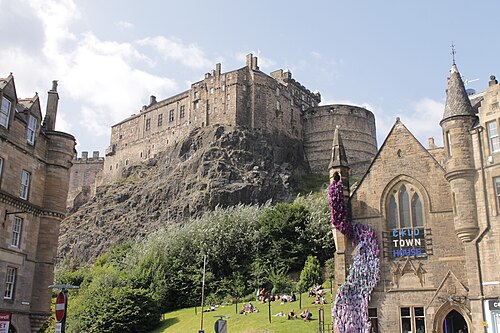 Edinburgh CastleRestored · prime 1520
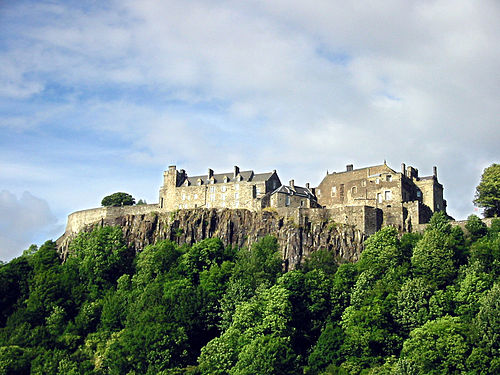 Stirling CastleRestored · prime 1542
 Glamis CastleStill standing · prime 1900
All castles in Scotland → · Strongest castles in Scotland → · Castles of Europe
Play As Your Clan
Hold a real castle against whatever you choose to send at it, take a ship out in her own service years, or stand at the shoulder of someone the record remembers. The chronicler sets the scene; the deeds are yours.
Notable bearers of the Hamilton name
- James Hamilton, 1st Duke of Hamilton (1606–1649)
- Patrick Hamilton (c.1504–1528), proto-Reformation martyr at St Andrews
- Alexander Hamilton (1755/57–1804), American Founding Father, first Secretary of the Treasury
- Ian Hamilton, QC (1925–2022), recoverer of the Stone of Destiny
Stories of Clan Hamilton
Patrick Hamilton at St Andrews
1528Patrick Hamilton, son of Sir Patrick Hamilton of Kincavel and Catherine Stewart (granddaughter of James II), was twenty-three or twenty-four years old when he was condemned for heresy at St Andrews on the twenty-eighth of February 1528, in a court convened by James Beaton, Archbishop of St Andrews. He had been to Paris and to Marburg and had read Luther; he had returned to Scotland in 1526 and had taught the new doctrines openly. The court found him guilty in the morning. He was burnt at the stake at the gate of St Salvator's College that same afternoon. The wood was wet, the wind was off the sea, the executioner had to be sent to the priory for more powder. The fire took six hours to consume him. Knox, writing his History thirty-eight years later, gave the phrase: the reek of Master Patrick Hamilton has infected as many as it blew upon. The Scottish Reformation, by the careful judgment of every later historian of it, has its first and longest fuse here.
Read the story →
Alexander Hamilton at Redoubt 10, Yorktown
1781On the night of the fourteenth of October 1781, Lieutenant Colonel Alexander Hamilton, twenty-six years old, aide-de-camp to General Washington and former officer of the New York Artillery, led the bayonet assault of the American light infantry on Redoubt 10, the British outer earthwork on the south-eastern flank of the besieged works at Yorktown. The French light infantry under Lieutenant Colonel de Deux-Ponts went in simultaneously against Redoubt 9 four hundred yards to the north. The orders to the American attacking column were that the muskets were to be unloaded, the bayonet alone was to do the work, and the column was to go in silently. They reached the abatis at fifteen minutes after seven and were inside the redoubt by ten minutes past. Nine American dead, twenty-five wounded. The British defenders, Captain Campbell of the Forty-Third Foot and seventy men, surrendered in ten minutes. The fall of the two redoubts placed Cornwallis's inner works under direct allied artillery enfilade. He asked for terms three days later. The British army of the South capitulated on the nineteenth. The American Revolution was, in operational terms, won at Yorktown by the assault on Redoubts 9 and 10 on the night of the fourteenth.
Read the story →
Alexander Hamilton and Aaron Burr at Weehawken
1804By the spring of 1804 Aaron Burr, Vice President of the United States, had been politically blocked at every turn by Alexander Hamilton's correspondence and was running for the governorship of New York with no chance of winning. After a public letter quoted Hamilton as having spoken of him with what was glossed as a "more despicable opinion", Burr demanded retraction. Hamilton refused. They met on the duelling-ground at Weehawken on the cliffs above the Hudson on the morning of the eleventh of July 1804. Hamilton, by his published note left with his counsel the night before, had decided to throw away his fire and discharge the pistol harmlessly. Burr, who knew nothing of this, took an aimed shot. The ball entered Hamilton's right side just above the iliac crest, fractured the second lumbar vertebra and lodged in the spine; he died at two o'clock the following afternoon at the home of his friend William Bayard on Greenwich Street, Manhattan. He was forty-seven years old. The duel ended Burr's political career and made Hamilton, in death, the founding figure of the financial system of the United States.
Read the story →
Ian Hamilton and the Stone of Scone
1950Just before five in the morning of the twenty-fifth of December 1950, four students of the University of Glasgow, Ian Hamilton (24), Gavin Vernon (24), Kay Matheson (22) and Alan Stuart (24), removed the Stone of Destiny, the inauguration stone of the kings of Scots taken to Westminster Abbey by Edward I in 1296, from beneath the Coronation Chair in the abbey. They broke the stone into two pieces in the lifting. They drove the larger piece north in a Ford Anglia by way of Kent, the smaller in a separate car by way of Birmingham. They had it repaired by a Glasgow stonemason, James Robert Gray, of Bath Street, and laid it on the high altar of Arbroath Abbey, where the Declaration of Arbroath had been signed in 1320, on the eleventh of April 1951. The Government of the day, on the advice of the Scottish Office, did not prosecute; the Stone was returned to Westminster, and in 1996 was formally returned to Scotland and is now in the Castle at Edinburgh. Ian Hamilton, who became a leading Scottish QC, said in his old age that he had done it because Scotland needed to know the Stone was not unliftable.
Read the story →