Scotland · Restored
Dalzell House
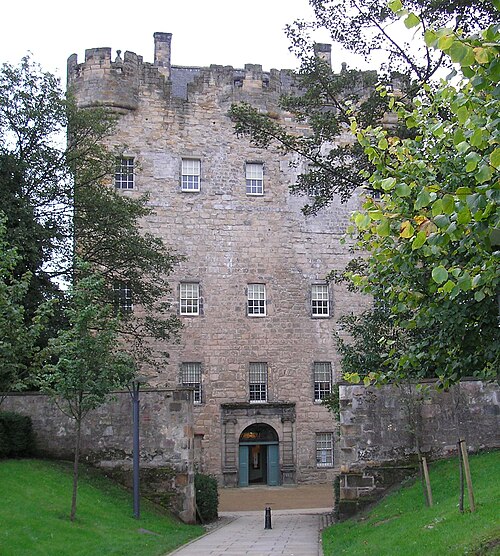
Dalzell House is a historic fortified house in Motherwell, North Lanarkshire, Scotland, with a 15th-century tower house at its core and substantial 17th- and 19th-century additions. The building was remodelled in the mid-19th century by R. W. Billings and retains Jacobean interior detailing; in the 1980s it was restored and converted into private apartments. The surrounding Dalzell estate lies on the north bank of the River Clyde and is managed as designed grounds.
Its prime
1888
Today
Restored
As it stood in 1888
What Dalzell House looked like in its prime.
A broad, asymmetrical sandstone house combining a squat 15th-century tower core with later gabled ranges and two prominent round corner turrets topped by conical slate roofs. A low crenellated ashlar curtain wall and arched entrance define the forecourt; the central block shows a warm red sandstone face with a stepped gable and tall, rectangular mullioned windows. Multiple tall stone chimneys and crow-stepped gables punctuate a complex roofline, set within mature planted grounds on the north bank of the River Clyde.
Its story
The story of Dalzell House.
The Dalzells, Bannockburn and the Earldom of Carnwath, 1314-1639
The Dalzell family acquired these lands on the north bank of the Clyde, south of Motherwell, in the thirteenth century, and at the core of the house stands the tower house they built in the fifteenth or early sixteenth century. Thomas de Dalzell fought at the Battle of Bannockburn in 1314. Sir Robert Dalzell forfeited the lands around 1342 for residing in England without the King's consent, but they were restored to the family through marriage in the fifteenth century. Another Sir Robert Dalzell was created Lord Dalzell in 1628, and his son was further elevated as Earl of Carnwath in 1639.
The Hamiltons of Boggs and the Orbiston Settlement
In 1645 the Earl of Carnwath granted the Dalzell estate to his nephew James Hamilton of Boggs, who built the first major extensions to the tower house, adding the south wing around 1649. By 1750 avenues of trees had been laid out in the grounds, probably the work of Archibald Hamilton, 4th of Dalzell. The seventh Hamilton laird, another Archibald Hamilton, entered a venture with the reformer Robert Owen. An attempt was made to build a model settlement at the Hamiltons' nearby property of Orbiston, but this proved an expensive failure.
Billings Remodels Dalzell and the Royal Visit of 1888
In the nineteenth century the family's fortunes were enhanced by the Lanarkshire coal mining boom, and in the 1850s John Hamilton (1829-1900), a Liberal politician later ennobled as Baron Hamilton of Dalzell, commissioned a major remodelling of the house. The architect Robert William Billings carried out extensive restorations to the earlier buildings and added a new north wing. He had recently published The Baronial and Ecclesiastical Antiquities of Scotland (1852), four volumes of engravings of Scottish architecture, and he drew heavily on that source material in his work at Dalzell; he lived at Dalzell for three years while overseeing the works. Andrew Cassels, a local man, undertook work on the gardens and grounds, possibly supervised by Billings. The south wing was also restored in 1869, following a fire.
Lord Hamilton served in the government of William Gladstone, who visited Dalzell on several occasions, and the Prince and Princess of Wales visited in 1888.
From Boarding School to Eighteen Apartments
On the death of the 2nd Baron in 1952 the property was sold out of the Hamilton family. Part of it was used as Gresham House Boys' Boarding School from 1954 until 1967, when it was purchased by Motherwell and Wishaw Town Council. The house then stood empty until the 1980s, when the developer Classical House renovated it as a series of eighteen private apartments; the interiors retain Billings' Jacobean detailing. The house was listed at Category A on 28 January 1971, the surrounding Dalzell estate is owned by North Lanarkshire Council, and the grounds are listed on the Inventory of Gardens and Designed Landscapes in Scotland.
Step inside
9 places to explore in 1888.
The record describes 9 distinct spots at Dalzell House, including 1 interior: jacobean interiors and detailing. Create your own photoreal reconstruction and explore every one, more scenes means more rooms, more angles, and more of the place to stand in.
Build Your Own Castle
Recreate Dalzell House with AI to explore it.
The artist rebuilds it as it stood in 1888, a photoreal reconstruction that belongs to you alone. Pay with coins, no subscription needed.
Recreate this castle →Defend this castle →Whose castle
Clans who held Dalzell House.
The families that held Dalzell House for a decade or more across its history, follow a name to its clan.
Nearby