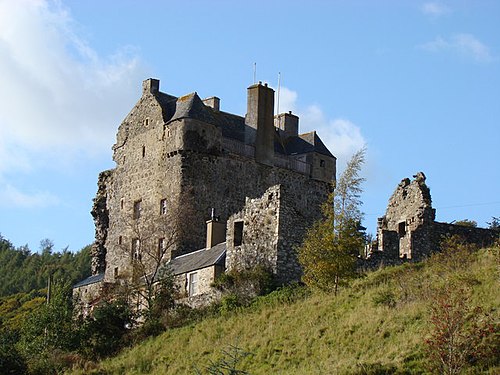
Scotland · Restored
Kinneil House
Kinneil House is a historic house near Bo'ness in east-central Scotland, built as a symmetrical 1677 mansion on the remains of an earlier 15th–16th century tower house. The mid-16th-century east wing contains significant painted interiors and some earlier defensive features such as wide-mouthed gunloops. The property is in the care of Historic Environment Scotland and stands within a public park that also contains remains of the Antonine Wall.
Its prime
1677
Today
Restored
As it stood in 1677
What Kinneil House looked like in its prime.
A symmetrical rectangular stone mansion of the 1677 rebuild with a flat balustraded parapet and a central, regular façade punctured by vertical rows of tall sash windows, flanked by projecting end pavilions and stone stair pavilions. The ashlar walls sit on the older tower core whose lower courses show two rows of wide-mouthed gunloops for early cannon. A straight gravel drive runs between paired stone gate piers onto a broad lawn, with stone chimneys and steep slate roofs breaking the skyline.
Its story
The story of Kinneil House.
Bruce's Grant to the Death of the First Earl, 1323-1529
Robert the Bruce granted the lands of Kinneil, with Larbert and Auldcathy, to Walter Fitz Gilbert, an ancestor of the Hamiltons, in 1323. A charter of 1474 names the castle of "Kynneil called Craig Lyown", along with saltpans; that earlier castle may have stood near the shore at Snab Brae. There was a deer park here by 1503, and James IV came in July 1508 to see Lord Hamilton's horses. James Hamilton, 1st Earl of Arran, died at Kinneil in 1529, though he asked to be buried at Hamilton.
Regent Arran's Palace and the Painted Rooms, 1548-1553
The surviving east wing, and perhaps the earlier tower with its wide-mouthed gunloops for early cannon, was built by James Hamilton, 2nd Earl of Arran, Governor of Scotland after the death of James V. Coal went from Kinneil to Leith for Edinburgh Castle; timber came back by boat in 1549 and 1550 for roofing, floors and panelling. In September 1553 Arran gave 44 shillings to the masons laying the foundation stones of another part of the palace.
Two rooms in the east wing keep their 16th-century painted decoration: the vaulted Arbour Room, imitating verdure tapestry with vignettes, and a second with scenes of the Good Samaritan, Lucretia and Mary Magdalene. The painter's name seems not to have been recorded. The scheme carries Arran's ducal coronet and the collar of the Order of Saint Michael, French honours of 1548; an armorial stone bears the Hamilton cry "Through!" and the motto of his wife Margaret Douglas, "Lock Sickar".
The French Burning and the Escape from the Window, 1560-1562
The house stood empty on 4 February 1560 when French troops led by d'Oysel attacked and burnt it. Two years later James Hepburn, Earl of Bothwell, came to Kinneil to make his peace with James Hamilton, 3rd Earl of Arran, and was said to have proposed that they seize Mary, Queen of Scots and kill her half-brother Lord James Stewart. On Easter Day, 29 March 1562, Arran, who suffered from mental ill health, got away from his worried father through a high window on a rope of sheets and made his way to Falkland to tell the queen of the plot. After the Battle of Corrichie that October, his father the Duke of Châtellerault was the reluctant keeper of George Gordon, forfeited heir of the Earl of Huntly.
Gunpowder, Forfeiture and the King's Christmas Court, 1570-1588
In May 1570, after the assassination of Regent Moray at Linlithgow by a Hamilton, Regent Lennox damaged the house with gunpowder and spoiled its lands, helped by an English force under William Drury. James VI reduced the power of the Hamiltons by military force in 1579, and in 1581 gave their estates and titles to James Stewart; for a time Kinneil was called Arran House, and after Stewart's fall in the autumn of 1585 he remained there under house arrest.
In May 1582 the king received Signor Paul, an envoy of the Duke of Guise bearing horses and gunpowder and known to have been involved in the St Bartholomew's Day massacre; some accounts put that reception at Dalkeith. In April 1584 the captive Earl of Gowrie was brought to Kinneil and held five days before being taken to Stirling for trial and beheading. At Christmas 1588 James held court here as the guest of John Hamilton, Commendator of Arbroath, playing at the "maye" with his English courtier Roger Aston.
From Anne Cunningham to Historic Environment Scotland
The Arbour Room was redecorated about 1620 for James Hamilton, 2nd Marquess of Hamilton and his wife Anne Cunningham, almost certainly by Valentine Jenkin, painter of the Chapel Royal at Stirling. In October 1641 the Earl of Argyll, the Marquess of Hamilton and the Earl of Lanark fled here from Edinburgh during the conspiracy known as the Incident. Anne Cunningham had laboured to make the coal mines and salt pans profitable, and when she died in 1644 she left Kinneil to her son James, 1st Duke of Hamilton, urging him never to put it out of his own hand.
William Douglas, 3rd Duke of Hamilton, rebuilt the main house in 1677 with a uniform facade. Family use declined as income from the mines and the port increased. In the late 18th century Dr John Roebuck, founder of the Carron Iron Works, lived at Kinneil while James Watt worked at perfecting his steam engine, and from 1809 to 1828 the 9th Duke lent the house to the philosopher Dugald Stewart. The Hamiltons had abandoned it by 1936, and Bo'ness Town Council were demolishing it when Stanley Cursiter of the National Galleries of Scotland heard that wall paintings had been found; the Ministry of Works secured the painted wing. The Category A listed house is now in the care of Historic Environment Scotland, in a public park that also holds a stretch of the Antonine Wall and the only Antonine fortlet with visible remains.
Step inside
11 places to explore in 1677.
The record describes 11 distinct spots at Kinneil House, including 6 interiors: laich hall (entrance hall), grand stair to the dining room, dining room (principal chamber above laich hall) and more. Create your own photoreal reconstruction and explore every one, more scenes means more rooms, more angles, and more of the place to stand in.
Build Your Own Castle
Recreate Kinneil House with AI to explore it.
The artist rebuilds it as it stood in 1677, a photoreal reconstruction that belongs to you alone. Pay with coins, no subscription needed.
Recreate this castle →Defend this castle →Whose castle
Clans who held Kinneil House.
The families that held Kinneil House for a decade or more across its history, follow a name to its clan.
Held by the Hamiltons from Robert the Bruce's grant of 1323; their principal seat in the east of Scotland.
Nearby