Belle Isle Castle
Belle Isle Castle is an 18th-century stone country house on Belle Isle (Lough Erne) near Lisbellaw in County Fermanagh, Northern Ireland. Built around 1700 for the Gore family and enlarged through the 18th century, the house includes a gallery, an overlook tower, a courtyard and a grand banquet hall; its estate includes coach houses, cottages and designed gardens that reach the Lough Erne shore. The building is now restored and operates as a hotel and wedding venue.
Its prime
1800
Today
Restored
As it stood in 1800
What Belle Isle Castle looked like in its prime.
A stone-built 18th-century country house set on a small isle, with a central multi-bay main block joined to an attached overlook tower and range of lower service wings and cottages framing a courtyard. The roofline is varied with smaller outbuildings and coach houses to one side. Large floor-to-ceiling sash windows face the gardens, which extend down to the Lough Erne shore; the ensemble sits within laid-out 18th-century grounds and terraces and appears complete and occupied at its prime.
Its story
The story of Belle Isle Castle.
Belle Isle, in Gaelic times Ballymacmanus Island, or Senadh-Mic-Maghnusa, carries a house built around 1700 for the Gore family. Sir Ralph Gore's grandson, the 1st Earl of Ross, was born in it in 1725 and spent his life expanding it, adding cottages and a tower and, with the designer Thomas Wright, creating the garden that extends to the Lough Erne shore.
On Lord Ross's death in 1801 the castle passed to his only surviving child, Lady Mary Hardinge, wife of Sir Richard Hardinge, 1st Baronet. In 1830 the estate was sold for £68,000 to the Rev. John Grey Porter of Kilskeery, whose descendants held it until 1991, when the Porter descendant Miss Lavinia Baird sold it to the 5th Duke of Abercorn. A purchase made for his youngest son, Lord Nicholas Hamilton.
The restored house, gallery, overlook tower, courtyard and grand banquet hall, now operates as a hotel and wedding venue on a 470-acre estate near Lisbellaw. The Belle Isle Cookery School opened behind the castle in 2004, and since 2018 pine martens have been reintroduced on the grounds to help control the grey squirrel.
Step inside
10 places to explore in 1800.
The record describes 10 distinct spots at Belle Isle Castle, including 3 interiors: grand banquet hall, interior gallery, drawing room with floor-to-ceiling windows. Create your own photoreal reconstruction and explore every one, more scenes means more rooms, more angles, and more of the place to stand in.
Build Your Own Castle
Recreate Belle Isle Castle with AI to explore it.
The artist rebuilds it as it stood in 1800, a photoreal reconstruction that belongs to you alone. Pay with coins, no subscription needed.
Recreate this castle →Defend this castle →Whose castle
Clans who held Belle Isle Castle.
The families that held Belle Isle Castle for a decade or more across its history, follow a name to its clan.
Gore
Built c.1700 for the Gore family; the 1st Earl of Ross, Sir Ralph Gore's grandson, was born there in 1725 and held it until his death in 1801.
Hardinge
Held by Lady Mary Hardinge, wife of Sir Richard Hardinge, 1st Baronet, from 1801 until the 1830 sale.
Held by the Porters from the Rev. John Grey Porter's 1830 purchase until 1991.
Bought in 1991 by the 5th Duke of Abercorn for his youngest son, Lord Nicholas Hamilton.
From the archive
Belle Isle Castle on paper: the measured plan and period views.
The survey plan and photographs below are the ground truth this page's reconstructions are checked against, drawn and photographed while the castle was still a working garrison. Every image is public-domain or openly licensed, with its source named.
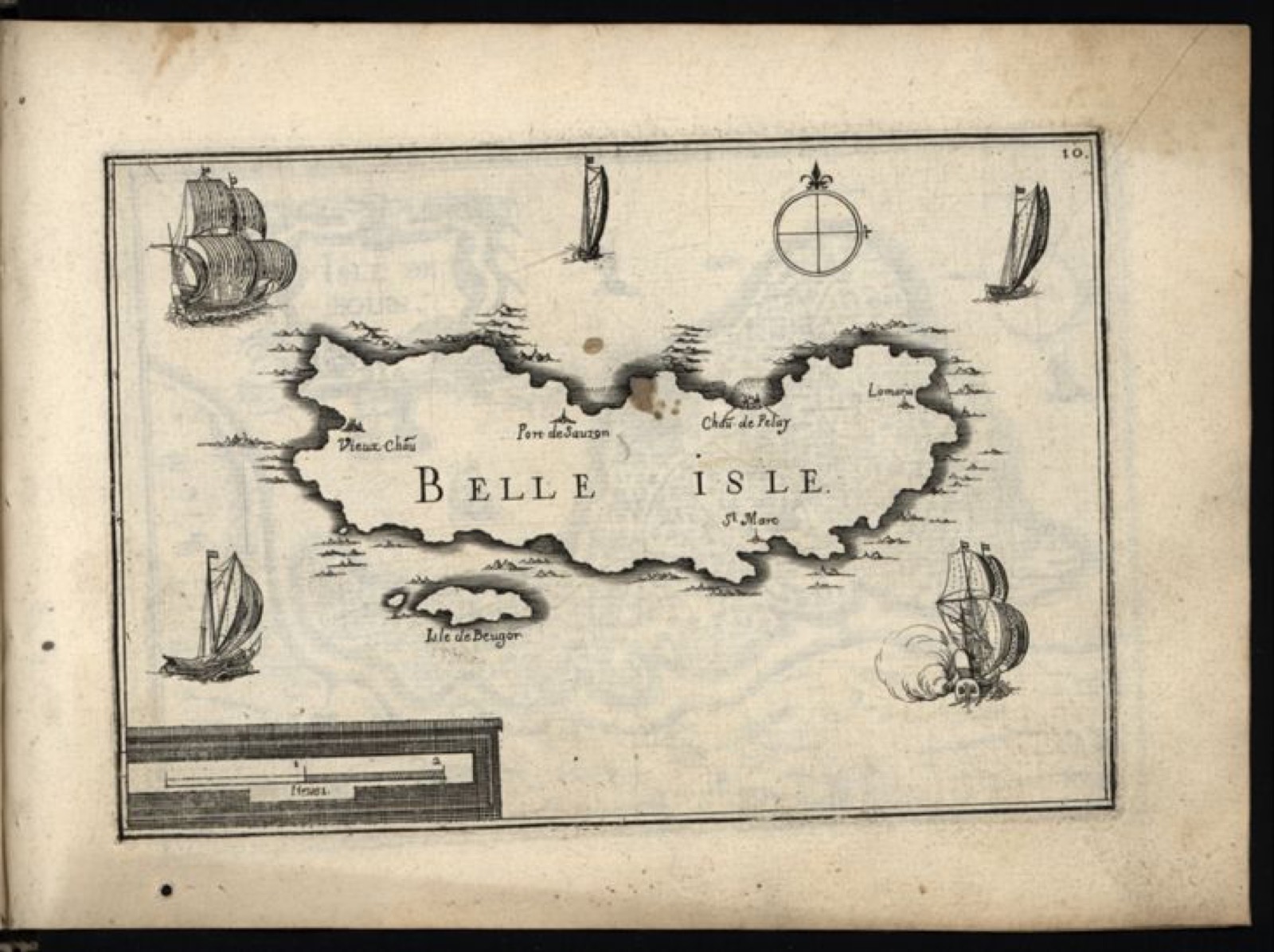
Belle Isle
1633 · Cartographic and Geological Institute of Catalonia (via Europeana)
Public domain


