Clan Douglas
One of the most powerful houses in medieval Scotland.
- Origin
- Glasgow & Strathclyde, Scotland
- Motto
- Jamais arrière
- Famous bearer
- 'Good Sir James' Douglas
- Register
- Scottish clan
Ranked of all time
The 10 Most Powerful Scottish Clans of All Time
The Douglas arms, crest badge, tartan and country

Crest badgeClan member crest badge - Clan DouglasCeltus · CC BY-SA 3.0 
TartanDouglas tartanSMcCandlish, made with the old Windows program Textile32 · CC0 
TartanDouglas tartan (Vestiarium Scoticum)As printed in the Vestiarium Scoticum, 1842, a collection whose claimed medieval source was never produced, and which is now generally held to be a forgery. Families adopted its patterns anyway, and wear them still.Celtus · CC BY 2.5 
Coat of armsDouglas crestTomasz Steifer, Gdansk · CC BY 2.5 
Coat of armsArms of the House of DouglasThe arms of the house itself: the main line, not one of its cadet branches.Euryrel · CC BY-SA 4.0


.png)


- Crest badge: The chief's crest inside a belt and buckle: the badge a clansman wears to show whose following he is in.
- Tartan: The checked cloth the family is known by.
- Coat of arms: Granted to an individual and inherited down that one documented line. These are the arms of particular families of the name, not of everyone who shares the surname.
What is the Douglas clan tartan?
Two Douglas setts are shown above, one of them the plate printed in the Vestiarium Scoticum in 1842. They are not rival claims to be picked between; they are different records, and different weaves, of the same family cloth. A sett is the block of coloured bands the cloth is built from, repeated in both directions; the whole plaid is that one square enlarged.
Douglas is a Lowland name, and Lowland families did not wear Highland dress; the 1746 proscription that broke the tradition in the north took nothing from them, because there was nothing there to take. The Douglas sett is a 19th-century assignment, made when tartan stopped being Highland and became Scottish and fixed by the Bannockburn weavers’ pattern books, the royal visit to Edinburgh in 1822, and the Vestiarium Scoticum of 1842. Nobody polices any of it. Wearing the Douglas sett declares allegiance to the name, not descent from any particular line of it.
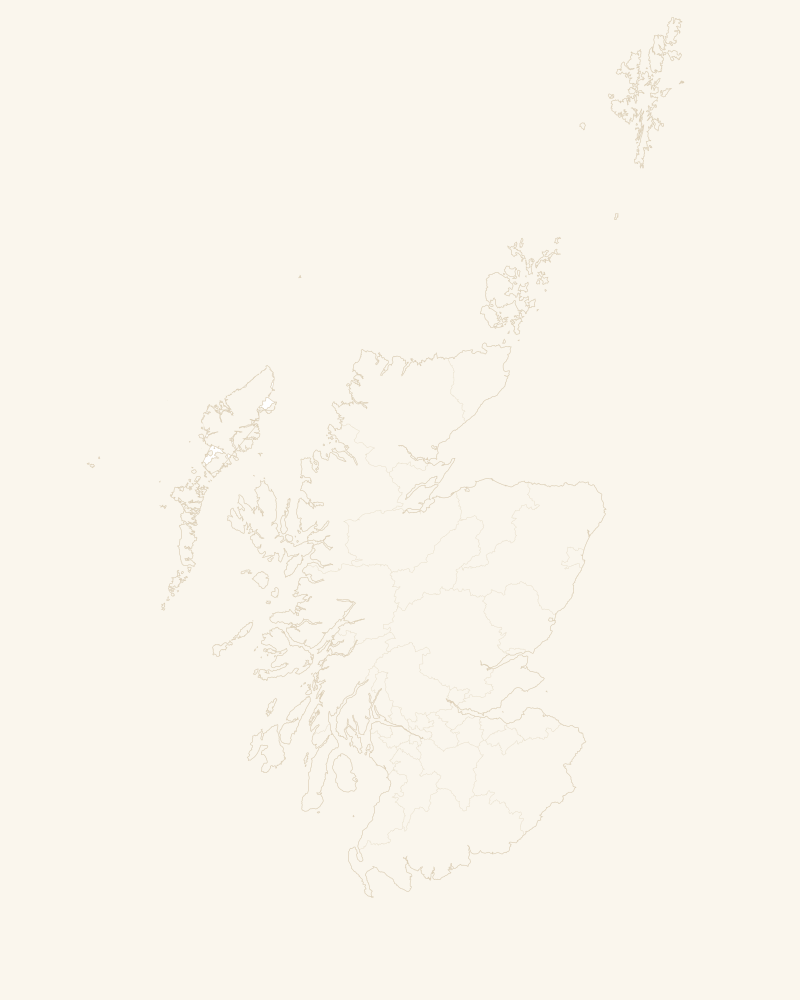
The seat of Clan Douglas
Seat vacantChief
No one leads the Clan Douglas community yet. When the movement opens, you can stand for its leadership, or help elect whoever does.
Current mission
No shared goal set yet. Once Clan Douglas has leadership, it sets the public focus: a restoration, a gathering, a real-world project that helps its own.
The Douglas clan is being rebuilt. Join the waiting list for the movement today, and you help decide who leads it and what it does.
Help rebuild the Douglas clan →Motto
Jamais arrière
“Never behind”
What does the Douglas name mean?
From Gaelic 'dubh ghlais', 'black water'. The first documented Douglas appears in 12th-century Morayshire.
The history of Clan Douglas
Black water: where the name comes from
Douglas is a place before it is a family. The name comes from the Gaelic elements dubh, "dark" or "black", and glas, "stream": the black water that runs through Douglasdale in Lanarkshire. That makes it a habitational surname: it belonged to whoever held that ground, and it spread outward from the ground rather than from a personal name. Scotland has a good many places called Douglas, but in most cases the surname points to one of them, Douglas in South Lanarkshire, the site of Douglas Castle and the original caput of the Lords of Douglas. The Gaelic form is Dùbhghlas, the Irish forms Dúghlas and Dubhghlas. Unusually for a Scottish surname, it also travelled back the other way and became a first name.
The first certain bearer is documented and unambiguous. In 1179 William Douglas was Lord of Douglas, and he witnessed a charter granted between 1175 and 1199 by the Bishop of Glasgow to the monks of Kelso. He is the earliest secure record of the name and, on the evidence, the ancestor of the whole house. His grandson, also Sir William de Douglas, had two sons who fought the Norsemen at the Battle of Largs in 1263. From that point the family is continuously in the record. Everything before 1179 is argued over.
The most serious of the arguments is the Flemish one. In 1147 a man recorded as Theobaldus Flammatius, Theobald the Fleming, received lands near Douglas Water in Lanarkshire in return for service to the Abbot of Kelso, who held the barony and lordship of Holydean, and he may well have been the father of the first William Douglas. The early Douglas family names include Arkenbald and Freskin, and Freskin is the name of the Flemish knight from whom Clan Murray descends, which is why some accounts place the earliest documented Douglas in twelfth-century Moray rather than Lanarkshire. The Flemish descent is genuinely disputed, though: others argue that the lands granted to Theobald were not the lands from which the Douglases later emerged.
The older stories are grander and weaker. One tradition makes the first chief a Sholto Douglas who helped a king of Scots win a battle in the year 767; it is unsubstantiated and most likely pseudohistory, as is the seventeenth-century claim of Frederic van Bossen that Douglas meant "gray hairs in the old language" and was first given to a Lord Shulton in the eighth century. One caution for readers tracing the name: the surname specialist George Fraser Black noted that in southern Argyllshire, Douglas is an anglicised form of MacLucas and MacLugash, from the Gaelic Mac Lùcais. Not every Douglas came from the black water.
Le Hardi, the Good Sir James, and the heart of Bruce
The Douglases enter national history on the losing side and refuse to stay there. Sir William Douglas, called le Hardi, Lord of Douglas (1243 – c. 1298), was governor of Berwick-upon-Tweed when the town and Berwick Castle were besieged by the English. He was captured, and released only after agreeing to accept the claim of Edward I of England to be overlord of Scotland. He then broke that agreement and joined William Wallace in the fight for Scottish independence. He was captured a second time, taken to England, and died in 1298 a prisoner in the Tower of London.
His son James ("the Good Sir James", born about 1286) was the first of the family to be called "the Black", and he is the reason the name still carries weight. He shared Robert the Bruce's early misfortunes, including the defeats at Methven and Dalrigh in 1306, and for both men those disasters were an education. Limitations in resources and equipment meant the Scots would always be at a disadvantage in conventional medieval warfare, and by the spring of 1307 they had learned the value of what was then called secret war: fast-moving, lightly equipped forces used against an enemy dependent on static defences. Buittle was given to Sir James in 1308. He took Roxburgh Castle back from the English in 1313, was made a knight banneret, and fought at Bannockburn in 1314.
He carries two names because two nations were describing the same man. John Barbour recounts that the English called him the Black Douglas for what they considered his dark deeds, and Sir Walter Scott records him as the bogeyman of a Northern English lullaby: "Hush ye, hush ye, little pet ye. Hush ye, hush ye, do not fret ye. The Black Douglas shall not get ye." Theories that the by-name described his colouring are tenuous. What is clear is that he is "the Black" only in English records; the Scots chronicles almost always call him the Guid, the Good. Later Douglas lords took up their forebear's by-name deliberately, in the same spirit in which they took Bruce's heart into their arms: to frighten enemies and advertise the prowess of their race.
Robert the Bruce asked that Douglas, latterly his most esteemed companion in arms, should carry his heart to the Holy Land as atonement for the murder of John III Comyn. In 1330 Douglas set out east with a company of Scots men-at-arms and joined the forces of Alfonso XI of Castile to fight the Moors of Granada at the siege of Teba. There Sir James was killed. The accounts vary and cannot be reconciled, but all of them show him either heavily outnumbered or entirely alone, fighting against overwhelming odds. The casket containing the heart of the Bruce was recovered and carried back to Scotland, to be interred at Melrose Abbey.
His own remains had a stranger journey. Douglas's bones were boiled and returned to Scotland, and tradition claims his embalmed heart was lodged in the Douglas vaults at the Kirk of St Bride at Douglas. His bones, however, are not in the stone vault beneath his effigy and have never been located. The lasting monument is heraldic. By 1333 King Robert's bloody heart had been taken into the arms of Sir James's son William, Lord of Douglas, and it went on to appear, sometimes beneath a royal crown, in every branch of the family.
Halidon Hill to Otterburn: the earldom made, the house divided
The generation after Teba was thinned out badly. The Scottish army that fought and lost the Battle of Halidon Hill in 1333 was led by Sir James's youngest brother, Sir Archibald Douglas, elected Regent of Scotland in late March of that year. Archibald has been badly used by some historians, who confuse him with a later and less fortunate Archibald nicknamed the Tyneman, the loser; the man himself is named in Barbour's The Brus for a real success in the Weardale campaign, leading the Scots south into County Durham and taking heavy booty from Darlington and the towns around it. He died at Halidon Hill, and William, Lord of Douglas, son of the Good Sir James, died there with his uncle.
What followed was a quiet legal tidying that produced an earldom. William may never have completed his title to the estates, possibly because he was underage. James's younger brother Hugh the Dull, a canon of the See of Glasgow, became Lord Douglas in 1342 and then resigned the title to his nephew, the youngest surviving son of the Regent Archibald, another William, who became the first Earl of Douglas. The earldom dates from 1358; the earldom of Wigtown had come to the family in 1341.
The first Earl's descendants split the house permanently, and the split was a matter of legitimacy. His legitimate son, James Douglas, succeeded as 2nd Earl of Douglas, and the family's prestige rose sharply when he married Isabel, a daughter of King Robert II. His illegitimate son, by Margaret Stewart, 3rd Countess of Angus, was George Douglas, 1st Earl of Angus, whose earldom dates from 1389 and who fathered the line later known as the Red Douglases. For the next seventy years the two branches were one family; after 1455 they were not.
The 2nd Earl's end is the most celebrated Douglas battle. At Otterburn in 1388 James Douglas was instrumental in the Scots' victory over an English army, and was killed in the fighting. He left no legitimate heir, and the titles passed sideways to the illegitimate son of his great-uncle: Archibald, called the Grim, who had already built a second power base in the south-west. Archibald raised Threave Castle in Galloway in the 1370s as Lord of Galloway, held Buittle from 1372, and brought Balvenie in Moray into the family, most likely through his marriage to Joanna Murray in 1362.
Duke of Touraine: the Black Douglases at their height
By 1400 the Black Douglases were not simply a great Scottish family; they were the most prominent house in lowland Scotland and very often the real power behind the throne of the Stewart kings. Archibald Douglas, 3rd Earl of Douglas, did much of the consolidating. He held Edinburgh Castle against Henry IV of England in 1400 and died the following year, leaving a territorial bloc running from Douglasdale through the Borders into Galloway, Moray and the Black Isle.
The castle list is the clearest statement of what that meant. Bothwell was a Black Douglas stronghold from 1362 to 1455 and Hermitage in Liddesdale was held from 1371 to 1492; Abercorn came to the family in 1400, Newark in Selkirk Forest was the 4th Earl's principal residence from about 1406, and Strathaven, Darnaway in Moray, Ormond on the Black Isle and Threave in Galloway were all Douglas. A king who wanted to move an army across southern Scotland moved it through Douglas country.
Archibald Douglas, 4th Earl of Douglas, married a daughter of Robert III and then spent his career on the largest stage available. He fought Henry IV at the Battle of Shrewsbury in 1403 and was taken prisoner there. In 1406, on the king's death, he became one of the council of regents ruling Scotland during the childhood of James I. In 1412 he was in Paris, where he entered a personal alliance with John the Fearless, Duke of Burgundy, and in 1423 he commanded a contingent of ten thousand Scots sent to the aid of Charles VII of France against the English.
France paid him in the highest coin it had. He was made lieutenant-general in Joan of Arc's French army and, on 19 April 1424, created Duke of Touraine with remainder to his heirs male: a Scottish earl holding a French duchy in his own right. It lasted four months. On 17 August 1424 the new duke was defeated and killed at the Battle of Verneuil, along with his second son James and his son-in-law John Stewart, Earl of Buchan. The family's dead lie scattered across the same map as its ambitions: the Kirk of St Bride at Douglas, Melrose Abbey and the Abbey of Saint-Germain-des-Prés in Paris hold the bones of many of the Earls of Douglas and of Angus.
The Black Dinner and the dagger at Stirling
On 24 November 1440 the sixteen-year-old William Douglas, 6th Earl of Douglas, and his younger brother David were invited to dine with the ten-year-old King James II of Scotland. The occasion, remembered ever since as the Black Dinner, was organised by Sir William Crichton, Lord Chancellor of Scotland, together with James Douglas, the uncle of the boys' late father, a man who stood to inherit the young Earl's wealth and titles. While they ate, a black bull's head, a symbol of death, was carried in and set before the Earl. Over the protests of the young king, the two brothers were dragged out to Castle Hill, given a mock trial, and beheaded.
The reckoning came fast and settled nothing. Clan Douglas laid siege to Edinburgh Castle; Crichton surrendered it to the king and was rewarded with the title Lord Crichton. Who else was ultimately responsible has never been established (Livingston and Buchan are both thought likely) but who benefited is not in doubt. The earldom went to that uncle, James Douglas, and from him to his son William, the 8th Earl. Two boys were killed to keep the Douglas inheritance inside the Douglas family.
The 8th Earl used what he inherited without restraint. The Douglases carried on a long feud with Clan Colville after Sir Richard Colville killed the Laird of Auchinleck, an ally of the house; they stormed the Colville castle, levelled it and put its men to the sword, and William, 8th Earl of Douglas, executed Richard Colville personally. In 1448 Hugh Douglas, Earl of Ormond, led a Scottish force to victory over an English army at the Battle of Sark. When the king's quarrel with the Black Douglases sharpened and the Gordons took the royal side, Archibald Douglas, Earl of Moray, sacked the Gordon lands and set Huntly Castle ablaze, and the Gordons came back and destroyed his people in their turn.
In 1452, after years of fruitless feuding, James II invited the 8th Earl to Stirling Castle under a promise of safe conduct. The king accused him of conspiracy: of dealings with the Yorkists in England, and of a pact made between Douglas, the Earl of Crawford and the Lord of the Isles. Douglas refused to repudiate the bond or reaffirm his loyalty. The king drew his dagger and stabbed him in the throat; the story goes that the King's Captain of the Guard finished him with a pole axe. The body was thrown from the window into the garden below. A stained glass window bearing the Douglas arms now overlooks the spot, still called Douglas Garden. A Scottish king had murdered his greatest subject under safe conduct, in his own castle, and kept his throne.
Arkinholm, 1455: the Douglases who destroyed the Douglases
The rebellion that answered Stirling was crushed by a Douglas. In 1455 James Douglas, 9th Earl of Douglas, rose against the king, and his forces were defeated at the Battle of Arkinholm by a royal army commanded by George Douglas, 4th Earl of Angus: the Red Douglas beating the Black. It ended the Black Douglases as a power in Scotland. An act of parliament afterwards gave the Earl of Angus the lordship of Douglas together with the original possessions of his ancestors in Douglasdale, so the ancient seat itself changed branches. The 9th Earl was beaten again, by the forces of James III, at the Battle of Lochmaben Fair in 1484.
What 1455 meant can be read off the map. James II captured and destroyed Abercorn Castle that year. Threave, Strathaven and Bothwell went out of Black Douglas hands; Darnaway was lost with the forfeiture of the Douglas Earls of Moray; the earldom of Ormonde, created only in 1445, was forfeited and regranted to the Earls of Angus. Douglas Castle in Lanarkshire, held since before 1288, was forfeited by the senior Black line and passed to the Red Douglas Earls of Angus. The crown had not weakened the name, though. It had only changed which Douglases held it.
The Red Douglases inherited both the position and its dangers. The earldom of Morton dates from 1458, granted with Morton Castle in Nithsdale to James Douglas of Dalkeith; Crawford was held by the Angus line from 1488 to 1528 and again after 1542. Loyalty to the crown then cost them in the field. In 1513 a strong Douglas contingent fought at Flodden, where two sons of Archibald Douglas, 5th Earl of Angus, were killed along with two hundred men of the name. In 1526 Archibald Douglas, 6th Earl of Angus, beat Walter Scott of Branxholme and Buccleuch, chief of Clan Scott, at the Battle of Melrose, where Scott was trying to free the young James V from Douglas control.
That 6th Earl made the boldest marriage in the family's history. He held the post of Lord Chancellor and became guardian of James V by marrying the king's widowed mother, Margaret Tudor, sister of Henry VIII of England; their daughter Margaret Douglas was the mother of Henry Stuart, Lord Darnley, which put Douglas blood into the line that produced the kings of Great Britain. He led his forces to victory over an English army at Ancrum Moor in 1545 during the Rough Wooing, and was present at the Scottish defeat at Pinkie Cleugh in 1547.
His nephew took the family to the top of the state and then to the scaffold. James Douglas, 4th Earl of Morton, succeeded to his title in 1553 and became a bitter enemy of Mary, Queen of Scots. He was one of the murderers of her secretary David Rizzio and was heavily implicated in the murder of her second husband, Lord Darnley, his own kinsman. In 1572 he was elected regent for the still-minor James VI, and in many respects he ruled energetically and well, while crushing the factions loyal to Mary with real brutality. Forced to resign in March 1578, he kept much of his power; then the Darnley murder came back for him, and he was executed in 1581. Between 1440 and 1581 the house of Douglas had a boy earl beheaded on Castle Hill, an earl stabbed by his king, an earl forfeited in battle and a regent of Scotland put to death. Jamais arrière, never behind, is a motto earned in a century when standing at the front of Scottish politics was reliably fatal.
Marquesses, dukes, and the burning of Douglas Castle
The seventeenth century turned the Douglases from warlords into grandees. William Douglas, 11th Earl of Angus, a Catholic, supported Charles I during the Wars of the Three Kingdoms and was created Marquess of Douglas in 1633. After the Battle of Kilsyth in 1645 he joined James Graham, 1st Marquess of Montrose, and was present when the Royalists were broken by Covenanter cavalry at Philiphaugh, where he barely escaped with his life; after Cromwell's victory he made his peace and was fined a thousand pounds. In 1689 James Douglas, Earl of Angus, raised the Cameronian regiment, which, heavily outnumbered, defeated a larger Jacobite force at the Battle of Dunkeld under Captain George Munro, 1st of Auchinbowie.
Two successor houses now carried the inheritance. In 1660 William Douglas, brother of the second Marquess of Douglas, became Duke of Hamilton through marriage, and in time the titles of Marquess of Douglas and Earl of Angus devolved to the Dukes of Hamilton, whose heir is styled Marquess of Douglas and Clydesdale to this day. Meanwhile the Douglases of Drumlanrig in Dumfriesshire, themselves descended from the Black Douglases, rose fast: Earls of Queensberry in 1633, Marquesses in 1682, Dukes in 1684. It was the manoeuvring of James Douglas, 2nd Duke of Queensberry, that helped carry the Union of 1707. That line bought Sanquhar, Neidpath and Drochil, and built Drumlanrig.
The senior line ran out. The Marquisate of Douglas was elevated to a Dukedom in 1703, but Archibald Douglas, 1st Duke of Douglas, married late (to Margaret Douglas, a distant relation) and had no direct heir. Through the Jacobite risings the Douglases stood with the British government: the 1st Duke led the volunteer horse at Sheriffmuir in 1715, and his young cousin Archibald Douglas, 2nd Earl of Forfar, colonel of the 3rd Regiment of Foot, died shortly afterwards of wounds taken there. Douglas Castle was burned by the Highland army of Bonnie Prince Charlie in the rising of 1745, burned again in 1755, and the Duke commissioned a new house from Robert Adam. Building stopped when he died in 1761, and the Dukedom died with him.
His death set off one of the great inheritance battles in Scottish legal history: Claypotts Castle was the Duke's property, and after 1761 an eight-year court fight ended with Archibald Douglas ruled the heir. The Marquisate of Douglas and the earldom of Angus went instead to James Hamilton, 7th Duke of Hamilton, senior male-line descendant of the 1st Marquess of Douglas through his son Lord William Douglas, 1st Earl of Selkirk, who had taken the name Hamilton as a condition of inheriting that dukedom on marrying Anne Hamilton, 3rd Duchess of Hamilton. His descendants later put Douglas back into the surname and became the Douglas-Hamiltons.
Skänninge and Langenstein: the Douglases who left
A Douglas cadet line became one of the great noble houses of Sweden, and it is still there. The Swedish branch descends from the Douglases of Dalkeith through James Douglas, documented in 1353 and dead by 1420. His descendant Sir William Douglas of Whittingehame (an estate that had come from the Earls of March by marriage to James Douglas of Dalkeith in 1372) was English ambassador to the royal Danish court at Copenhagen in 1603. His grandson, the Scottish-born Robert Douglas (1611–1662), transplanted the line when he took a commission in the Thirty Years' War in 1627.
Robert Douglas rose about as far as a foreign soldier could. He was made a Swedish Baron in 1651, a Count in 1654 (the highest title Sweden awards outside the royal house) and field marshal in 1657. He was enfeoffed with the county of Skänninge and introduced to the class of counts of the Swedish nobility under number 19. From 1655 he built Stjärnorp Castle in Östergötland, still an ancestral seat of the Swedish branch alongside Ekensholm and Rydboholm. The escutcheon of the Swedish family's arms is the Scottish Douglas arms: the bloody heart went to the Baltic unchanged.
The branch rooted itself in Germany as well. Through an 1848 marriage to Countess Louise von Langenstein und Gondelsheim, an illegitimate daughter of Louis I, Grand Duke of Baden, Count Carl Israel Wilhelm Douglas (1824–1898) came into Langenstein Castle in Baden, near Lake Constance. Their children took high office in both countries: Count Wilhelm Douglas (1848–1908) sat in the German Reichstag, his brother Count Ludvig Douglas (1849–1916) was Swedish foreign minister, and their grandson Count Archibald Douglas (1883–1960) was chief of staff of the Swedish army. Langenstein belongs today to Count Leopold Douglas, born in 1989, and his family lives in it still.
In Britain the twentieth-century Douglases went to the air. Alfred Douglas-Hamilton inherited the Dukedom of Hamilton in 1895 and gave over Hamilton Palace as a hospital in the First World War. At the outbreak of the Second, his four sons (the 14th Duke of Hamilton, the 10th Earl of Selkirk, Lord Malcolm Douglas-Hamilton and Lord David Douglas-Hamilton) were all squadron leaders or above; Lord David was killed in action in 1944, and the 14th Duke was the first man to fly over Mount Everest. Sir Alec Douglas-Home renounced an earldom to lead his country and twice served as Foreign Secretary, the Border statesman at the end of a very long line.
There is one last twist, and it is a legal one. Clan Douglas has no chief recognised by the Lord Lyon, and under Scots law a group without a chief recognised by the Sovereign has no official standing, because a clan is a noble community only when its chief's undifferenced arms are recognised by the Crown. The principal Douglas is the Duke of Hamilton, and Alexander Douglas-Hamilton, 16th Duke, is heir to the chiefship, but because his surname is Douglas-Hamilton rather than plain Douglas, the laws of the Lyon Court prevent him from assuming it, and the same bar falls on the Douglas-Homes, who joined their surnames in the nineteenth century. The greatest of the Lowland houses is chiefless on a technicality of spelling. Readers should also treat sept lists with care: most were drawn up in the nineteenth century by clan societies and tartan manufacturers, linking as many surnames as possible to a clan whether or not any real connection existed. The Douglas record does not need the padding.
Champions of the Douglas name
The bearers whose lives are inseparable from this surname. Each has their own page, biography, achievements, geography, connection to the family.
Castles the Douglas held
Strongholds this name held for a decade or more, look one up, or rebuild it to explore.
- Bothwell Castle
Black Douglas stronghold, 1362–1455.
- Tantallon Castle
Fortress of the Red Douglases, Earls of Angus, c.1350–1651.
- Hermitage Castle
Held by the Douglases, 1371–1492.
- Loch Leven Castle
Granted to William Douglas, 1st Earl of Douglas, in the latter part of the 14th century; held by the Douglases for the next 300 years.
- Dalkeith Palace
Passed to the Douglases by marriage in 1341–42; seat of the Earls of Morton.
- Neidpath Castle
Held by the Douglases from 1686, bought by William Douglas, 1st Duke of Queensberry, then held by his son's line, the Earls of March.
- Broughty Castle
George Douglas, 4th Earl of Angus, was licensed to fortify the site in 1454; his son was coerced into ceding it to the crown.
- Crawford Castle
Held by the Douglas Earls of Angus 1488–1528, and again after 1542.
- Aberdour Castle
Held by the Douglases from Sir William Douglas of Liddesdale; the Douglas Earls of Morton kept Aberdour as a second home until 1642.
- Darnaway Castle
Held by the Douglas Earls of Moray until the forfeiture of 1455.
- Balvenie Castle
Held by the Black Douglases from the 14th century, most likely from the 1362 marriage of Joanna Murray to Archibald 'the Grim', until the king divided their estates after 1443.
- Rydboholm Castle
Passed by marriage to the late Count Gustaf Douglas and his wife Elisabeth von Essen.
- Greenan Castle
Granted to William Douglas, son of Archibald, Earl of Angus, by James IV in 1493.
- Hawthornden Castle
Held by the Douglases from the 14th century; John Douglas sold Hawthornden timber to James V in 1540.
- Claypotts Castle
Property of the Duke of Douglas; after his death in 1761, an eight-year legal battle ended with the courts ruling Archibald Douglas heir.
- Langenstein Castle
Owned by the Douglases, descendants of the Swedish count Ludvig Douglas; Count Leopold Douglas of the Swedish-German branch lives there today.
- Dudhope Castle
The last family of occupants of the castle, until about 1790.
- Drochil Castle
Begun by James Douglas, 4th Earl of Morton, in 1578; bought in 1686 by William Douglas, 1st Duke of Queensberry, and still owned by his descendant the Duke of Buccleuch.
- Old Tulliallan Castle
Owned by William Douglas, 1st Earl of Douglas; Archibald Douglas, 4th Earl, gifted the estate to the Edmistons in 1402.
- Morton Castle
Granted by James II to James Douglas of Dalkeith, later Earl of Morton, in the mid-15th century; sold in 1608 to William Douglas of Coshogle and in 1618 to William Douglas of Drumlanrig, later first Earl of Queensberry.
- Mains Castle
An earlier castle held by the Douglas Earls of Angus from the 14th century until 1530.
- Halton Castle
Owners of Halton; John Douglas rebuilt the house about 1696, and the heiress Anne Douglas carried it to the Blacketts by her 1757 marriage.
- Buittle Castle
Given to Sir James Douglas in 1308 and to Archibald the Grim, 3rd Earl of Douglas, in 1372; held by the Douglases until 1456.
- Sanquhar Castle
Bought in the mid-17th century by Sir William Douglas, 1st Duke of Queensberry, builder of nearby Drumlanrig.
- Auchen Castle
Held by the Douglases of Morton in the 15th century.
- Newark Castle
Principal Selkirk Forest residence of Archibald Douglas, 4th Earl of Douglas, from c.1406 until the fall of the Black Douglases in 1455.
- Douglas Castle
Stronghold and seat of the Douglas, later Douglas-Home, family from before 1288 to the 20th century; forfeited by the senior 'Black' line in 1455, the Lanarkshire lands passing to the 'Red' Douglas Earls of Angus.
- Threave Castle
Built in the 1370s by Archibald the Grim, Lord of Galloway, and a stronghold of the Black Douglas Earls of Douglas until their overthrow by James II in 1455.
- Strathaven Castle
Held by the Earls of Douglas until their suppression by James II in 1455.
- Bonkyll Castle
Held by the Douglas Earls of Angus from 1417 until the late 18th century.
- Bedrule Castle
Passed to the Douglas family on the Comyn forfeiture of 1306.
- Abercorn Castle
Held by Clan Douglas from 1400 until James II captured and destroyed the castle in 1455.
- Ormond Castle
Held by the Douglases from 1362; Earldom of Ormonde created in 1445, forfeited after Arkinholm in 1455, regranted to the Earls of Angus.
- Redhouse Castle
Belonged to the Douglas family, the first Redhouse was probably a pilgrims' hospice, until sold in 1607.
Castles that share the Douglas name
The same name on the map, look one up, see what it looked like in its prime, and recreate it to explore.

All castles in Scotland → · Strongest castles in Scotland → · Castles of Europe
Play As Your Clan
Hold a real castle against whatever you choose to send at it, take a ship out in her own service years, or stand at the shoulder of someone the record remembers. The chronicler sets the scene; the deeds are yours.
Notable bearers of the Douglas name
- 'Good Sir James' Douglas
- James Douglas, 4th Earl of Morton
Stories of Clan Douglas
The heart of Bruce
1329–1330In June 1329 Robert the Bruce lay dying at Cardross. He had vowed years earlier to take the cross to the Holy Land, but the Scottish wars had kept him from it; on his deathbed he asked that his heart be cut from his body, embalmed, and carried on crusade in his place. The man who took the charge was Sir James Douglas, his closest companion in arms, called Good Sir James. Douglas wore the heart in a silver casket on a chain at his neck the next year, through France and Spain and into a foreign battle on the Andalusian frontier, where what he did at the head of a Castilian charge became the founding act of the Douglas line.
Read the story →
The Black Dinner
1440On the twenty-fourth of November 1440, the sixteen-year-old William Douglas, sixth Earl of Douglas, head of the Black Douglas line and the most powerful subject in Scotland, was invited with his younger brother David to dine in the great hall of Edinburgh Castle in the presence of the ten-year-old King James II. The dinner was hosted by William Crichton (the Lord Chancellor) and Sir Alexander Livingston (the Custodian of the Castle and the King's tutor), the two regents who effectively ruled Scotland during the king's minority and who had been alarmed for two years at the rising power of the Douglas earl. By the tradition of the next century, told in the chronicles of John Major and Hector Boece, a black bull's head was brought in on a silver platter as the principal dish, the symbol in fifteenth-century Scotland of imminent execution. The two Douglas brothers were seized at the table, given a hasty trial in the courtyard, and beheaded on the spot. The political effect was immediate: the Black Douglas eclipse, the rise of a new (and deliberately diminished) Douglas line under the eighth Earl. The Black Dinner is the most consistently remembered episode of medieval Scottish political violence, has produced two surviving children's rhymes (one in the eastern Border tradition, one Aberdeenshire), and was deliberately referenced by George R. R. Martin as the structural model for the Red Wedding in A Storm of Swords.
Read the story →