Scotland · Partial ruin
Crawford Castle
Crawford Castle (also called Lindsay Tower) is a medieval motte-and-bailey castle on the north bank of the River Clyde in South Lanarkshire, Scotland. Substantial remains of stone walls and a tower-range survive on a roughly 5 m high motte, and the site was extensively rebuilt in the 17th century before later falling into ruin.
Its prime
1648
Today
Partial ruin
As it stood in 1648
What Crawford Castle looked like in its prime.
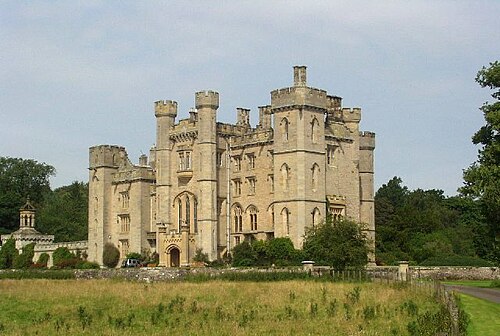
Perched on a roughly 5 m high motte, the castle is defined by a square stone enclosure about 20 m across with fragments of curtain wall and traces suggesting round corner towers. A three-storey, tower-like range with attic stands on the south-west side, with a projecting chimney-breast and vaulted basement; a later 17th-century south-east range has larger window openings. A prominent arched recess breaks the east wall where a single-storey projection stood. The ruins are built of grey-brown rubble masonry and sit among mature trees above the river valley.
Its story
The story of Crawford Castle.
Sveinn to the Lindsays, before 1100–1398
Excavations north-west of the castle have found evidence of a Roman fort, garrisoned by perhaps 300 men, occupying the site between about 80 and 170 AD. The barony of Crawford, then the largest and most influential in southern Scotland, was established before 1100, when records show Sveinn as its lord; on his death his son Thor, also Lord of Tranent and Sheriff of Edinburghshire, succeeded him. An earthwork and timber castle at the site was in existence by 1175, probably built before that date by Thor or his father Sveinn. William Lindsay, who married Thor's younger daughter around 1154, is thought to have built the stone castle that replaced it, and is recorded as Lord of Crawford by 1185–1190. From an early date the Carmichaels of Meadowflatt served as hereditary constables of the castle, a post they retained under successive owners.
In 1398 David Lindsay was created Earl of Crawford, having won praise for his bravery in a duel with the English champion Baron Welles on London Bridge on St George's Day, 23 April 1390; Welles, as Champion of England, had issued the challenge at an Edinburgh banquet.
James IV's Rebel Grant to Angus and James V's Hunting Lodge, 1488–1595
At the accession of James IV in 1488 the barony was transferred to Archibald Douglas, 5th Earl of Angus, in reward for backing the young prince's rebellion against his father James III. The Earls of Angus held Crawford until 1528, when their estates were forfeited by the young James V, who used the castle as a hunting lodge until his own death in 1542; his mistress Elizabeth Carmichael, daughter of the hereditary constable, was the mother of John Stewart, later Commendator of Coldingham. In July 1541 James V and Mary of Guise brought tapestry to furnish their lodging at Crawford, and George Carmichael, son of the castle's captain, presented the queen with three ounces of Scottish gold.
After 1542 the barony was returned to the Earls of Angus, and the Carmichaels' keepership of the castle came to an end in 1595.
Marquess of Douglas to Ruin and Scheduled Monument, 1633–1967
In 1633 the 11th Earl was created Marquess of Douglas, and the castle was probably rebuilt after this date; four stone tablets bearing coats of arms, one dated 1648, survive built into the walls of the present Castle Crawford House. The castle later passed to the Duke of Hamilton, then was sold to Sir George Colebrooke in the eighteenth century; after a spell as a farmhouse it was abandoned at the end of the eighteenth century, and much of its stone was reused to build the present Crawford Castle Farm.
The ruin, on its motte above the Clyde, has been a scheduled monument since 1967.
Step inside
8 places to explore in 1648.
The record describes 8 distinct spots at Crawford Castle, including 2 interiors: vaulted basement in the tower-range, first-floor chamber with chimney-breast. Create your own photoreal reconstruction and explore every one, more scenes means more rooms, more angles, and more of the place to stand in.
Build Your Own Castle
Recreate Crawford Castle with AI to explore it.
The artist rebuilds it as it stood in 1648, a photoreal reconstruction that belongs to you alone. Pay with coins, no subscription needed.
Recreate this castle →Defend this castle →Whose castle
Clans who held Crawford Castle.
The families that held Crawford Castle for a decade or more across its history, follow a name to its clan.
Lindsay
Held by the Lindsays from William Lindsay's marriage c. 1154; David Lindsay was created Earl of Crawford in 1398.
Held by the Douglas Earls of Angus 1488–1528, and again after 1542.
Carmichael
The Carmichaels of Meadowflatt were hereditary constables of the castle until 1595.