
Scotland · Ruin
Drochil Castle
Drochil Castle is a late-16th-century, unfinished stone castle in the Scottish Borders of Scotland, begun by James Douglas, 4th Earl of Morton. Construction was never completed and the building survives as a multi-storey ruin owned by the Buccleuch family and protected as a scheduled monument.
Its prime
1581
Today
Ruin
As it stood in 1581
What Drochil Castle looked like in its prime.
A tall rectangular four-storey block with an additional garret, built of rough dark whinstone rubble dressed with red sandstone around openings and corners. Two round towers about 25 feet in diameter project from diagonally opposite corners, each pierced by small gunloop openings. The roof is absent and many window openings are voids; the outer walls are thick and irregular, set on a grassy slope with trees and the Lyne Water below.
Its story
The story of Drochil Castle.
Morton's Retirement House, Begun 1578
James Douglas, 4th Earl of Morton and Regent of Scotland, began Drochil Castle above the Lyne Water in 1578, meaning to retire there from worldly business. He was executed by King James VI three years later, with the castle no more than half built, and it was never finished. Morton sold the wool from his Drochil estates to a merchant, John Provand, and his tenants from Linton carted it to Edinburgh.
The Double-Tenement Plan
What Morton raised was as much palace as castle: four storeys and a garret, laid out as a double-tenement with a wide central corridor running end to end on every storey, with suites of apartments opening off either side. A round tower 25 feet across stands at each of two diagonally opposite corners, two gunloops in each keeping an enemy off the walls, and the great hall on the first floor measured 50 by 22 feet.
From Queensberry to Buccleuch, 1686–1928
William Douglas, 1st Duke of Queensberry, bought the castle in 1686. The outer walls are whinstone rubble quarried at Broomlee Hill, dressed with red sandstone, and in the early 19th century stone was taken from them to build the adjacent farm. The ruin has been protected as a scheduled monument since 1928, and it is still owned by Queensberry's descendant, the Duke of Buccleuch.
Step inside
8 places to explore in 1581.
The record describes 8 distinct spots at Drochil Castle, including 4 interiors: central longitudinal corridor, great hall (first floor), garret (attic) level and more. Create your own photoreal reconstruction and explore every one, more scenes means more rooms, more angles, and more of the place to stand in.
Build Your Own Castle
Recreate Drochil Castle with AI to explore it.
The artist rebuilds it as it stood in 1581, a photoreal reconstruction that belongs to you alone. Pay with coins, no subscription needed.
Recreate this castle →Defend this castle →Whose castle
Clans who held Drochil Castle.
The families that held Drochil Castle for a decade or more across its history, follow a name to its clan.
Begun by James Douglas, 4th Earl of Morton, in 1578; bought in 1686 by William Douglas, 1st Duke of Queensberry, and still owned by his descendant the Duke of Buccleuch.
From the archive
Drochil Castle on paper: the measured plan and period views.
The survey plan and photographs below are the ground truth this page's reconstructions are checked against, drawn and photographed while the castle was still a working garrison. Every image is public-domain or openly licensed, with its source named.
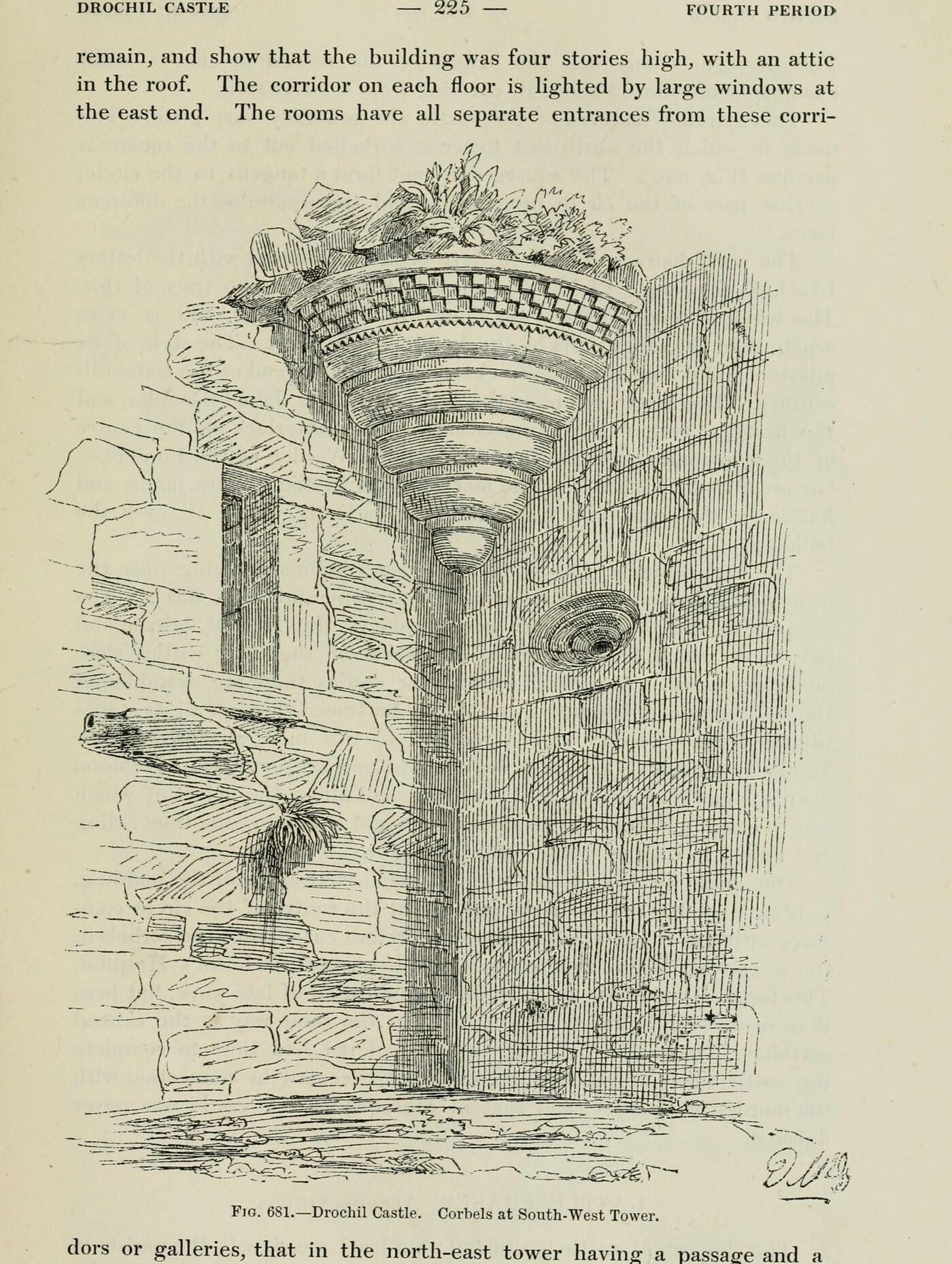
Fig. 681. Drochil Castle. Corbels at South-West Tower.
1887 · MacGibbon & Ross, vol. 2 (1887)
Public domain
Nearby


