
Germany · Still standing
Langenstein Castle
Schloss Langenstein
Langenstein Castle is a Renaissance-era palace built in the sixteenth century in Orsingen-Nenzingen in the Hegau region of southern Germany. The well-preserved complex remains a private residence of the Douglas family and houses a Carnival Museum and other estate uses today.
First raised
1100
Its prime
1560
Today
Still standing
As it stood in 1560
What Langenstein Castle looked like in its prime.
Low-rise rectangular Renaissance palace composed of interconnected three-storey wings with pale cream rendered walls highlighted by red-painted stringcourses; steep slate hipped roofs and a shallow square roof tower with a small flag and three round oculi. Façades show regularly spaced small rectangular windows in symmetrical grids. A small round turret with a conical roof sits at the lower left, the complex rests on a gentle lawned slope with exposed stone at the base and no battlements.
Its story
The story of Langenstein Castle.
Reichenau Abbey's Bergfried and the Lords of Langenstein
The oldest work at Langenstein belongs to the abbey of Reichenau, which around 1100 raised a bergfried on a long spine of Jurassic limestone in the Hegau, south of Eigeltingen and between Stockach and Singen. That tower survives as the lower storey of the present building. Through the twelfth and thirteenth centuries the site was held by ministerials of Reichenau who took the castle's name as their own.
The line of von Langenstein died out at the beginning of the fourteenth century. Over the centuries that followed the castle passed through the hands of a long succession of nobles, among them the knight Bilgeri von Heudorf.
Raitenau, Welsperg and a Debt Sale, 1568–1826
In 1568 Hans Werner von Raitenau bought Langenstein and its attached estates from Hans Wilhelm von Knöringen. The main range of the schloss went up largely between 1570 and 1605, built around a square tower, and was later enlarged by the so-called New Schloss and tied to it by a linking wing; a chapel, the Ludwigshof and the Reichenau tithe cellar complete the group.
Guidobald Graf von Welsperg inherited Langenstein in 1677, and the estate stayed with his family until 1826, when Karl Graf von Welsperg, overwhelmed by debt, sold it to Grand Duke Ludwig of Baden as the grand duke's private property.
The Counts of Langenstein und Gondelsheim, 1820–1900
The grand duke died in 1830 and Langenstein went to his son Ludwig Wilhelm August, Count of Langenstein und Gondelsheim (1820-1872), together with the other holdings his father had bought privately in the Hegau, the Linzgau, the Danube valley and the Kraichgau and gathered into the comital Langenstein family estate. The count stood outside the grand-ducal succession: his mother, Katharina Werner, an extra at the Karlsruhe court theatre, was not of equal birth, and he had been born before the marriage.
He left no children, so the estates and Langenstein with them passed to his sister, Luise von Langenstein und Gondelsheim (1825-1900).
A Field Marshal's Line: The Swedish Douglases from 1848
In 1848 Luise married Carl Israel Vilhelm Graf Douglas (1824-1898), a Swedish noble descended from Robert Graf Douglas (1611-1662), a Scot who served as a field marshal in Swedish pay during the Thirty Years' War and who founded the Swedish comital line of Clan Douglas, a line that has produced several notable politicians and soldiers. Langenstein has been the family's principal residence since 1906.
After the end of the First World War the abdicated Grand Duke Friedrich II of Baden stayed at Langenstein for a time as a guest of Count Douglas, along with his wife, his mother Luise and his sister Viktoria, by then Queen of Sweden.
The Carnival Museum, the Country Club and the Douglas Succession
Wilhelm Graf Douglas opened a carnival museum at Langenstein in 1969, and it occupied the schloss until 2018; the museum society then built a replacement close by, which opened in June 2025. Its Alefanzorden has been given out each carnival season since the 1970s, the recipients put forward by several "Loschoren": Walter Fröhlich took it in 1977, Bruno Epple in 1998 and Günther Oettinger in 2020.
From the late 1980s Axel Graf Douglas (born 1943) built up the country club at Langenstein, with an eighteen-hole golf course and a clubhouse near the schloss, riding stables and a shotgun hunting course, its facilities open to guests as well as members. In 2014 he sold the castle and all its lands to his cousin Christoph Graf Douglas (1948-2016). Christoph's son Leopold Graf Douglas, born in 1989 and of the Swedish-German branch of Clan Douglas, lives in the schloss with his family and looks after the South Baden property together with his brother Ludwig Graf Douglas.
Step inside
7 places to explore in 1560.
The record describes 7 distinct spots at Langenstein Castle, including 1 interior: palace interior (later carnival museum). Create your own photoreal reconstruction and explore every one, more scenes means more rooms, more angles, and more of the place to stand in.
Build Your Own Castle
Recreate Langenstein Castle with AI to explore it.
The artist rebuilds it as it stood in 1560, a photoreal reconstruction that belongs to you alone. Pay with coins, no subscription needed.
Recreate this castle →Defend this castle →Whose castle
Clans who held Langenstein Castle.
The families that held Langenstein Castle for a decade or more across its history, follow a name to its clan.
Owned by the Douglases, descendants of the Swedish count Ludvig Douglas; Count Leopold Douglas of the Swedish-German branch lives there today.
From the archive
Langenstein Castle on paper: the measured plan and period views.
The survey plan and photographs below are the ground truth this page's reconstructions are checked against, drawn and photographed while the castle was still a working garrison. Every image is public-domain or openly licensed, with its source named.
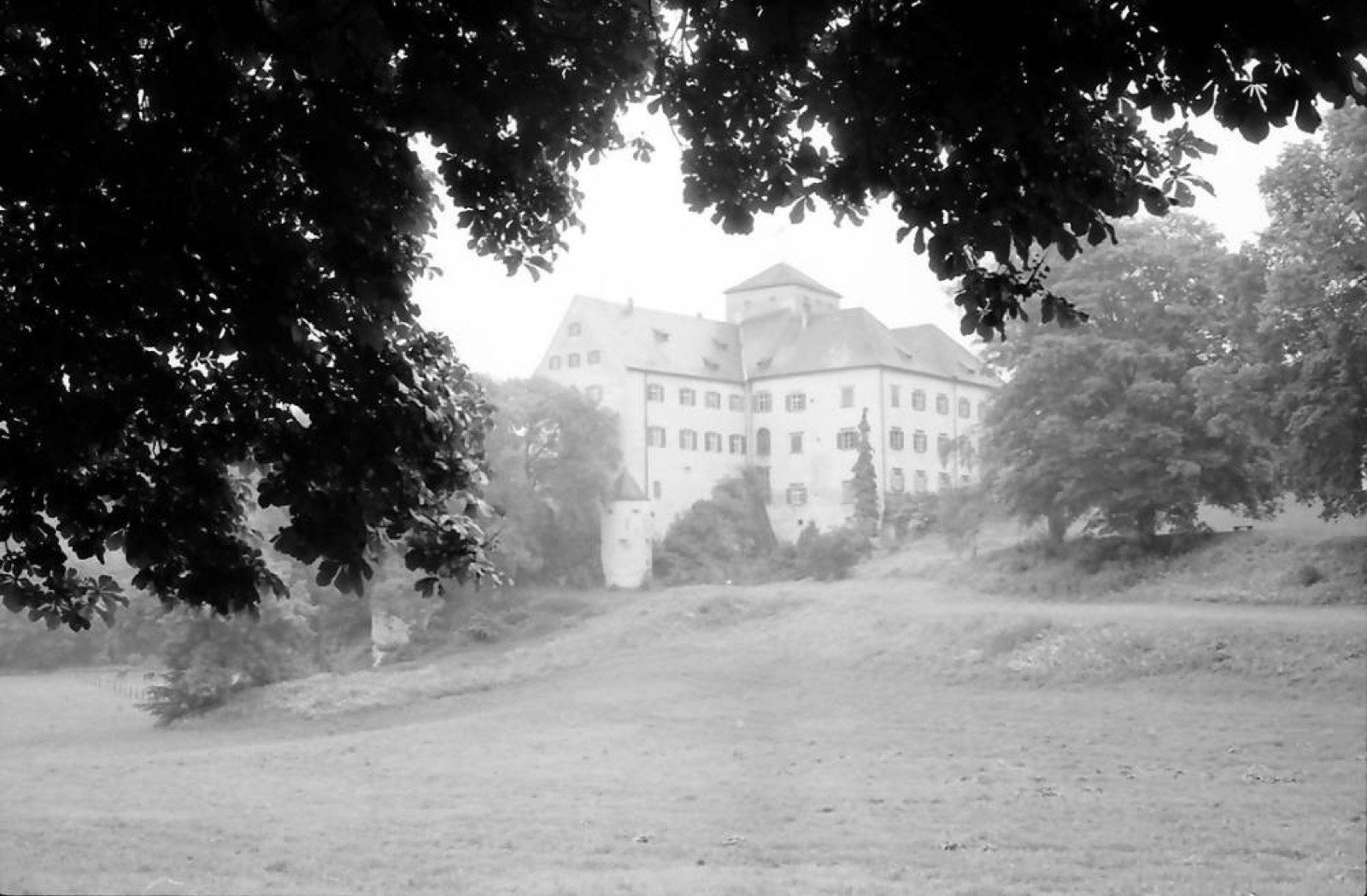
Eigeltingen: Schloss Langenstein, Parkseite
· State Archives of Baden-Württemberg (via Europeana)
CC BY
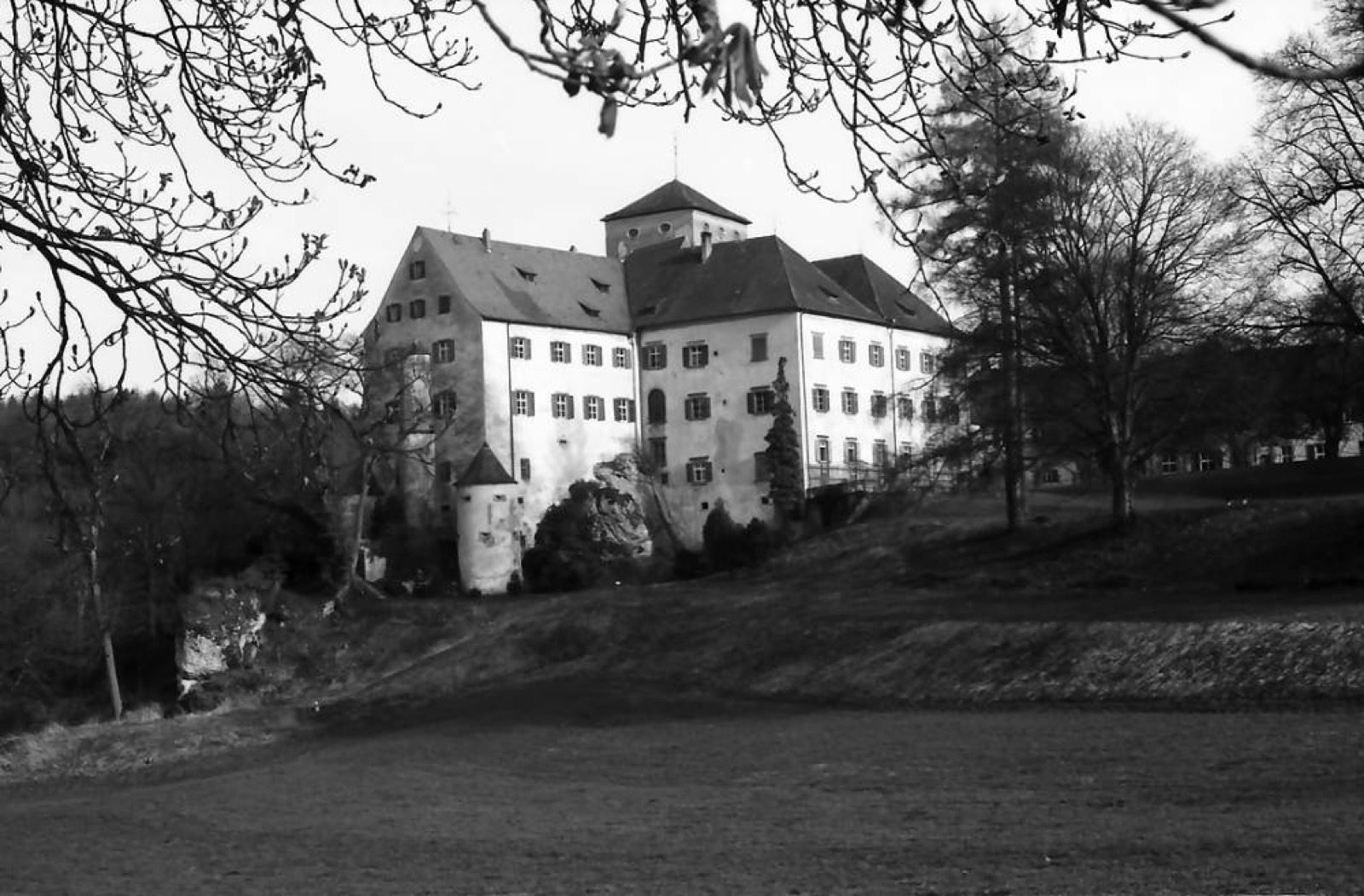
Eigeltingen: Schloss Langenstein, Parkseite
· State Archives of Baden-Württemberg (via Europeana)
CC BY


