Scotland · Ruin
Strathaven Castle
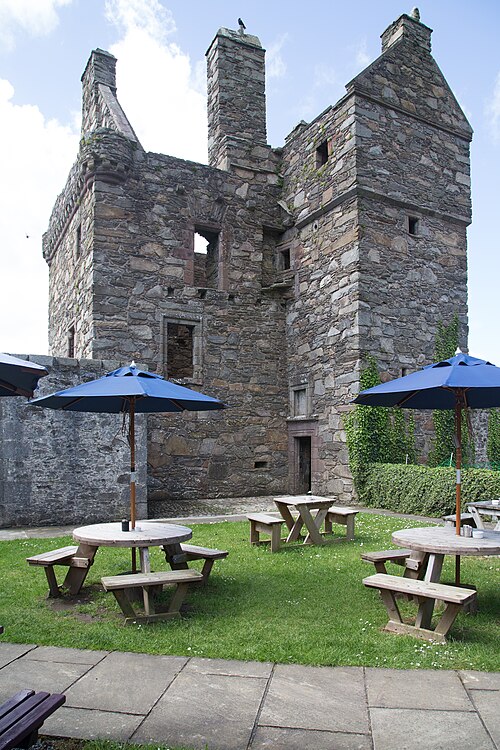
Strathaven Castle is a medieval castle ruin in the centre of Strathaven, South Lanarkshire, Scotland. Built on a rocky, partly artificial mound above the Powmillon Burn, the stone keep and round tower survive as the most visible remains. The site is a scheduled ancient monument and has been long abandoned.
Its prime
1560
Today
Ruin
As it stood in 1560
What Strathaven Castle looked like in its prime.
A compact three-storey rectangular stone block (roughly 11.2m by 21.2m) with a taller four-storey cylindrical tower at its north-west corner and a small projecting wing to the south-east, all of roughly grey-brown rubble stone. The castle sits atop a rocky, partly artificial grassy mound surrounded by a low barmkin wall, with steep banks of the Powmillon Burn to the east, south and west; roofs and battlements intact, the tower pierced by wide gunloops.
Its story
The story of Strathaven Castle.
Strathaven Castle, also known as Avondale Castle, stands on a rocky, partly artificial mound defended by the steep banks of the Powmillon Burn, in the centre of Strathaven in South Lanarkshire. The castle passed to the Sinclairs and then to the Earls of Douglas, and after James II's suppression of the Douglases in 1455 it was sacked and slighted.
In 1457 Strathaven was granted to Sir Andrew Stewart, an illegitimate grandson of Murdoch Stewart, Duke of Albany; as Lord Avondale he either rebuilt the earlier castle or built anew on the site. Sir James Hamilton of Finnart, who took it in 1534, expanded the buildings, and in 1611 the castle was sold to James, Marquis of Hamilton. Its last occupant was Anne, Duchess of Hamilton (1632–1716), whose main residence was Hamilton Palace.
Tradition holds that the wife of a past lord was walled up alive here, led into a purpose-built niche, blessed by a priest, given food and water, and sealed in forever; when part of the walls came down in the mid-19th century, human bones were reportedly found. The ruin, a scheduled ancient monument, comprises a three-storey rectangular block and a round tower with wide gunloops, probably added in the 16th century.
Step inside
9 places to explore in 1560.
The record describes 9 distinct spots at Strathaven Castle, including 2 interiors: main courtyard on top of the mound, basement vault (collapsed). Create your own photoreal reconstruction and explore every one, more scenes means more rooms, more angles, and more of the place to stand in.
Build Your Own Castle
Recreate Strathaven Castle with AI to explore it.
The artist rebuilds it as it stood in 1560, a photoreal reconstruction that belongs to you alone. Pay with coins, no subscription needed.
Recreate this castle →Defend this castle →Whose castle
Clans who held Strathaven Castle.
The families that held Strathaven Castle for a decade or more across its history, follow a name to its clan.
Held by the Earls of Douglas until their suppression by James II in 1455.
Granted in 1457 to Sir Andrew Stewart, later Lord Avondale, who rebuilt the castle.
Sir James Hamilton of Finnart held and expanded it from 1534; sold in 1611 to James, Marquis of Hamilton, whose duchess was its last occupant.
Nearby