Scotland · Ruin
Castle of Old Wick
Castle of Old Wick is the ruined medieval tower standing on a headland near Wick on the northern Scottish coast. The visible remnant is a single tall stone keep sited on a grassy cliff above a narrow sea inlet.
Its prime
1300
Today
Ruin
As it stood in 1300
What Castle of Old Wick looked like in its prime.
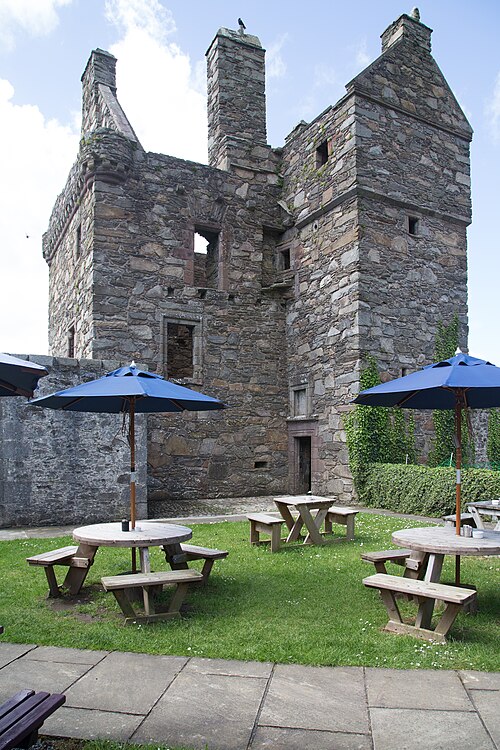
A solitary, rectangular stone tower perched on the edge of a steep, grassy headland overlooking a narrow sea inlet; the surviving masonry is grey-brown, coursed rubble with traces of small slit openings and very thick walls. No enclosing curtain wall is visible from the photo; the surrounding land is low, grassy moor dropping to vertical layered cliffs of dark sedimentary rock that fall to the waterline. In prime the tower would have presented continuous vertical stone faces and an intact roofline.
Its story
The story of Castle of Old Wick.
The Castle of Old Wick stands on a cliff-girt peninsula south-west of Wick in Caithness, its landward approach cut by two moats and reached by a drawbridge across a rock-cut ditch, guarded by a gatehouse and defensive wall. Only the square tower remains, originally four storeys, of which three survive, with kitchen and stores below, the hall on the first floor and the lord's quarters above. A narrow courtyard once ran down the peninsula, lined with barracks, brewery and chapel.
The castle passed by marriage to Nicholas Sutherland in 1345, and again by the marriage of Christian, heiress of Alexander Sutherland of Duffus, to William Oliphant in the 15th century. Andrew Oliphant of Berrideale sold the property to his uncle, Lord Oliphant, in 1526, and in July 1569 Laurence, Lord Oliphant and his servants were besieged and attacked there by John Sinclair, Master of Caithness.
It came to the Sinclair family in 1644, then passed to John Campbell, Lord Glenorchy, after George Sinclair, Earl of Caithness, died without issue. Glenorchy sold it to the Dunbars of Hempriggs in 1690, and the Dunbars owned the castle until 1910.
Step inside
5 places to explore in 1300.
The record describes 5 distinct spots at Castle of Old Wick, including the full exterior approach. Create your own photoreal reconstruction and explore every one, more scenes means more rooms, more angles, and more of the place to stand in.
Build Your Own Castle
Recreate Castle of Old Wick with AI to explore it.
The artist rebuilds it as it stood in 1300, a photoreal reconstruction that belongs to you alone. Pay with coins, no subscription needed.
Recreate this castle →Defend this castle →Whose castle
Clans who held Castle of Old Wick.
The families that held Castle of Old Wick for a decade or more across its history, follow a name to its clan.
Passed by marriage to Nicholas Sutherland in 1345; held by the Sutherlands of Duffus into the 15th century.
Oliphant
Came by marriage to William Oliphant in the 15th century; held by the Oliphants until 1644.
Came to the Sinclair family in 1644, until the Earl of Caithness died without issue.
Dunbar
Sold to the Dunbars of Hempriggs in 1690; the Dunbars owned the castle until 1910.