
Stadium · Scotland · Restored
Hampden Park
Pàirc Hampden
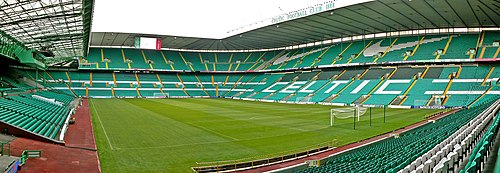
Hampden Park is Scotland's national football stadium in the Mount Florida area of Glasgow and the long-time home of the Scotland national team. Opened in 1903 and expanded through the 1920s–30s, it became one of the world's largest stadiums and held European and international football finals and record attendances. It remains an active, renovated stadium owned by the Scottish Football Association.
Its prime
1937
Today
Restored
As it stood in 1937
What Hampden Park looked like in its prime.
A vast oval, open-air bowl of steep continuous terracing encircling a rectangular grass pitch; terraces formed from shaped natural slopes with rigid crush barriers and rows of standing spectators at capacity. The south side is marked by twin grandstands with a pavilion wedged between them and a multi-storey press box above. The playing surface sits low in the bowl, sightlines steep from the terraces, and no continuous roof covers the stands in this period.
Its story
The story of Hampden Park.
The Three Hampdens and the World's Biggest Ground, 1873-1950
Queen's Park, the oldest club in Scottish football, first played at a ground called Hampden Park on 25 October 1873, overlooked by a terrace named after John Hampden, who fought for the roundheads in the English Civil War. When the Cathcart District Railway planned a line through its western terrace, the club moved 150 yards to a second Hampden, opened in October 1884.
Refused more land by its landlords, Queen's Park bought 12 acres off Somerville Drive from Henry Erskine Gordon in 1899. James Miller designed the twin grandstands, and Archibald Leitch the terracing banked out of the natural slopes. Construction ran over three years; during it part of the wooden terracing collapsed at Ibrox, and in response the Hampden terraces were set firmly into the earthwork. Queen's Park beat Celtic 1-0 in the first match on 31 October 1903, and from its opening until the Maracanã surpassed it in 1950 it was the biggest stadium in the world.
Crowds of 100,000 and the 1937 Record
The first Scotland v England match there, in April 1906, drew 102,741 and established Hampden as the primary home of the national team. The two Old Firm matches of the 1909 Scottish Cup Final drew 131,000 between them and ended in a riot when the second also finished level; with Hampden unfit to host a second replay the trophy was withheld, and the riot ended the SFA's use of the ground for the final.
When the Glasgow Corporation intervened in 1935 over crowd safety, Queen's Park defeated a rival bid from Rangers to enlarge Hampden at its own expense in exchange for the official Scotland v England fixture and Cup Final. The work raised the theoretical capacity to 183,388 by 1937, though only 150,000 tickets could be issued. The 1937 Scotland v England match had an official attendance of 149,415, still the European record for an international; a week later the Cup Final between Celtic and Aberdeen drew 147,365, a world record for a club match until 1963.
Wartime Restrictions and the Post-War Crowds, 1939-1946
National league and cup competitions were suspended for the Second World War, regional ones taking their place, and attendance initially capped at half capacity: the 75,000 at a wartime cup final in May 1940 were the maximum permitted. The Parashots, a forerunner of the Home Guard, set up a command post at Lesser Hampden in 1940, and when a government official ordered both pitches ploughed for vegetables the Queen's Park committee ignored the order, which was not pursued. Scotland beat England 5-4 before 91,000 on 18 April 1942. In the post-war boom Hampden was the only ground big enough for the crowds: 139,468 watched the Victory International against England on 13 April 1946, before capacity was officially cut to 135,000 following the Burnden Park disaster.
European Finals and the Safety Reforms, 1960-1976
Real Madrid beat Eintracht Frankfurt 7-3 in the 1960 European Cup Final, before a crowd variously given as 127,621 and 130,000. Celtic moved the home leg of their 1970 European Cup semi-final against Leeds United to Hampden, where 136,505 saw them win 2-1, a record for any match in UEFA competition. Bayern Munich beat St Etienne in the 1976 European Cup Final; the French club, convinced two efforts that rebounded off the square crossbar would have been goals had it been round, bought the posts for their museum.
After 66 spectators were crushed to death at Ibrox in January 1971, the Safety of Sports Grounds Act 1975 compelled licensing, crowd segregation and restricted attendances; Hampden's capacity fell to 81,000.
Rebuilt by Lottery, Bought by the SFA, 1981-2025
Demolition of the North Stand and concreting of the terraces, 1981-1986, cost £3 million and cut capacity to 74,370. A £12 million all-seater conversion followed a £3.5 million government grant in 1992, and the partially rebuilt ground reopened for a Scotland v Netherlands friendly in 1994. A final £59 million National Lottery stage from November 1997 overran and drew a fraud squad investigation; the new South Stand opened for the 1999 Scottish Cup Final, leaving a capacity of 51,866.
The Scottish Football Museum opened inside the ground in 2001. Hampden hosted the 2002 Champions League Final, the 2007 UEFA Cup Final, football at the 2012 Olympics and, converted for athletics, the 2014 Commonwealth Games. The SFA, until then a tenant, agreed in September 2018 to buy the ground and had taken ownership by August 2020; Queen's Park's lease expired in March 2021, though they rented the ground back for the 2023-24 season. The stadium houses the offices of the SFA and the Scottish Professional Football League, and naming rights were sold for the first time in December 2025.
Step inside
7 places to explore in 1937.
The record describes 7 distinct spots at Hampden Park, including 4 interiors: upper terrace behind the north goal, side terrace (east bank), pitch touchline from the terraces and more. Create your own photoreal reconstruction and explore every one, more scenes means more photos, more angles and more of the immersive experience.
Build Your Own Castle
Recreate Hampden Park with AI to explore it.
The artist rebuilds it as it stood in 1937, a photoreal reconstruction that belongs to you alone. Pay with coins, no subscription needed.
Recreate Stadium to Explore →Nearby
Castles within reach of Hampden Park.


Landmarks within reach of Hampden Park.


More landmarks of Scotland


Explore the city


