
Scotland · Ruin
Bothwell Castle
Bothwell Castle is a large medieval fortress sited on a high, steep bank above a bend in the River Clyde in South Lanarkshire, Scotland. Begun in the 13th century, it is dominated by a huge cylindrical donjon to the west and, after 15th‑century rebuilding, a Great Hall and chapel to the east with long curtain walls and corner towers enclosing a rectangular courtyard. The site is a scheduled monument managed by Historic Environment Scotland.
Its prime
1424
Today
Ruin
Ranked among Europe’s castles
As it stood in 1424
What Bothwell Castle looked like in its prime.
A broad rectangular ruin of red‑brown sandstone set on a steep river bank, dominated at the west end by a massive cylindrical donjon with a crenellated summit; long, thick curtain walls run east from the keep to a large Great Hall and adjacent chapel. Round corner towers stand at the south‑east and south‑west, with other towers along the walls. At its prime the castle was complete with battlements, roofs and an enclosed central courtyard overlooking the River Clyde.
Its story
The story of Bothwell Castle.
Walter of Moray's Donjon on the Clyde
The barony of Bothwell came from King David I, who granted it to David Olifard, Justiciar of Lothian, in the mid-12th century. Through the marriage of Olifard's daughter it passed to the Morays, ancestors of Clan Murray, and by 1252 it belonged to Walter of Moray, who began a castle on the steep bank above a bend of the Clyde to guard a strategic crossing of the river. He conceived it on a grand scale, in the manner of Coucy, Kildrummy and Dirleton: a cylindrical donjon 82 feet high and 62 feet across, with walls 15 feet thick. It was never finished to that design, when the Wars of Independence opened in 1296, only the donjon, the prison tower and a short stretch of connecting curtain wall stood complete, the foundations of the rest probably defended by no more than a wooden palisade.
Seized, Besieged and Retaken, 1296–1301
Edward I's invading army seized Bothwell at the start of the war, when it was held by Walter's son, William Moray of Bothwell. The Scots then besieged the English garrison for fourteen months through 1298–99 until it capitulated, and Edward returned in 1301 to retake the castle with 6,800 men and specially constructed siege engines. Bothwell became the headquarters of Aymer de Valence, 2nd Earl of Pembroke, Edward's appointed Warden of Scotland, and stayed in English hands for several years.
Slighted Twice: 1314 and 1337
After Robert the Bruce's victory at Bannockburn in 1314, several English nobles took shelter at Bothwell, but the castle's constable, Sir Walter FitzGilbert, surrendered it to the approaching Scots, an act for which he was granted the barony of Cadzow, where his descendants became the powerful Hamilton family. The Scots slighted the castle after its surrender.
Edward III brought the English back in 1336, repairing Bothwell and making it his headquarters in Scotland. The next year Sir Andrew Murray, great-nephew of Sir William and the castle's rightful owner, recaptured the stronghold, again using siege engines, and slighted it a second time, pulling down the west side of the donjon and tumbling it into the Clyde so the enemy could not reoccupy it. The castle lay derelict until the 1360s.
Archibald the Grim and the Douglas Great Hall
In 1362 Joan Moray of Bothwell, heiress of the Morays, married Archibald Douglas, nicknamed 'the Grim' and later Lord of Galloway and Earl of Douglas. He commenced the rebuilding, repairing the donjon and completing the walls, and his son Archibald, the 4th Earl, carried the work on: by 1424 they had raised the Great Hall and adjacent chapel to the east, with towers at the north-east and south-east corners and curtain walls running back to the donjon.
When the Black Douglases were forfeited in 1455 their lands returned to the crown. James III granted Bothwell to Lord Crichton and then to Sir John Ramsay, both forfeited in turn; in 1488 it went to Patrick Hepburn, 2nd Lord Hailes, for whom the Earldom of Bothwell was created. Hepburn did not keep it long, exchanging the castle with Archibald Douglas, 5th Earl of Angus, 'Bell-the-Cat', for Hermitage Castle in Liddesdale, which returned Bothwell to Douglas hands. James IV visited in 1503 and 1504.
Quarried for a Mansion, Given to the Nation
Bothwell descended through the Earls of Angus and Marquesses of Douglas to the Earls of Forfar. Archibald Douglas, 1st Earl of Forfar, began a new mansion nearby and demolished the castle's north-east tower for its stone; his house was itself pulled down in 1926 after mining subsidence. Following the 2nd Earl's death at Sheriffmuir in 1715, the castle reverted to the senior Douglas line under the 1st Duke of Douglas, and later descended to the Earls of Home. In 1935 the 13th Earl gave Bothwell into state care.
Abandoned by the 18th century, the castle was described by the archaeologist William Douglas Simpson as one of the 'foremost secular structures of the Middle Ages in Scotland'. A scheduled monument in the care of Historic Environment Scotland, it was closed to visitors in 2020 over safety issues.
Step inside
9 places to explore in 1424.
The record describes 9 distinct spots at Bothwell Castle, including 2 interiors: great hall interior, chapel adjacent to the great hall. Create your own photoreal reconstruction and explore every one, more scenes means more rooms, more angles, and more of the place to stand in.
Build Your Own Castle
Recreate Bothwell Castle with AI to explore it.
The artist rebuilds it as it stood in 1424, a photoreal reconstruction that belongs to you alone. Pay with coins, no subscription needed.
Recreate this castle →Defend this castle →Whose castle
Clans who held Bothwell Castle.
The families that held Bothwell Castle for a decade or more across its history, follow a name to its clan.
From the archive
Bothwell Castle on paper: the measured plan and period views.
The survey plan and photographs below are the ground truth this page's reconstructions are checked against, drawn and photographed while the castle was still a working garrison. Every image is public-domain or openly licensed, with its source named.
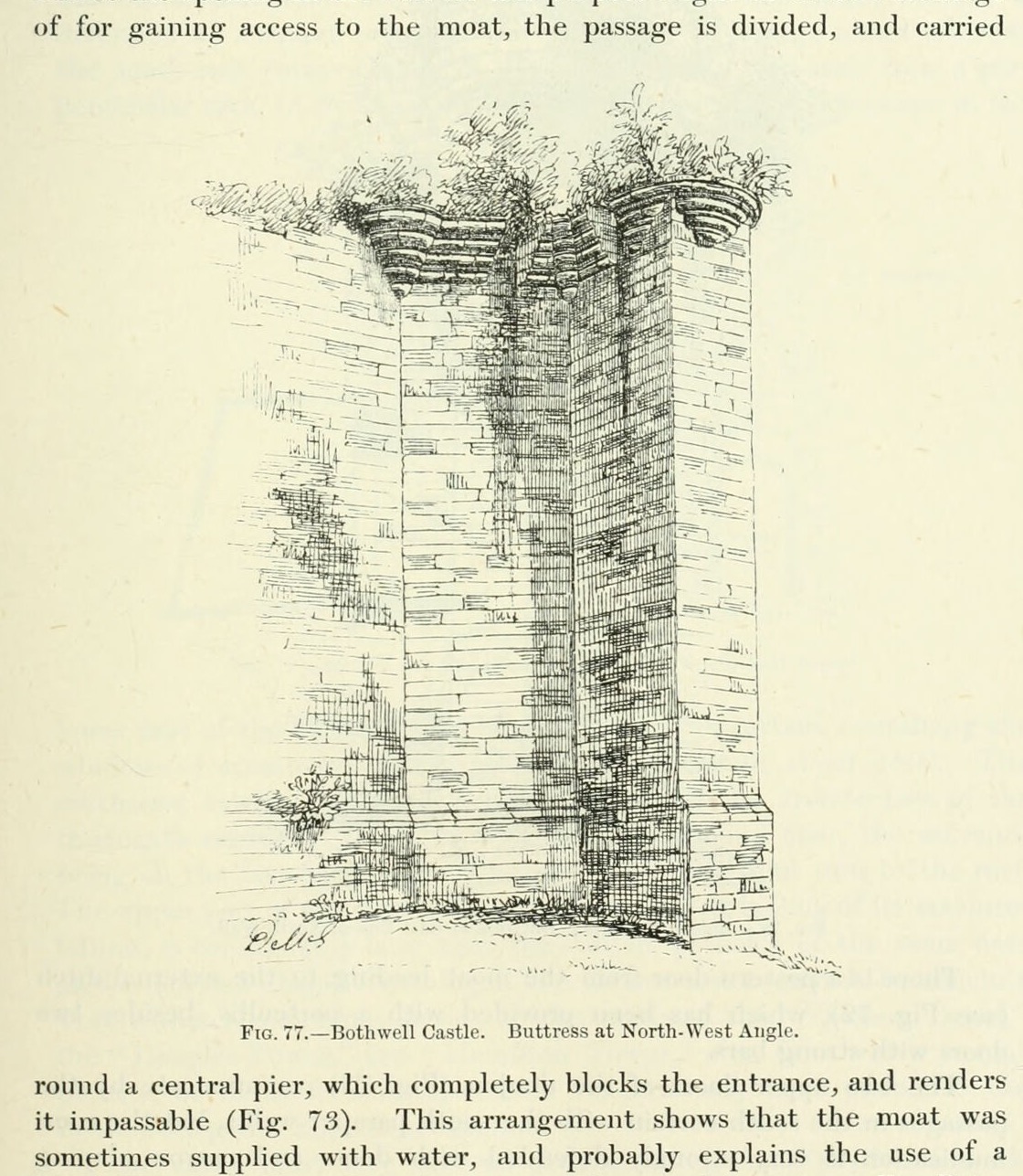
Fig. 77. Bothwell Castle. Buttress at North-West Angle.
1887 · MacGibbon & Ross, Castellated and Domestic Architecture of Scotland, vol. 1 (1887)
Public domain
Nearby
Landmarks within reach of Bothwell Castle.


Questions about Bothwell Castle
What is the history of Bothwell Castle?
What is inside Bothwell Castle?
Who owns Bothwell Castle now?
Why was Bothwell Castle built, and what was it used for?
Where is Bothwell Castle?
When was Bothwell Castle built?
Was Bothwell Castle ever attacked or besieged?
Which family or clan held Bothwell Castle?
What did Bothwell Castle look like in its prime?
Is Bothwell Castle still standing, or is it a ruin?
Can you visit Bothwell Castle?
More castles of Scotland


Explore the city


