Scotland · Ruin
Balvenie Castle
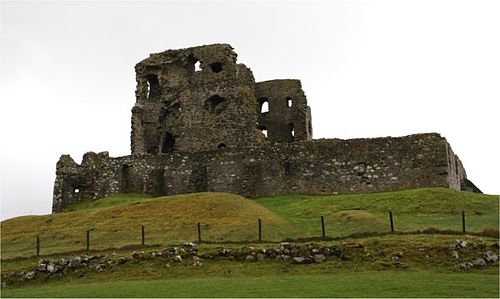
Balvenie Castle is a medieval castle ruin about 1 km north of Dufftown in Moray, Scotland. Built and altered from the 13th through the 16th centuries, it sits on a grassy mound and is today a scheduled monument managed by Historic Environment Scotland and open to visitors seasonally.
Its prime
1562
Today
Ruin
As it stood in 1562
What Balvenie Castle looked like in its prime.
Long, low rubble curtain walls of pale grey stone sit on a rounded earthen mound, punctuated at the right end by a cylindrical round tower with narrow vertical slits. The central ground‑level arched entrance is set in the long façade; above it the wall rises with regularly spaced rectangular window openings and tall broken gable profiles to the left. At prime the walls and towers would have been complete with an unbroken roofline and intact battlements, set amid woodland and pasture.
Its story
The story of Balvenie Castle.
Mortlach, the Comyns and Bruce's Attack, 1285-1308
Balvenie was originally known as Mortlach, a stronghold a kilometre north of Dufftown in Moray. Alexander Comyn, Earl of Buchan, acquired it in the thirteenth century after surrendering part of his inheritance to build up his north-east possessions, exchanging territory at Tranent in East Lothian for Mortlach and its castle in Highland Banffshire; a charter of 1285 shows the transaction had taken place a generation earlier. The site was a valuable strategic holding, bridging Buchan and the lordship of Badenoch and Lochaber, the two real seats of Comyn power in thirteenth-century Scotland. The castle fell out of use after an attack by Robert the Bruce in 1308 left the property uninhabitable.
The Black Douglases and the Forfeiture after Arkinholm, 1362-1455
At some point in the fourteenth century the castle and estates passed to the Earl of Douglas. Nothing is documented as to how the Black Douglases first acquired Balvenie; the most likely account is that it came with the marriage of the heiress Joanna Murray to Archibald 'the Grim', 3rd Earl of Douglas, in 1362. In 1408 his son and successor Archibald, 4th Earl of Douglas, granted the lordship of Balvenie to his younger brother James Douglas, latterly known as James 'the Gross'. James's main residence was Abercorn Castle, a coastal fortress west of Edinburgh, and Balvenie's use was as temporary accommodation when the need arose.
In 1440 William Douglas, 6th Earl of Douglas, was killed by James the Gross, probably in a conspiracy with William Crichton and Alexander Livingston of Callendar, the guardians of the child-king James II. James then became 7th Earl, and immediately provided the lordship of Balvenie and its castle to his youngest son, John Douglas, Lord of Balvenie. Earl James's death in 1443 signalled a resumption of hostility between the royal Stewarts and the Black Douglases, and at the Battle of Arkinholm in May 1455 this main Douglas line was defeated by an army loyal to James II. All their lands and titles were forfeited to the Crown, Balvenie among them. The king divided the estates among his supporters, who included the Douglas Earl of Angus, and gave Balvenie Castle to Sir John Stewart, who later became the first Earl of Atholl.
Extension, Mary's Visit and the Jacobite Rebellion of 1746
Balvenie was extended and altered in the fifteenth and sixteenth centuries. Mary, Queen of Scots came to the castle on 4 September 1562 during her first northern progress. William Duff committed suicide at Balvenie in 1718, and the castle was effectively abandoned from that point. In 1746 Hanoverian forces used it as an encampment during the second Jacobite rebellion.
Historic Environment Scotland and the Baron of Balvenie
The remains are managed today by Historic Environment Scotland as a scheduled monument, though ownership continues in private hands: the current owner is Jeremy Duncan Nicholson, Baron of Balvenie, who resides in Atlanta, Georgia. The castle is open to the public from the beginning of April to the end of September. Down the hill from the castle, William Grant & Sons produce Balvenie whisky at the Balvenie distillery.
Step inside
6 places to explore in 1562.
The record describes 6 distinct spots at Balvenie Castle, including 1 interior: interior courtyard (through the gate). Create your own photoreal reconstruction and explore every one, more scenes means more rooms, more angles, and more of the place to stand in.
Build Your Own Castle
Recreate Balvenie Castle with AI to explore it.
The artist rebuilds it as it stood in 1562, a photoreal reconstruction that belongs to you alone. Pay with coins, no subscription needed.
Recreate this castle →Defend this castle →Whose castle
Clans who held Balvenie Castle.
The families that held Balvenie Castle for a decade or more across its history, follow a name to its clan.
Comyn
Acquired by Alexander Comyn, Earl of Buchan, in the 13th century.
Held by the Black Douglases from the 14th century, most likely from the 1362 marriage of Joanna Murray to Archibald 'the Grim', until the king divided their estates after 1443.
Granted to Sir John Stewart, later first Earl of Atholl, when the Douglas estates were divided.