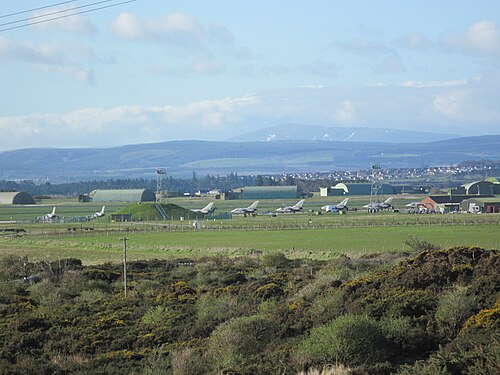
Scotland · Partial ruin
Auchindoun Castle
Auchindoun Castle is a mid-15th-century L-plan tower castle near Dufftown in Moray, Scotland. The site comprises a large central tower within a high curtain wall and a secondary round tower at the north-west corner, with several service buildings once standing within the enclosure. The ruins are a scheduled monument cared for by Historic Environment Scotland.
Its prime
1460
Today
Partial ruin
As it stood in 1460
What Auchindoun Castle looked like in its prime.
A mid-15th-century L‑plan stone tower rising within a high enclosing curtain wall on a low grassy knoll; the main central tower dominates the silhouette while a smaller round tower guards the north‑west corner. The enclosure contains lower ranges of outbuildings; walls are built of rough grey-brown rubble stone. In prime condition the curtain wall and towers are complete to their full height, with the inner yard occupied by timber-roofed service buildings (stable, brewery, bakery).
Its story
The story of Auchindoun Castle.
From Earthwork to Gordon Stronghold, mid-15th century–1535
Prehistoric or Pictish earthworks survive in the grounds at Auchindoun, but the ruins most visible today belong to the L-plan tower castle raised in the mid-15th century, sometimes said to be the work of Robert Cochrane, a favourite of King James III. While standing, it had a large central tower inside a high curtain wall, with a stable, brewery and bakery built against the wall, a second round tower guarding the north-west corner, and cellars, possibly dungeons, cut directly into the bedrock beneath the tower. The castle passed to Clan Ogilvy in 1489 and, in 1535, from the Ogilvys to Clan Gordon.
A Feud Told and Disputed, 1550–1593
Accounts by William Forbes Skene and Alexander Macbain hold that William Mackintosh, 15th of Mackintosh, burned the Earl of Huntly's castle at Auchindoun (the reason, in their telling, that Huntly had him executed in 1550), but Alexander Mackintosh-Shaw dismissed the story as entirely fictitious. In September 1562 Mary, Queen of Scots, ordered John Gordon to surrender Auchindoun and Findlater Castle; Gordon was executed after the Battle of Corrichie. An arbitration in July 1564 gave Elizabeth Gordon a liferent interest in Auchindoun, settling a dispute with her stepson, James Ogilvie of Cardell.
Clan Mackintosh damaged the castle again in 1592, in retaliation for Huntly's killing of the Bonny Earl of Moray, their ally. Patrick Gordon of Auchindoun was forfeited as a rebel in March 1593, and the castle was given to Sir George Home, whose wife Elizabeth Gordon was Patrick Gordon's stepdaughter.
Glenlivet, the Slighting Order and Viscount Dundee, 1594–1689
After the Battle of Glenlivet in October 1594, Huntly's wounded followers came to Auchindoun for safety; that same year the Ogilvys reclaimed the castle, which the Gordons had extended earlier in the century. King James VI ordered Auchindoun slighted or demolished, along with Slains Castle, Huntly Castle and the Gordon castles of Abergeldy and Newton. Following the Restoration of Charles II the castle was again awarded to the Marquis of Huntly, and on 6–7 June 1689, during the first Jacobite rising, it served as a temporary headquarters for John Graham, 1st Viscount Dundee, and his Jacobite army.
Ruin, Ballad and Return to the Public, 1725–2007
The castle was derelict by 1725, and its stones were carried off for local farm buildings and for nearby Balvenie Castle. Its sacking by Clan Mackintosh inspired the traditional song "The Burning of Auchindoun" (Child Ballad 183, also known as "Willie MacIntosh").
The ruins have been a scheduled monument since March 1994 and are in the care of Historic Environment Scotland, but for many years they were too dangerous to open to the public; on completion of consolidation works, Auchindoun reopened for public viewing in November 2007.
Step inside
8 places to explore in 1460.
The record describes 8 distinct spots at Auchindoun Castle, including 4 interiors: bakery, interior of an outbuilding, brewery, interior of an outbuilding, stable, interior of the stable range and more. Create your own photoreal reconstruction and explore every one, more scenes means more rooms, more angles, and more of the place to stand in.
Build Your Own Castle
Recreate Auchindoun Castle with AI to explore it.
The artist rebuilds it as it stood in 1460, a photoreal reconstruction that belongs to you alone. Pay with coins, no subscription needed.
Recreate this castle →Defend this castle →Whose castle
Clans who held Auchindoun Castle.
The families that held Auchindoun Castle for a decade or more across its history, follow a name to its clan.
Ogilvy
Held by Clan Ogilvy from 1489 to 1535, and reclaimed by the Ogilvys in 1594.
Held by Clan Gordon from 1535; the Gordons added the 16th-century extension before the Ogilvys reclaimed the castle in 1594.
From the archive
Auchindoun Castle on paper: the measured plan and period views.
The survey plan and photographs below are the ground truth this page's reconstructions are checked against, drawn and photographed while the castle was still a working garrison. Every image is public-domain or openly licensed, with its source named.
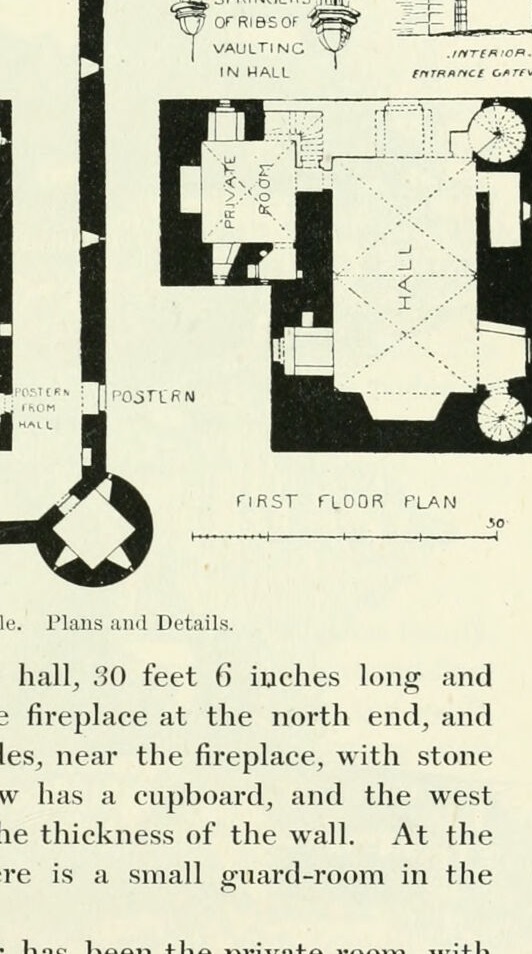
GROUND PLAN
1887 · MacGibbon & Ross, Castellated and Domestic Architecture of Scotland, vol. 1 (1887)
Public domain
FIRST FLOOR PLAN
1887 · MacGibbon & Ross, Castellated and Domestic Architecture of Scotland, vol. 1 (1887)
Public domain
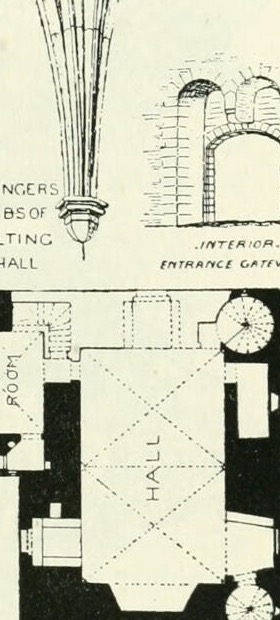
SPRINGERS OF RIBS OF VAULTING IN HALL
1887 · MacGibbon & Ross, Castellated and Domestic Architecture of Scotland, vol. 1 (1887)
Public domain