Clan Graham
also Grahame
Of Grægham, the Anglo-Norman knight who became one of Scotland's great houses.
- Origin
- Glasgow & Strathclyde, Scotland
- Motto
- Ne oublie
- Famous bearer
- James Graham, 1st Marquess of Montrose (1612–1650), Royalist general
- Register
- Scottish clan
The Graham arms, crest badge, tartan and country

Crest badgeClan member crest badge - Clan GrahamCeltus · CC BY-SA 3.0 
TartanGraham tartanMicheletb · CC BY-SA 4.0 
TartanGraham Red tartanMicheletb · CC BY-SA 4.0 
Coat of armsArms of Graham of BracoBorne by the Braco line, one branch of the name rather than all of it.MostEpic · CC BY-SA 4.0 
Coat of armsArms of Graham (ancient)Borne by the Graham line, one branch of the name rather than all of it.Newm30 · CC BY-SA 4.0


.svg)
- Crest badge: The chief's crest inside a belt and buckle: the badge a clansman wears to show whose following he is in.
- Tartan: The checked cloth the family is known by.
- Coat of arms: Granted to an individual and inherited down that one documented line. These are the arms of particular families of the name, not of everyone who shares the surname.
What is the Graham clan tartan?
Two Graham setts are shown above. They are not rival claims to be picked between; they are different records, and different weaves, of the same family cloth. A sett is the block of coloured bands the cloth is built from, repeated in both directions; the whole plaid is that one square enlarged.
Graham is a Lowland name, and Lowland families did not wear Highland dress; the 1746 proscription that broke the tradition in the north took nothing from them, because there was nothing there to take. The Graham sett is a 19th-century assignment, made when tartan stopped being Highland and became Scottish and fixed by the Bannockburn weavers’ pattern books, the royal visit to Edinburgh in 1822, and the Vestiarium Scoticum of 1842. Nobody polices any of it. Wearing the Graham sett declares allegiance to the name, not descent from any particular line of it.
CoreHistoric reach
The seat of Clan Graham
Seat vacantChief
No one leads the Clan Graham community yet. When the movement opens, you can stand for its leadership, or help elect whoever does.
Current mission
No shared goal set yet. Once Clan Graham has leadership, it sets the public focus: a restoration, a gathering, a real-world project that helps its own.
The Graham clan is being rebuilt. Join the waiting list for the movement today, and you help decide who leads it and what it does.
Help rebuild the Graham clan →Motto
Ne oublie
“Do not forget”
What does the Graham name mean?
From the manor of Grægham in Lincolnshire, 'grey home' in Old English, held by William de Graham, who came north with David I in the 1120s and was granted the lands of Abercorn and Dalkeith. The name Graham, then, is Anglo-Norman in form but has been Scottish in fact for nine centuries. The cross-border resonance, the Grahams of the West March on both sides of the line, comes from a parallel cadet branch in Cumberland.
The history of Clan Graham
Gregham, Grantham, and the knight who came north with David I
There is an old tradition that the first Graham was a warrior called Greme who broke through the Roman Antonine Wall and drove the legions out of Scotland. It is a splendid story and the family have never quite let go of it, but it is tradition rather than record, and the likelier origin is documented and Anglo-Norman. The Manor of Gregham appears in William the Conqueror's Domesday Book, and when David I claimed the throne of Scotland in the 1120s, a Graham was one of the knights who came north with him. The sources do not entirely agree on the place behind the name: one line takes it from Grægham in Lincolnshire, 'grey home' in Old English, while another identifies it with Grantham in the same county, recorded in the eleventh-century Domesday Book variously as Grantham, Grandham, Granham and Graham, from Old English grand, possibly 'gravel', and ham, a hamlet smaller than a village. Either way the conclusion is the same. Graham is Anglo-Norman in form and has been Scottish in fact for nine centuries.
What William de Graham received was not a gift but a bargain. A knight in the twelfth century held land as a fief, and the military service he owed was the quid pro quo for it; the word knight itself comes from Old English cniht, 'boy' or 'servant', and it is a reminder that these men began as the armed retainers of somebody greater. David I was importing exactly this machinery into Scotland, planting Anglo-Norman knights on Scottish soil so that the Crown could call on armoured cavalry it did not have to raise from the old kindreds. The Grahams were among the first to take the bargain, and they kept their end of it for six hundred years.
Sir William de Graham was present at the erection of Holyrood Abbey and witnessed its foundation charter, an unglamorous line in a document, and the earliest hard evidence the family has. The first lands the chiefs held were around Dalkeith in Midlothian, which stayed in Graham hands from the twelfth century until the middle of the fourteenth, when it passed to the Douglases. They also held Abercorn, granted early and likewise passed on in time to the Douglases, and lands at Craigcrook and Midhope, where Henry Graham of Mannerstoun was in possession in the fourteenth century. By 1290 the family was inside the political nation: Sir Nicholas de Graham attended the Parliament that year at which the Treaty of Birgham was signed.
Dunbar, Falkirk, and the man who stood beside Wallace
The Wars of Independence made the Grahams' reputation and cost them heavily. At the Battle of Dunbar in 1296, when the Scottish host broke, Sir Patrick de Graham of Kincardine was remembered as the only man who did not retreat, and he fought where he stood until he was killed. It is the sort of detail that survives in a family's memory because it is the sort of thing families choose to remember, but it set the pattern for everything the name did afterwards: the Grahams tended to lose late rather than leave early.
Sir John de Graham was William Wallace's friend, follower and right-hand man. He is remembered for rescuing Wallace at Queensbury, and he died at the Battle of Falkirk in 1298 with Wallace at his side. His grave is still in Falkirk churchyard, covered by table stones from three successive periods (each generation replacing the last one's slab rather than letting the marker go) and his name survives in the Falkirk district of Grahamston. Two great two-handed swords carried his memory: one is preserved at Buchanan Castle by the Duke of Montrose, and another, long in the hands of the Grahams of Orchil, is now treasured by the Freemason Lodge at Auchterarder. Graham's Castle at Dundaff, also called Sir John de Graham Castle, is said to have been his birthplace, and he is credited with fighting at Stirling Bridge in 1297, though that is tradition attaching itself to a hero rather than charter evidence.
The clan fought the English again at the Battle of Durham in 1346 in support of King David II, and in the same century secured the land that would define them. The Grahams acquired Mugdock, north of Glasgow, and built a stout castle there around 1370. They had held Mugdock from the middle of the thirteenth century and would hold it until 1945, which is close to seven hundred years in one family's hands. John Stewart, in his book The Grahams, made a claim few Scottish families could make: most clans would be proud to have one great hero, and the Grahams have three: Sir John de Graham, the Marquis of Montrose and the Viscount of Dundee. He also observed that the early Grahams rose gradually and steadily on their own ability rather than by royal favour or at the expense of their peers, and that in an age when the reputations of most of the Scottish nobility were sullied by violence and treachery, the Grahams stand out as loyal to the causes they chose.
Mugdock, Kincardine and the climb to an earldom
Between the Wars of Independence and the Reformation the Grahams did the unspectacular work that turns a knightly family into a great house: they held castles, married well, and turned up when the king called. Kincardine Castle at Auchterarder was theirs from about 1250, a substantial fortress that survived until the Campbell Earl of Argyll demolished it in 1646. Mains Castle, also called Fintry Castle, was originally a Stewart holding and passed to the Grahams in 1350; it was the Grahams who built the castle that stands today, and it stayed with the Grahams of Fintry from 1530 until Robert Graham sold the lands in the nineteenth century, after which it went to the Erskines, then the Cairds, and finally to the people of Dundee, whose public park now surrounds it. Inchtalla Castle was the seat of the Grahams who were Earls of Menteith, the second of the clan's two main houses.
The rise was confirmed on the battlefield. The third Lord Graham led his men at Sauchieburn on 11 June 1488, fought beside the Sauchie Burn about two miles south of Stirling. For his gallantry Lord Graham was created Earl of Montrose in the first years of the sixteenth century: the staged sources give 1504 and the family's own record gives 1505, and the discrepancy is worth noting rather than smoothing over. The new earl led part of the Scottish vanguard against the English at Flodden in 1513 and was killed there. The Grahams were out again at Pinkie Cleugh in 1547, where Robert, the eldest son of the second Earl, was killed. Three generations, three battles, two dead earls' heirs: this is what a title cost in sixteenth-century Scotland.
The clan divided into two main families, each with its own tartan: the Grahams of Menteith, descended from the Earl of Menteith, and the Grahams of Montrose, descended from the line that became Dukes. William Graham became 7th Earl of Menteith in 1610, in what is now Perthshire. The Montrose Grahams held territory in both the Highlands and the Lowlands, which is unusual and which mattered later: it is part of why a Montrose could raise Highland foot and command Lowland gentry in the same campaign.
Six victories in a single year: the Great Marquess
James Graham, 1st Marquess of Montrose (1612–1650), was a poet and, above all, the most distinguished Royalist soldier of his time. When the Civil War reached Scotland the Grahams rallied to their chief, and what followed is the most concentrated run of success in Scottish military history. Montrose won at Tippermuir, at Aberdeen, at Inverlochy in 1645, at Auldearn, at Alford and at Kilsyth: six victories in roughly twelve months, fought mostly with fewer than two thousand Highland and Irish foot against forces several times their size. He had the support of Alasdair MacColla, known as Alaster M'Coll Keitach, and his Irish soldiers, and he moved faster in winter through worse country than his enemies believed possible.
It ended at Philiphaugh on 13 September 1645, where the Covenanter army of David Leslie, Lord Newark, caught and destroyed his force and restored the power of the Committee of Estates. Montrose kept fighting. In 1646 he laid siege to Chanonry Castle, held by the Clan Mackenzie, and took it after four days. In March 1650 he captured Dunbeath Castle from the Clan Sinclair, who would nonetheless support him afterwards at Carbisdale. There he was defeated by the Munros, Rosses and Sutherlands under Colonel Alexander Strachan, and captured.
He was hanged at the Mercat Cross in Edinburgh in 1650, by an Estates parliament that judged the political theology of his Royalism more dangerous than his generalship. Read the record plainly and the executioners were not fools: a man who could raise the Highlands twice in five years was a standing threat to whoever held Edinburgh. That is the hard part of the story, and it should not be softened. But the reason his name outlived theirs is that he had told them exactly where he stood and did not move, and Scotland has always been a country that forgives losing more readily than it forgives trimming.
Bonnie Dundee: the last charge at Killiecrankie
By the late seventeenth century, through purchase and inheritance, the Graham lands were among the richest in Scotland. Out of that wealth came the second of the clan's soldier-heroes. John Graham of Claverhouse, Viscount Dundee (1648–1689), 'Bonnie Dundee', bought Dudhope Castle in 1684; Claypotts Castle, bought by Sir William Graham of Ballunie in 1601, later passed to Sir William Graham of Claverhouse and became a Claverhouse holding too.
Claverhouse made his name in the Covenanting wars, and the record is mixed rather than heroic throughout. At Drumclog in 1679 he led a small government troop of cavalry, was surprised, and was beaten by a rebel Covenanter force estimated at four times his strength. Later the same year he was on the winning side at Bothwell Brig in Lanarkshire on 22 June 1679, where the Covenanter rising was put down. To the Covenanting tradition he is not 'Bonnie' anything, and a reader whose family came out of the south-west of Scotland may have inherited the other view of him. Both views are part of the name's history.
King James VII appointed him Commander in Chief of all Scottish Forces, and when the king lost his throne Claverhouse raised the first Jacobite rising for him. At Killiecrankie in 1689 his Jacobite army beat a much larger Williamite force, and he was killed in the moment of victory. The rising effectively ended with him, before it had properly begun. It is the sharpest single sentence in the clan's history: the Grahams won the field at Killiecrankie and lost the war that afternoon.
The riding Grahams of the Debatable Land
There is a second Graham story, and it belongs to a different sort of people. The Grahams of the West March, in and around the Debatable Land on the Anglo-Scottish border, were a riding clan, Border reivers, related to the Montrose Grahams by name rather than by close blood, and grown from a parallel cadet branch in Cumberland. They lived on both sides of the line, which was the point: the Debatable Land was ground neither kingdom effectively governed, and a family that could ride out of it and back into it was very hard to punish.
They were clans in law as well as in fact. An Act of the Scottish Parliament of 1587 speaks of the 'cheiffis and chiftanes of all clannis, alsweill on the hielandis as on the bordouris' (chiefs and chieftains of all clans, on the Highlands as well as on the Borders) and goes on to list the Lowland riding families by name, the Maxwells, Johnstones, Carruthers, Turnbulls and the rest. The same act refers to the principals of the branches of those clans, to pledges relieved by others of the same clan or branch, and to young men sprung up in their race and clan. Whatever else the Border Grahams were, they were not a lawless rabble in the eyes of the state that hunted them; they were an organised kindred with a head, and the Crown dealt with them as such.
The Union of the Crowns in 1603 ended the frontier and ended them with it. James VI, now ruling both kingdoms, had no further use for a buffer zone full of armed families and set about breaking the riding clans systematically. The Grahams were among the hardest hit: broken up, dispossessed, and many of them transported to Ireland, the same fate handed to the Armstrongs. The Graham surname was carried into Northern Ireland by Scottish and English settlers through the seventeenth century, and a great many Ulster and later American, Canadian and Australian Grahams descend from that forced scattering rather than from Mugdock. If your family came through Ulster, this is very probably your line, and it is not a lesser one. It is the harder half of the same name.
Neutral in the risings, and the duke who gave the tartan back
Having produced the man who won Killiecrankie, the clan then did the thing nobody expects of it: in the Jacobite risings of the eighteenth century, Clan Graham took no side and stayed neutral throughout. The chiefly line had been raised to the marquessate in 1644 and to the dukedom of Montrose in 1707, and dukes with estates in both Highlands and Lowlands had a great deal to lose and no appetite for losing it. The Grahams of Kinross came into Burleigh Castle after the Balfour forfeiture, and the Dukes held Crookston Castle from 1703 to 1757.
The clan's most quietly important act came after the fighting was over. Highlanders can thank James Graham, 3rd Duke of Montrose, for the repeal in 1782 of the Dress Act of 1746, which had forbidden the wearing of Highland dress. He argued it through Parliament and got the law removing tartan from Scots taken off the books. A family that gave the Jacobite risings nothing at all handed the Highlands back their plaid, which is a more useful legacy than another lost battle.
The military tradition did not stop. Thomas Graham of Balgowan, whose family lived at Newton Castle, became one of Wellington's generals and was created Lord Lynedoch. Mugdock, the seat since the mid-thirteenth century, was finally sold in 1945. Buchanan Castle in Stirlingshire is the chief's seat now, and since 1992 the chief has been James, Duke of Montrose, Marquis of Graham and Buchanan, Earl of Kincardine, Viscount of Dundaff, Lord of Mugdock, Aberuthven and Fintrie, Baronet of Braco: a string of titles that reads as a map of everywhere the family got to.
Ne oublie: the name today
The clan motto is Ne oublie, 'do not forget', which for a family with this record is less a pious sentiment than an instruction. The surname travels as Graham, Grahame and Graeme, and it is now so familiar that it has become a common man's forename in its own right; among the earlier examples of the reverse traffic was Graham Cockburn, a daughter of Henry Cockburn, Lord Cockburn, given the surname as a first name.
The name has a literary streak that surprises people who know only the soldiers. Simon Grahame (1570–1614) was a Scottish writer; James Grahame (1756–1811) and Robert Cunninghame Graham of Gartmore (1735–1797) were Scottish poets; and Kenneth Grahame (1859–1932), the Scottish novelist, wrote The Wind in the Willows. Montrose himself was a poet before he was a general. In the modern game, George Graham of Lanarkshire won the league at Arsenal twice over, first as an elegant player and then as the manager of one of the great English defences.
One caution for the reader tracing the name. A clan surname on its own does not prove agnatic descent from the chiefly house; Scottish clanship ran on lordship, clientage and territorial dependence as much as on blood, and families living on a chief's land commonly took his name over time. Septs make this murkier still: there is no official list of clan septs, the decision on who is a sept is left to each clan, and the same sept name is often claimed by more than one clan. None of that makes a Graham less a Graham. It means the honest thing to say is that you carry a name that Sir John de Graham died with at Falkirk, that Montrose was hanged under, and that James VI could not stamp out of the Debatable Land, and that is quite enough to be going on with.
Champions of the Graham name
The bearers whose lives are inseparable from this surname. Each has their own page, biography, achievements, geography, connection to the family.
Castles the Graham held
Strongholds this name held for a decade or more, look one up, or rebuild it to explore.
- Midhope Castle
The lands of Midhope were owned by Henry Graham of Mannerstoun in the 14th century.
- Dalkeith Palace
In the possession of Clan Graham, Lords of Dalkeith, from the 12th century until 1341–42.
- Mugdock Castle
Stronghold of Clan Graham, later Earls and Dukes of Montrose, from the mid-13th century until sold in 1945.
- Crookston Castle
Held by the Graham Dukes of Montrose, 1703–1757.
- Claypotts Castle
Bought by Sir William Graham of Ballunie in 1601, later sold to Sir William Graham of Claverhouse.
- Dudhope Castle
Bought by John Graham of Claverhouse, 'Bonnie Dundee', in 1684.
- Mains Castle
Seat of the Grahams of Fintry from 1530 until Robert Graham sold the lands in the 19th century.
- Newton Castle
The Grahams of Balgowan lived at the castle; Thomas Graham, one of Wellington's generals, became Lord Lynedoch.
- Craigcrook Castle
Held the lands of Craigcrook in the 14th century.
- Abercorn Castle
Passed to Clan Graham by marriage, before passing on to the Douglases.
- Burleigh Castle
Passed to the Grahams of Kinross after the Balfour forfeiture.
The castles of the homeland
The great strongholds of the homeland, look one up, see what it looked like in its prime, and recreate it to explore.
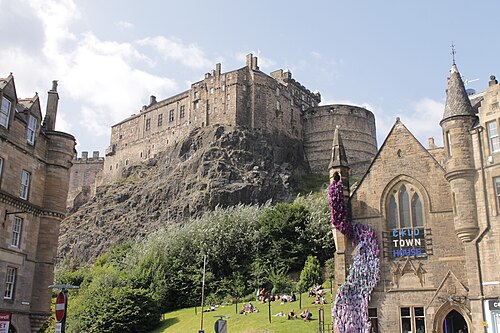 Edinburgh CastleRestored · prime 1520
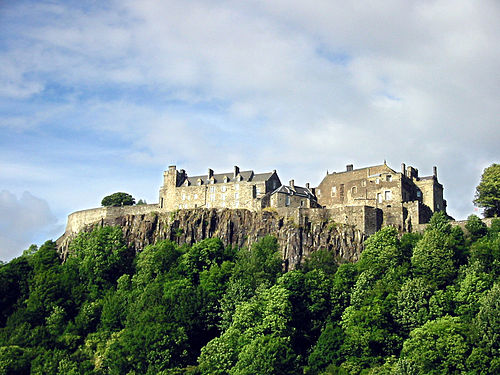 Stirling CastleRestored · prime 1542
 Glamis CastleStill standing · prime 1900
All castles in Scotland → · Strongest castles in Scotland → · Castles of Europe
Play As Your Clan
Hold a real castle against whatever you choose to send at it, take a ship out in her own service years, or stand at the shoulder of someone the record remembers. The chronicler sets the scene; the deeds are yours.
Notable bearers of the Graham name
- James Graham, 1st Marquess of Montrose (1612–1650), Royalist general
- John Graham of Claverhouse, Viscount Dundee, 'Bonnie Dundee' (1648–1689)
- Kenneth Grahame (1859–1932), author of The Wind in the Willows
Stories of Clan Graham
Killiecrankie
1689In April 1689 the Convention of Estates declared the throne of Scotland forfeit and offered the crown to William and Mary. James VII and II, lately deposed, had one party in Scotland that would not accept the change: the Highland clans. The man who raised them was John Graham of Claverhouse, recently created Viscount Dundee, called Bonnie Dundee in the country and Bluidy Clavers in the kirk. By July 1689 he had two and a half thousand Highlanders at his back, against four thousand government foot under Major-General Hugh Mackay. They met at the Pass of Killiecrankie above the River Garry on the evening of the twenty-seventh of July. The Highland charge that came down the slope decided the field in ten minutes and lost the war in the same minute.
Read the story →
Montrose at the Mercat Cross
1650On the twenty-first of May 1650, James Graham, fifth Earl and first Marquess of Montrose, by general assent the most brilliant Royalist commander of the Scottish civil wars and the architect of the annus mirabilis of 1644–45, was hanged at the Mercat Cross at the head of the High Street in Edinburgh on a thirty-foot gibbet. He had been captured at Ardvreck Castle in Sutherland three weeks earlier, after the failure of his Royalist landing in support of Charles II at the head of Loch Eriboll. He was thirty-seven years old. The Earl of Argyll, his old enemy, watched from a window of the Marquess's lodging on the Royal Mile as the cart went up. The crowd that had been ordered to spit on him as he passed was, by every contemporary report, silent and weeping. He went to the gallows in a black suit Argyll had refused to let him replace with the scarlet of his Order of the Garter. He carried his copy of George Wishart's biography of him around his neck on a string, in a parchment volume bound in calf, and the gibbet rope was placed over the volume. After the execution his body was quartered, the head spiked at the Tolbooth where it remained for eleven years, the limbs sent to Glasgow, Stirling, Perth and Aberdeen. In May 1661, after the Restoration, the body parts were collected and reassembled and the funeral he had not had was held at St Giles. He is buried in the abbey of the Knights of St John, by the south transept of St Giles, ten yards from where his head had stood.
Read the story →
Frequently asked
What does the surname Graham mean?
Where does the Graham family come from?
Where did the Graham family historically hold territory?
Is Graham Scottish or Irish?
How old is the Graham surname?
What is the Graham family known for?
What is the Graham motto?
What does "Ne oublie" mean in English?
Is there a Graham family crest or coat of arms?
What is the Graham clan tartan?
Who is the most famous Graham?
Who are some famous Grahams?
What stories are told about the Graham family?
What is the story of Killiecrankie?
Is Grahame the same family as Graham?
Where is the Graham surname found today?
What does the Clan Rising page for the Graham family cover?
Who is the head of the Graham family today?
A note from the editors
- Cross-border with England: the West March Grahams held the Debatable Land. The England catalogue will surface this entry alongside the Scottish home.