Clan Cockburn
A border clan of jurists and queen's men.
- Origin
- The Borders, Scotland
- Motto
- Accendit cantu
- Famous bearer
- Sir Alexander J. E. Cockburn, Lord Chief Justice
- Register
- Scottish clan
The Cockburn crest badge, tartan and country

Crest badgeClan member crest badge - Clan CockburnCeltus · CC BY-SA 3.0 
TartanCockburn tartanMicheletb · CC BY-SA 4.0


- Crest badge: The chief's crest inside a belt and buckle: the badge a clansman wears to show whose following he is in.
- Tartan: The checked cloth the family is known by.
What is the Cockburn clan tartan?
One Cockburn sett is recorded, and it is the swatch above. A sett is the block of coloured bands the cloth is built from, repeated in both directions; the whole plaid is that one square enlarged.
Border families did not wear Highland dress, and no proscription touched them. What was worn on the Cockburn ground was the shepherd’s check: the two-colour Border plaid, older than any clan sett and belonging to a district rather than a surname. The Cockburn tartan is a later thing: a Highland-style pattern attached to a Border name in the 19th century, when tartan stopped being Highland and became Scottish. Nobody polices any of it. Wearing the Cockburn sett declares allegiance to the name, not descent from any particular line of it.
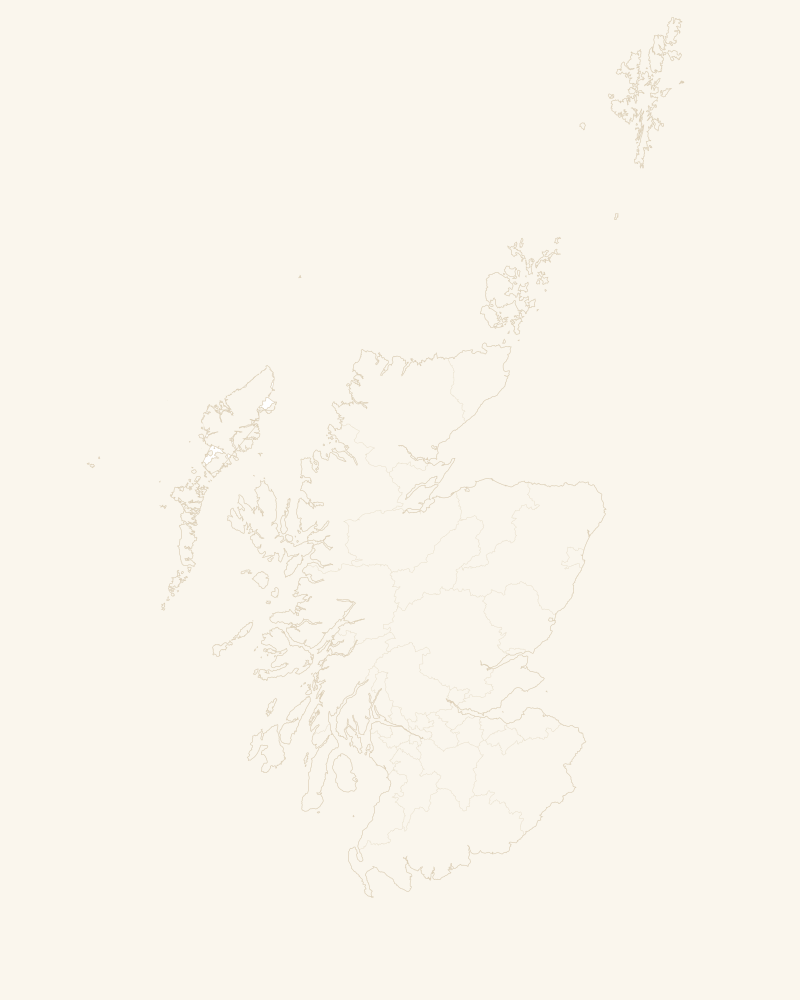
The seat of Clan Cockburn
Seat vacantChief
No one leads the Clan Cockburn community yet. When the movement opens, you can stand for its leadership, or help elect whoever does.
Current mission
No shared goal set yet. Once Clan Cockburn has leadership, it sets the public focus: a restoration, a gathering, a real-world project that helps its own.
The Cockburn clan is being rebuilt. Join the waiting list for the movement today, and you help decide who leads it and what it does.
Help rebuild the Cockburn clan →Motto
Accendit cantu
“He excites us with song”
What does the Cockburn name mean?
From a place name near Duns in Berwickshire, likely 'cock' (woodcock or rooster) + 'burn' (stream).
The history of Clan Cockburn
A moor-cock, a burn, and the hill above the Whiteadder
The name is Border landscape before it is a family. The usual reading joins 'cock', from the Old English cocc, meaning a moor-cock or wild bird and possibly simply a hill, to 'burn', from burna, a brook or stream. A moor-cock's stream: the sort of small feature that identified a man when there was no other way to tell one Robert from another in a Border parish.
Which stream is disputed. The candidate most often named is a place near modern Duns in Berwickshire, where Cockburn names cluster along the Whiteadder Water: Cockburn farm, Cockburn Mill, the ruined Cockburn East, under the Iron Age fort on Cockburn Law. But there are rivals: a former Cokoueburn district in early medieval Roxburghshire, and Cockburnspath on the east coast, originally Kolbrand's Path, which only later drifted into the Cockburn spelling. Nobody can now say which stream gave the family its name.
One thing the name never did was stay quiet. The Scots pronunciation is KOH-burn, the ck silent, and has been for centuries. The spelling invites a reading the family never intended, and that gap has followed Cockburns from the Border to Washington and into the internet age.
Charters, the Ragman Roll, and the rebel of Megget
The surname had appeared by the early 13th century, marking out individuals from a place called Cockburn. Perhaps the earliest recorded bearer is a Petro de Cokburne, who witnessed a charter in the Register of the House of Soltre recording a gift of arable land at Lempitlaw, east of Kelso in Roxburghshire. It was long dated to about 1190 to 1220, but that dating has recently been revised to 1251 to 1274: even the family's first appearance in writing is disputed.
After that the men come thick and traceable. A Robert de Cockburn appears as a serviens, a servant or sergeant, in a charter of 1232 to 1242. The knight Sir Roberto de Cokeburn, possibly the same man, is named in a charter drawn at Chirnside on 4 November 1261, and in another of 1269 to 1289 he holds real office as constable of the royal burgh of Roxburgh.
In the summer of 1296, with Edward I overrunning Scotland, most of the Scottish nobility and clergy sealed the Ragman Roll swearing allegiance to him, Pieres and Thomas de Cokeburn 'del counte de Rokesburgh' among them. At least one Cockburn made the other choice. A charter of 20 March 1312 records Edward II restoring to Nigel de Cockburn his land in Megget (later Henderland) stripped from him because he was declared a rebel, most likely for refusing the Roll. Eleven other rebels were restored in the same charter: policy, not mercy, from a king buying allies before his next invasion.
Two heiresses, the Great Seal, and the barony of Langton
The family's rise was made by marriage. In 1330 Sir Alexander de Cokburne married the Anglo-Norman heiress Mariota de Veteriponte, also recorded as Maria de Vipont, and with her took the baronies of Langton in Berwickshire, Carriden in West Lothian and Bolton in East Lothian. Langton lay south-west of Duns, six kilometres from Cockburn Tower. A second marriage, to the heiress Maria de Monfode, added Skirling in Peeblesshire.
The estate was split among Sir Alexander's three sons, Langton and Carriden staying with the eldest, also Alexander. For four hundred years the Cockburns of Langton were among the principal landowners of Berwickshire, and cadet lines took root beside them at Ormiston and Clerkington in East Lothian, Henderland in Megget, and Skirling in western Peeblesshire.
Office followed land. Sir Alexander Cockburn of Langton became Keeper of the Great Seal of Scotland in 1390, and his son was created Great Usher in the Scots Parliament, a hereditary place at the door of the nation's assembly. It is the start of the pattern that runs through the family story: Cockburns are found less often leading armies than holding the seals, the courts and the records.
Cockburn Tower and the reiver of Henderland
The senior line got a seat of its own late. About 1527 William Cockburn bought the land around Cockburn Law from Alexander Lindsay, 4th Earl of Crawford, and Cockburn Tower (a small fortified house on the southern slope of the Law, above the Whiteadder Water) was the seat of the Cockburns of that Ilk until 1696, when tower and land were auctioned to pay the debts of Sir James Cockburn of that Ilk. The tower is a ruin today.
Three years after that purchase the family produced its most notorious member. William Cockburn of Henderland was a Border reiver, and a successful one: known for his thieving and, more dangerously, for his working relationship with his English counterparts over the line. That made him the man the young James V needed to destroy to prove the crown, and not the riding surnames, governed the Border. Cockburn was arrested in 1530, tried in Edinburgh, convicted of treason and beheaded, his lands forfeited.
The family clawed it back. His son, another William, recovered Henderland after an appeal in 1542 to the Regent, James, 2nd Earl of Arran. The reprieve lasted a century: his great-great-grandson Samuel Cockburn sold the estate in 1634.
Ormiston, the Reformation, and the queen's men
The Ormiston branch begins with a marriage in 1370, when John Cokburne, second son of Sir Alexander de Cokburne, married Johanetta de Lyndessay, an heiress who owned the estate of Ormiston in East Lothian. The Cockburns held it from the 14th century, and Ormiston became the branch that argued hardest about how Scotland ought to be run.
John Cockburn of Ormiston and his brother Ninian were Protestant supporters of the Scottish Reformation, and in 1548, during the war of the Rough Wooing, they came out for the English cause, treason by one reading and principle by another, but either way it put the family inside the century's central quarrel rather than on its edge.
A generation later they stood on the other side of the same fight. The Cockburns were staunch supporters of Mary, Queen of Scots, and paid the ordinary price of backing a losing queen: in 1568 they lost their castle at Skirling. Reformers in 1548, queen's men in 1568: Border families chose, they lost, and they carried on.
Improvement, debt, and the auction of two estates
What finally broke the Cockburn landholdings was not warfare but agricultural improvement, the 18th-century enthusiasm for remaking Scottish farming, pursued by two branches with more conviction than capital. Sir Archibald Cockburn, 4th Baronet of Langton, borrowed heavily, chiefly from the Cockburn of Cockburn branch of his own family, to finance reforms at Langton, and three succeeding baronets failed to resolve it.
By the death of Sir Alexander Cockburn, 7th Baronet, at Fontenoy in 1745, the position was critical. In 1747 his heir, Sir James Cockburn, 8th Baronet, could not fend off creditors who included Sir James Cockburn, 3rd Baronet Cockburn of that Ilk, one Cockburn line foreclosing on another. The Lords of Session found for the creditors and the House of Lords upheld them on appeal. Langton was auctioned and bought in 1757 by David Gavin; the barony held since 1330 was gone.
Ormiston went the same way for the same reason. John Cockburn of Ormiston tried to prove the case for modern agriculture by building a model community there; the scheme ran into debt and he sold the estate in 1747 to John Hope, 2nd Earl of Hopetoun. The Langton Cockburns lost their land but not their standing, staying prominent well into the 19th century through the military and the law.
Coburn, Cogburn, de Cockborne, Kabrun
Few Scottish surnames have splintered as widely. Early medieval clerks wrote Cokburne, Cokeburne and Kokeburne; in Scotland the spelling settled on Cockburn by the late 17th century, the form still used across the Commonwealth. In the United States most branches adopted the simplified Coburn, others Cogburn, and in Cumberland the Cockbain family emerged from Scottish Cockburn ancestors.
The continental branches came out of soldiering and trade. Under the Auld Alliance a branch was founded in France in the 16th century by mercenary soldiers, and as early as 1494 a Thomas Cocquebourne was an archer in the Garde Écossaise, the Scots bodyguard of the King of France; one French line settled on de Cockborne, sounding the middle ck. The mercenary commander Samuel Cockburn signed himself Cobron in Swedish service, and a Cockburn merchant founded a German branch in Hanseatic Danzig under the name Kabrun, whose great-grandson Jacob Kabrun Jr, 1759 to 1814, became a wealthy merchant and collector of books and art.
The pronunciation stayed a live issue. The spelling is famously mispronounced as 'cock burn', sometimes deliberately, and enough bearers have changed to Coburn purely to force the right sound. During the War of 1812, after the burning of Washington, Admiral George Cockburn had the printing houses of the National Intelligencer destroyed and told his men to be sure all the C's were destroyed, so that the rascals could not any longer abuse his name.
The bench, the quarterdeck and the far ports
The family's second act was made in the courts. Henry, Lord Cockburn was the leading Whig advocate at the Scottish bar through a long Tory generation, sat as an Edinburgh judge, drafted the Scottish Reform Act and wrote Memorials of His Time, still the foundational personal record of late-Georgian and early-Victorian Edinburgh. Sir Alexander J. E. Cockburn went further south and higher: Solicitor-General in 1850, Chief Justice in 1858 and Lord Chief Justice of England in 1859, presiding over many of the most notorious trials of Victorian England, including the Tichborne case in 1873. He was also 12th Baronet of Langton, and at his death in 1880 without legitimate issue that baronetcy went dormant; of the two Cockburn baronetcies, only Cockburn of Cockburn survives.
The name also travelled with the fleet and the colonial service, and that history is not a comfortable one. Cockburns were living in the Bahamas, Barbados and Jamaica by the early 18th century, in a Caribbean built on enslaved labour; three generations of one Langton family practised medicine there, beginning with Dr James Cockburn, born about 1659 at Langton and dead in Jamaica in 1718. Admiral Sir George Cockburn fought the French and Spanish in those waters during the Napoleonic Wars, and Sir Francis Cockburn administered British Honduras from 1830 to 1837 and then the Bahamas, giving his name to Cockburn Town on San Salvador Island.
Some Scottish Cockburn men settled in those islands and married Caribbean women, and their descendants carry the name still; other bearers there acquired it by routes that had nothing to do with a Berwickshire burn. A family that began as the men of a moor-cock's stream can look at the whole of that record (the seals and the courts, the reiving and the scaffold, the auctions and the far ports) and neither disown it nor gild it.
Champions of the Cockburn name
The bearers whose lives are inseparable from this surname. Each has their own page, biography, achievements, geography, connection to the family.
Castles the Cockburn held
Strongholds this name held for a decade or more, look one up, or rebuild it to explore.
- Duns Castle
Sir James Cockburn of Cockburn bought the estate and burgh of Duns in 1670; sold on in 1698.
- Ormiston Castle
The Cockburns acquired the property in the 14th century.
The castles of the homeland
The great strongholds of the homeland, look one up, see what it looked like in its prime, and recreate it to explore.
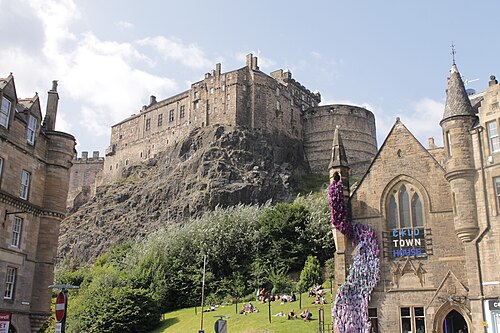 Edinburgh CastleRestored · prime 1520
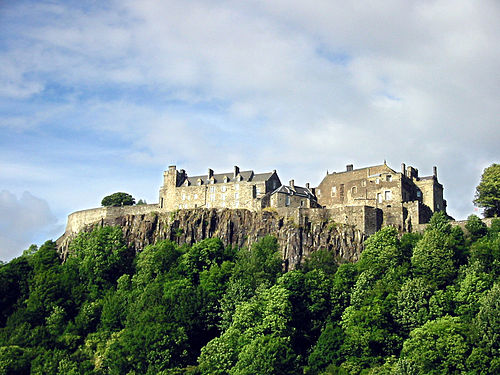 Stirling CastleRestored · prime 1542
 Glamis CastleStill standing · prime 1900
All castles in Scotland → · Strongest castles in Scotland → · Castles of Europe
Play As Your Clan
Hold a real castle against whatever you choose to send at it, take a ship out in her own service years, or stand at the shoulder of someone the record remembers. The chronicler sets the scene; the deeds are yours.
Notable bearers of the Cockburn name
- Sir Alexander J. E. Cockburn, Lord Chief Justice
Frequently asked
What does the surname Cockburn mean?
Where does the Cockburn family come from?
Is Cockburn Scottish or Irish?
How old is the Cockburn surname?
What is the Cockburn family known for?
What is the Cockburn motto?
What does "Accendit cantu" mean in English?
Is there a Cockburn family crest or coat of arms?
What is the Cockburn clan tartan?
Who is the most famous Cockburn?
Where is the Cockburn surname found today?
What does the Clan Rising page for the Cockburn family cover?
Who is the head of the Cockburn family today?
Neighbouring clans
- ElliotOne of the great riding clans of the Borders.
- ScottOf the Borders, Buccleuch, Walter Scott, and the Antarctic.
- ReidThe red one, descriptive Scots surname, dense in the Lothians and the Borders.
- WatsonSon of Wat, the Lowland patronymic that produced both the steam engine and Sherlock Holmes's friend.