Clan Scott
Of the Borders, Buccleuch, Walter Scott, and the Antarctic.
- Origin
- The Borders, Scotland
- Motto
- Amo
- Famous bearer
- Sir Walter Scott
- Register
- Scottish clan
Ranked of all time
The 10 Most Powerful Scottish Clans of All Time
The Scott arms, crest badge, tartan and country

Crest badgeClan member crest badge - Clan ScottCeltus · CC BY-SA 3.0 
TartanScott tartan (Vestiarium Scoticum)As printed in the Vestiarium Scoticum, 1842, a collection whose claimed medieval source was never produced, and which is now generally held to be a forgery. Families adopted its patterns anyway, and wear them still.Celtus · CC BY 2.5 
Coat of armsArms of the house of Scott of BuccleuchThe arms of the house itself: the main line, not one of its cadet branches.MostEpic · CC BY-SA 4.0 
Coat of armsScott (of Sinton, Roxburghshire, Scotland) armsBorne by the Sinton line, one branch of the name rather than all of it.Lobsterthermidor · CC BY-SA 3.0

.png)

_arms.svg)
- Crest badge: The chief's crest inside a belt and buckle: the badge a clansman wears to show whose following he is in.
- Tartan: The checked cloth the family is known by.
- Coat of arms: Granted to an individual and inherited down that one documented line. These are the arms of particular families of the name, not of everyone who shares the surname.
What is the Scott clan tartan?
One Scott sett is recorded, and it is the swatch above (the plate printed in the Vestiarium Scoticum in 1842). The Vestiarium claimed to copy a medieval manuscript that was never produced, and is now generally held to be a forgery; families adopted its patterns anyway, and wear them still. A sett is the block of coloured bands the cloth is built from, repeated in both directions; the whole plaid is that one square enlarged.
Border families did not wear Highland dress, and no proscription touched them. What was worn on the Scott ground was the shepherd’s check: the two-colour Border plaid, older than any clan sett and belonging to a district rather than a surname. The Scott tartan is a later thing: a Highland-style pattern attached to a Border name in the 19th century, when tartan stopped being Highland and became Scottish. Nobody polices any of it. Wearing the Scott sett declares allegiance to the name, not descent from any particular line of it.
This name is thick on both sides of the border, so the map shows the whole of Britain and Ireland with every region it touches highlighted. It is a regional pattern for the surname, not proof that your branch lived in each place.
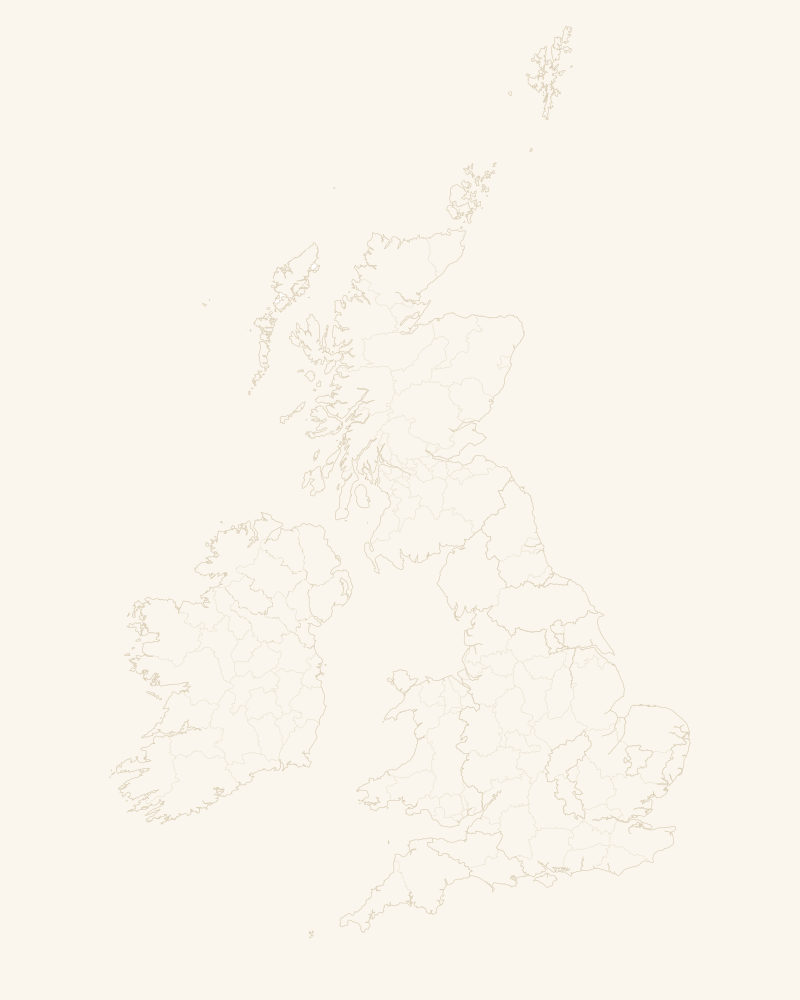
CoreHistoric reach
The seat of Clan Scott
Seat vacantChief
No one leads the Clan Scott community yet. When the movement opens, you can stand for its leadership, or help elect whoever does.
Current mission
No shared goal set yet. Once Clan Scott has leadership, it sets the public focus: a restoration, a gathering, a real-world project that helps its own.
The Scott clan is being rebuilt. Join the waiting list for the movement today, and you help decide who leads it and what it does.
Help rebuild the Scott clan →Motto
Amo
“I love”
What does the Scott name mean?
Originally a name for the Gaelic-speaking peoples, 'Scotti' was the Roman term for the Irish raiders who would settle the western seaboard and lend their name to Scotland itself. The surname is cross-border, with substantial English-Scott populations principally in Northumberland, Cumbria, and the late-Victorian London middle class (which is the Scott of Captain Robert Falcon Scott of the Antarctic).
The history of Clan Scott
Uchtred's son, and a name that meant 'a Scot'
The surname begins as a description of a people rather than of a family. Scotti was the Roman word for the Gaelic-speaking Irish, the raiders who crossed to settle the western seaboard and in time lent their name to Scotland itself. That neat line will not stand. There is no evidence the surname originated with those first settlers; in the medieval period it attached to the Kingdom of Scotland rather than to the earlier Gaelic kingdom of Dalriada, whose inhabitants did not call themselves by it. Other accounts still derive it from the Scots who came into Argyll out of Ireland, and the two readings have never been reconciled. To a twelfth-century clerk it meant something simpler: this man is a Scot (said, invariably, by somebody who was not).
The earliest certain record is the one George Fraser Black gives in his Surnames of Scotland: Uchtred, styled Filius Scoti, in the charter of about 1120 recording the foundation of Holyrood Abbey and Selkirk. In 1195 Henricus le Scotte witnessed a charter by David, Earl of Strathearn, and early in the thirteenth century a Master Isaac Scotus witnessed charters by the Bishop of St Andrews, the name already at work in the business of the kingdom, a century before the Wars of Independence. Some accounts push the riding families back to Peeblesshire in the tenth century, but the surname is only visible on parchment from the twelfth, and the earlier claim rests on tradition rather than record.
The strangest early bearer is Michael Scott, called the Wizard (1175–c.1232), a real scholar and philosopher whose reputation outran him by centuries. The novelist who shared his surname six hundred years later wrote of him in The Lay of the Last Minstrel as "addicted to the abstruse studies of judicial astrology, alchemy, physiognomy, and chiromancy. Hence he passed among his contemporaries for a skilful magician".
Rankilburn, Murthockstone and the making of Buccleuch
Four generations after Uchtred, Sir Richard Scott married the heiress of Murthockstone and took her estates with her; in 1296 Richard le Scott of the Buccleugh family became feudal lord of Murdostoun, the same place under its other spelling, by that marriage. He was appointed ranger of Ettrick Forest, an office that brought him the additional lands of Rankilburn, and the new laird built his residence at a spot called Buccleuch. The estates became generally known by that name, and so, before long, did the family. It is the hinge of the whole story: the Scotts took their designation from a place, and thereafter the place carried the name of the Scotts.
His son Sir Michael Scott, second Laird of Buccleuch, was a staunch supporter of Robert the Bruce through the Wars of Scottish Independence. Michael distinguished himself at Halidon Hill in 1333, being one of the few who escaped the carnage of that day, and was killed thirteen years later at the Battle of Durham in 1346. He left two sons. Robert became the third laird; John founded the Scotts of Synton, the cadet branch from which the Lords Polwarth descend. Robert died in about 1389, probably of wounds taken at the Battle of Otterburn. Three consecutive lairds, three English battlefields: that is the tax the Border country levied on the families who held it.
A thousand spears in Teviotdale
Robert Scott, fifth of Buccleuch, succeeded in 1402 after his father Walter was killed in battle, and began the accumulation that made the family formidable. In 1420 he acquired half the lands of Branxholme, held by Scotts from that year to this. He supported the Crown in its long struggle to break the power of the Clan Douglas, and when the king's cause prevailed was rewarded with tracts of Douglas land. On 23 July 1446 Sir Walter Scott took the remaining lands of the barony of Branxholme from Thomas Inglis in exchange for Murdostoun: the family traded away its Lanarkshire inheritance to buy out its Teviotdale stronghold entire. Goldielands, near Hawick, came the same year.
In 1463 Branxholme was erected into a free barony, held of the Crown for the annual payment of a red rose on the feast day of St John the Baptist, a rent so light it was really a statement about standing. The rest follows in a steady line. Newark, on what is now the Bowhill estate, dates from around 1423. William Scott, first laird of Harden, took that estate from Lord Home in 1501. Aikwood was granted to Robert Scott by James V in 1517, its tower dated to 1535. Dryhope came to the Scotts of Harden, and Smailholm, a fifteenth-century Pringle stronghold, to the same branch.
By the end of the fifteenth century the Scotts were one of the most powerful of all the Border clans, and the chief could call upon a thousand spears, not an army in any modern sense, but tenants, kinsmen and clients who lived on Scott ground and owed riding service for it, raised in a day and dispersed in a week. That is also why the word clan belongs here. The Highland-clan-versus-Lowland-family distinction is a nineteenth-century invention, as Sir Crispin Agnew of Lochnaw of the Court of the Lord Lyon has pointed out; an Act of the Scottish Parliament of 1587 speaks plainly of the "cheiffis and chiftanes of all clannis, alsweill on the hielandis as on the bordouris", and names the Border riding surnames alongside the rest.
The Kerrs, the Elliots and the price of a feud
Like most of the riding families the Scotts quarrelled with their neighbours, and the deepest quarrel was with the Kerrs. It began on 25 July 1526 in an action known as the Battle of Melrose, when Sir Walter Scott of Buccleuch attacked to rescue the young James V, who was being held by the Douglas Earl of Angus at Darnick, just west of Melrose. Kerr of Cessford was killed in the fighting and Sir Walter wounded. The raid that opened twenty-six years of blood between two families was mounted on behalf of the king: in the Borders the Crown's business and the family's feud were frequently the same errand.
Sir Walter went on to fight the English at Pinkie Cleugh, and four years later was made warden of Liddesdale and the Middle Marches, the Crown's usual answer to Border disorder being to give the strongest local man charge of the frontier he had spent his life riding across. The Kerrs were biding their time. In 1552 they set upon him on Edinburgh High Street and killed him. The feud was won by neither side; it ended when Sir Thomas Kerr of Ferniehirst married Janet Scott, sister of the tenth Laird of Buccleuch, which is how most Border quarrels were actually closed.
The second great feud opened in 1565, when Scott of Buccleuch executed four Elliots for the minor crime of cattle rustling. Three hundred Elliots rode to avenge their kinsmen; losses on both sides were heavy, and eventually the two clans came to terms. Neither half of that story flatters anybody. Four hangings for stolen beasts was within the reach of Border justice as then practised, and three hundred riders in answer was the recognised remedy. That is the true shape of the reiving Borders: a country where the law and the feud used the same men, the same horses and the same short notice.
Bold Buccleuch and the raid on Carlisle
The tenth Laird of Buccleuch was a staunch supporter of Mary, Queen of Scots, in the years when that was an expensive loyalty. His son, another Walter Scott, became a daring military leader and is remembered by the name the Border gave him: Bold Buccleuch. In 1596 he carried out the most retold exploit on the frontier, rescuing his vassal William Armstrong, Kinmont Willy, from the fortress of Carlisle, which had been thought impregnable. This is no ballad embroidery: it was a deliberate breach of an English royal stronghold by a Scottish laird, and it was carried through. Walter Scot of Goldielands rode with him, and the tower at Goldielands dates from that man.
Then the frontier stopped being a frontier. James VI's accession to the English throne was followed by a royal policy to pacify the Borders, and the whole economy of raid, warden and reprisal the Scotts had lived inside for three centuries was dismantled by the simple fact of one king holding both ends of it.
Walter Scott, 1st Lord Scott of Buccleuch, took his fighting abroad instead and sought adventure on the Continent for the Prince of Orange in the Netherlands. His son Walter Scott, 2nd Lord Scott of Buccleuch, commanded a regiment for the States of Holland against the Spanish, and in 1619 was advanced to the rank of Earl of Buccleuch. In two generations the family turned from riders into professional soldiers, and from professional soldiers into peers.
From the Covenant to the Forty-Five
During the Scottish Civil War, Francis Scott, 2nd Earl of Buccleuch, supported the National Covenant and opposed Charles I's religious policies, leading his cavalry against the royalist James Graham, 1st Marquis of Montrose, at the Battle of Philiphaugh, fought in the Scotts' own country, a few miles from Newark. The family's politics from here on are Border, Protestant and constitutional, which matters a century later.
Francis died in 1651 and was succeeded by his four-year-old daughter, Mary Scott, 3rd Countess of Buccleuch. The General Assembly of the Church of Scotland allowed Mary to be married at the age of just eleven; she died at fourteen. Her sister Anne Scott followed her and was reckoned one of the greatest heiresses in the kingdom. Said plainly: an estate of that size turned two small girls into property, and church and Crown handled them accordingly.
Charles II arranged for Anne Scott to marry his illegitimate son, James, Duke of Monmouth, who took the surname Scott on marriage. On their wedding day the couple were created Duke and Duchess of Buccleuch, and the chief's title has been Duke of Buccleuch since 1663. Monmouth later rose in rebellion, was executed in 1685 and his titles forfeited, but because Anne had been created Duchess of Buccleuch in her own right, hers were untouched. She was succeeded by her grandson, Francis Scott, 2nd Duke. The dukedom survived the scaffold because it had been settled on the Scott rather than on the Stuart.
The Scotts were not a Jacobite family, and a reader tracing the name should know it. Several fought for the government in 1745. Captain John Scott, commanding two companies of Royal Scots, was beaten and taken prisoner at the Highbridge Skirmish that August, losing a sergeant and up to six men; wounded himself, he had the wound dressed at Achnacarry by arrangement of the Jacobite MacDonald of Keppoch. It did not stay so civil. Captain Caroline Frederick Scott of Guise's Regiment held Fort William in March 1746 and has been described as one of the most notorious Redcoats of the rebellion. One story alleges three Highlanders who surrendered to him were drowned in a mill flume at Lochoy, though there is no independent confirmation of it.
The Borderer who reinvented Scotland
Sir Walter Scott (1771–1832) was an Edinburgh advocate who invented the historical novel and used it to rebuild his country's idea of itself. From Waverley to Rob Roy, his books did more than any other single writer's to shape the modern romantic image of Scotland, and gave the Highland clans a cultural afterlife that has outlasted every institution the clans actually had. He built Abbotsford near Melrose, on the south bank of the Tweed, and in 1818 led the search that recovered the lost Honours of Scotland and handed them back to the nation.
In 1822 he staged the royal visit of King George IV to Scotland and put the king in tartan. The surge in demand for kilts and tartan outran the Scottish linen industry; the designation of individual clan tartans was largely settled in that same period, and the modern picture of clans, each with its own sett and its own patch of map, was promulgated by Scott himself. Queen Victoria and Balmoral cemented it. The irony is worth stating: the man who made all Scotland look Highland came from a Lowland Border riding family who spoke Scots, took cattle from their neighbours and had no part in Gaelic culture at all.
Two honest footnotes. The enthusiasm he set off is where the sept lists come from: nineteenth-century clan societies and tartan manufacturers drew up rosters linking as many surnames as possible to a clan regardless of historical connection, and readers chasing an affiliation should treat them with care. And Scott ended his life carrying a fortune in debt, which he set himself to clear by writing rather than let it go unpaid, as a point of honour.
Scot's Hall, Knappogue and the Antarctic
The name crossed the frontier early and never came back. Scott appears in Kent by the fourteenth century, the family of Scot's Hall being the notable example, and its descent is unsettled: traced either to Alexander de Balliol or William de Balliol le Scot, brothers of John de Balliol, King of Scotland, or to retainers of King David I who held lands from the Earl of Huntingdon. The sources do not choose between them. Among the English bearers is Reginald Scot, who wrote The Discoverie of Witchcraft. The heaviest English concentrations are Northumberland and Cumbria, the other side of the same frontier, with a late-Victorian London middle class as well. In Ireland the name is first recorded as a surname in the seventeenth century. In Scotland it is one of the twelve commonest surnames in the country.
The branches took houses to match. Sir William Scott bought Ardross in 1607 and the Scotts of Elie held it to the end of the seventeenth century. Scotstarvit Tower was bought in 1611 and rebuilt in the 1620s by Sir John Scott of Scotstarvet. Easter and Wester Bavelaw went to Laurence Scott of Harperrig from James VI in 1628. The Scott family of Cahircon bought Knappogue in County Clare in 1800 and restored it. Piel Castle in England was held by the Scott Dukes of Buccleuch from the late eighteenth century and restored by Duke Walter Scott in 1877–78.
Out of that late-Victorian London line came Captain Robert Falcon Scott (1868–1912), Royal Navy officer and Antarctic explorer, known to the world simply as Scott of the Antarctic. His last journal entry, written in 1912, is one of the stories this site keeps.
The senior line is still there. The Duke of Buccleuch is today one of the largest private landowners in the United Kingdom, and the Buccleuch collection hangs at Drumlanrig, Bowhill and Boughton. Bowhill was bought in 1747 by Francis Scott, 2nd Duke, for his son Lord Charles Scott, and remains the family's Borders house; Branxholme, held since 1420, was remodelled in 1837 for the 5th Duke. The chief is Richard Walter John Montagu Douglas Scott, 10th Duke of Buccleuch, whose subsidiary titles (Queensberry, Doncaster, Dalkeith, Drumlanrig and Sanquhar) read like a map of everything the family gathered up. Their motto is the least expected thing about a riding clan: Amo. I love.
Champions of the Scott name
The bearers whose lives are inseparable from this surname. Each has their own page, biography, achievements, geography, connection to the family.
Also found in
The Scott name has substantial historical presence beyond Scotland. See it on England.
Castles the Scott held
Strongholds this name held for a decade or more, look one up, or rebuild it to explore.
- Ardross Castle
Held by the Scotts of Elie from the 1607 purchase by Sir William Scott until the end of the 17th century.
- Smailholm Tower
Later owned by the Scotts.
- Piel Castle
Held by the Scott Dukes of Buccleuch from the late 18th century; Duke Walter Scott restored the castle in 1877–78.
- Knappogue Castle
The Scott family of Cahircon bought Knappogue in 1800 and carried out major restoration and extension.
- Stobo Castle
Bought in 1939 by Wenefryde Scott, 10th Countess of Dysart.
- Branxholme Castle
On land held by Clan Scott since 1420; remodelled in 1837 for the 5th Duke of Buccleuch.
- Cessnock Castle
Owned by the Scotts before the De Fresnes acquired the castle in 1946.
- Bavelaw Castle
Easter and Wester Bavelaw granted to Laurence Scott of Harperrig by James VI in 1628.
- Dryhope Tower
Held by the Scotts of Harden from Wat Scott's marriage; acquired in the late 17th century by the senior branch, the Scott Dukes of Buccleuch.
- Aikwood Tower
Granted to Robert Scott by King James V in 1517; the tower was built soon after.
The castles of the homeland
The great strongholds of the homeland, look one up, see what it looked like in its prime, and recreate it to explore.
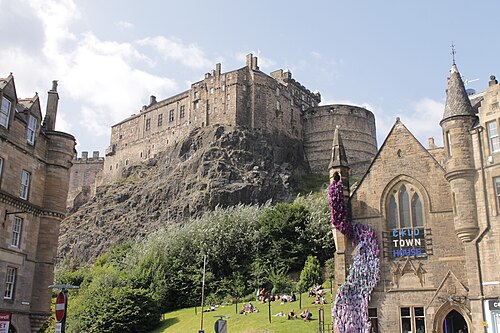 Edinburgh CastleRestored · prime 1520
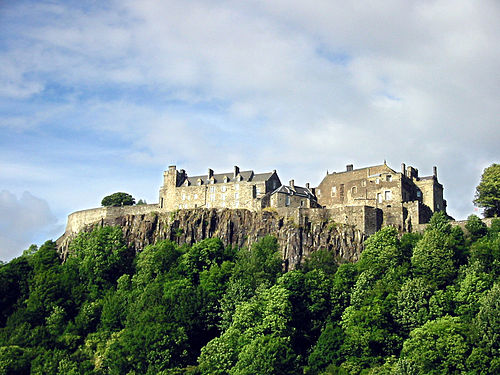 Stirling CastleRestored · prime 1542
 Glamis CastleStill standing · prime 1900
All castles in Scotland → · Strongest castles in Scotland → · Castles of Europe
Play As Your Clan
Hold a real castle against whatever you choose to send at it, take a ship out in her own service years, or stand at the shoulder of someone the record remembers. The chronicler sets the scene; the deeds are yours.
Notable bearers of the Scott name
- Sir Walter Scott
Stories of Clan Scott
The Honours of Scotland
1818The Honours of Scotland, the Crown of James V, the Sceptre, and the Sword of State, are the oldest crown jewels in Britain, used to crown every Scottish monarch from Mary, Queen of Scots, in 1543 to Charles II at Scone in 1651. After the Treaty of Union of 1707 they were locked in a chest in the Crown Room of Edinburgh Castle. The doors were sealed; the country was left to assume that they had been quietly taken to London or melted down. By 1818 the door of the Crown Room had not been opened in a hundred and eleven years. Sir Walter Scott, the most-read writer in Europe, petitioned the Prince Regent for permission to open it. The warrant was granted. What came out reset Scotland's image of itself.
Read the story →
Scott of the Antarctic, the last journal entry
1912On the twenty-ninth of March 1912, in a small canvas tent about eleven miles south of One Ton Depot on the Ross Ice Shelf, in a blizzard that had pinned them in the tent for the nine previous days, Captain Robert Falcon Scott, forty-three years old, Captain in the Royal Navy and leader of the British Antarctic Expedition of 1910–13, dying of frostbite, starvation and exhaustion, wrote the closing entries of the journal he had kept since the voyage south on the Terra Nova in 1910. His two surviving companions, Henry Birdie Bowers and Edward Wilson, were already dead beside him in the tent. The third member of the five-man polar party, Petty Officer Edgar Evans, had died near the foot of the Beardmore Glacier on the seventeenth of February; Captain Lawrence Titus Oates, in his famous I am just going outside and may be some time, had walked out of the tent into the blizzard on the seventeenth of March, his thirty-second birthday. Scott's closing journal-line, written by the dying hand in pencil on the twenty-ninth of March 1912, has become the closing-paragraph of the British public-school heroic-failure tradition: we shall stick it out to the end, but we are getting weaker, of course, and the end cannot be far. It seems a pity, but I do not think I can write more. R. Scott. For God's sake look after our people. The search-party, under Edward Atkinson, found the tent on the twelfth of November 1912, eight months after Scott's death. The thirty-nine pencil-written notebooks of the expedition diary, the photographs by Herbert Ponting, and the geological-and-biological scientific specimens collected on the march back were retrieved with the bodies and brought home to England in 1913.
Read the story →
Frequently asked
What does the surname Scott mean?
Where does the Scott family come from?
Is Scott Scottish or English?
How old is the Scott surname?
What is the Scott family known for?
What is the Scott motto?
What does "Amo" mean in English?
Is there a Scott family crest or coat of arms?
What is the Scott clan tartan?
Who is the most famous Scott?
What stories are told about the Scott family?
What is the story of the Honours of Scotland?
Who were the Scott family's rivals?
Where is the Scott surname found today?
What does the Clan Rising page for the Scott family cover?
Who is the head of the Scott family today?
Rivals and allies
Neighbouring clans
- CockburnA border clan of jurists and queen's men.
- ReidThe red one, descriptive Scots surname, dense in the Lothians and the Borders.
- WatsonSon of Wat, the Lowland patronymic that produced both the steam engine and Sherlock Holmes's friend.
- YoungDescriptive, the younger, sister surname to Vaughan in Wales and Óg in Ireland.