Young
also Younge, MacYoung
Descriptive, the younger, sister surname to Vaughan in Wales and Óg in Ireland.
- Origin
- Grampian & the North-East, Scotland
- Motto
- Robori prudentia praestat
- Famous bearer
- Sir James Young Simpson (1811–1870), pioneer of obstetric anaesthesia
- Register
- Scottish family
The Young arms, tartan and country

TartanChristina Young 1726 blanket tartanThe pattern as it was recorded in 1726.SMcCandlish, using the old Windows software Tartan32. Pattern ultimately from Scottish Tartans Authority . · CC BY 4.0 
Coat of armsArms of Young of AuldbarBorne by the Auldbar line, one branch of the name rather than all of it.Celtus · CC BY-SA 3.0 
Coat of armsArms of Young of InschesBorne by the Insches line, one branch of the name rather than all of it.Wikimandia · CC BY-SA 4.0


- Tartan: The checked cloth the family is known by.
- Coat of arms: Granted to an individual and inherited down that one documented line. These are the arms of particular families of the name, not of everyone who shares the surname.
What is the Young clan tartan?
One Young sett is recorded, and it is the swatch above (the sett as it was recorded in 1726). A sett is the block of coloured bands the cloth is built from, repeated in both directions; the whole plaid is that one square enlarged.
Young is a north-eastern name, and Aberdeenshire and Moray sit across the Highland line (Gaelic up the straths, Scots along the coast), so the tartan story runs both ways at once. Highland dress was proscribed from 1746 until 1782, and when it returned it returned as ceremony rather than everyday cloth. The surname-to-sett map was fixed after that break, by the Bannockburn weavers’ pattern books, the royal visit to Edinburgh in 1822, and the Vestiarium Scoticum of 1842, and whether the Youngs wore tartan before it depended on which side of the line the branch farmed. Nobody polices any of it. Wearing the Young sett declares allegiance to the name, not descent from any particular line of it.
CoreHistoric reach
The seat of Young
Seat vacantChief
No one leads the Young community yet. When the movement opens, you can stand for its leadership, or help elect whoever does.
Current mission
No shared goal set yet. Once Young has leadership, it sets the public focus: a restoration, a gathering, a real-world project that helps its own.
The Young clan is being rebuilt. Join the waiting list for the movement today, and you help decide who leads it and what it does.
Help rebuild the Young clan →Motto
Robori prudentia praestat
“Prudence excels strength”
What does the Young name mean?
Descriptive, the younger. Old English geong, applied as a personal byname distinguishing a son who shared a forename with a father or older kinsman. Direct equivalent of the Welsh Vaughan (Fychan), the Irish Óg, the Scottish Gaelic Òg. A descriptive surname, frozen at the moment of Tudor-era surname compression.
The history of Young
The younger of two men with the same name
Young is not a trade name and it is not a patronymic. It belongs to the third great class of European surname, the descriptive byname: a word hung on a man to tell him apart from somebody standing next to him. The root is Old English geong, 'young'. Where a father and a son shared a Christian name, or where two men in one small place did, the parish, the rent roll and the baron court all needed to know which was meant. One became the young one, and in time simply Young.
In Scotland the byname carried more weight than that. There it runs synonymous with Younger, the word used to describe the heir to a feudal title, so the man marked out as the younger was often the man who would inherit. The same idea appears across Europe in whatever language was to hand: Fychan in Welsh, which comes into English as Vaughan; Óg in Irish and Òg in Scottish Gaelic; Jung in German, Jeune in French. Five vernaculars, one habit of speech, because two neighbours everywhere turned up sharing a forename.
Descriptive names were also unreliable, and knowing that is part of understanding this one. The Oxford English Dictionary of Family Names in Britain and Ireland sets Young's class alongside Brown, Short and Thin, names describing the original bearer, and its project leader Richard Coates noted that Short may in fact be an ironic nickname for a tall man. A Young stopped being young almost at once. What survived was not the description but the label.
Malmor and Ade Young, Dumbarton, 1271
The earliest records of the name in Scotland put Malmor and Ade Young at Dumbarton in 1271. In 1342 John Young of Dingwall witnessed a charter granted by the Earl of Ross to Reginald, son of the Lord of the Isles: a Young at the top of Highland politics, where the witness list was the legal spine of a land grant. In 1439 Alexander Young was chaplain to the House of the Holy Trinity in Aberdeen, the first firm attachment of the name to the north-east, where it is densest still.
Those entries straddle the moment the byname froze. By the 14th century most English and most Scottish people used surnames, and by 1400 most English families and those of Lowland Scotland had adopted them as hereditary; Wales followed only after unification under Henry VIII in 1536. The Young of 1271 may well have been literally the younger of two men at Dumbarton. The Young of 1439 was simply a Young, and his children would be Youngs whatever their age.
The name was doing the same work elsewhere. Gruffydd Young (1370-1435) was a churchman and close supporter of Owain Glyndwr through the Welsh rebellion, a Young bearing the anglicised form in the country where its cousin Fychan was hardening into Vaughan.
The man who taught a three-year-old king
In 1569 Peter Young was recommended by the Regent Moray as assistant preceptor to James VI of Scotland, then three years old. The infant king was the whole of the Stewart succession, and the men chosen to form his mind held a quiet, permanent influence over the reign that followed. Young kept the position and the favour, and was knighted at Whitehall in 1605, two years after his pupil took the English throne as well.
His household rose with him. Sir Peter's first wife was Elizabeth Gibb, a gentlewoman in the household of Anne of Denmark, and several of their large family took up royal patronage. One son, another Peter, formed part of the embassy sent in 1628 to Gustavus Adolphus of Sweden. The descendants married into numerous prominent families, and a Scots name that began as a way of telling two men apart was now moving through courts and embassies. Patrick Young (1584-1652) made his name in the same generation as a Scottish scholar and librarian: the Young who gets on by his book rather than his sword.
Easter Seton, Auldbar and the grants in Ulster
Sir Peter Young was succeeded by his eldest son, Sir James Young, who held extensive grants of land in Ireland. That single inheritance is why the surname is common today across Antrim, Tyrone, Down and Londonderry. If your line reaches back into the north of Ireland rather than into Scotland, this is very probably the door it came through.
The Scottish estates changed hands twice in the century that followed. In 1670 the family sold their original estate at Easter Seton and purchased the lands of Auldbar in Angus. Auldbar went in turn in 1743, bought by William Chalmers of Hazlehead, himself related to the Youngs by marriage, so even the sale kept the property inside the wider kindred.
The Auldbar line kept its stamp long after the land was gone. Peter Young (d. 1988), a descendant of the Youngs of Auldbar, became a distinguished military historian, was awarded the Military Cross three times, and commanded the Ninth Arab Legion, an elite unit of the kingdom of Jordan. In 1968 he founded the Sealed Knot Society, dedicated to the English Civil War and the Scottish Wars of the Covenant.
Rue, Auldbar and Harburn: the stones the name held
Rue Castle, near Jedburgh in the Scottish Borders, is the site of a castle once held by the Youngs. The English torched it in 1513 and torched it again in 1545: twice inside thirty-two years, the plain measure of what it meant to hold ground in the Borders.
Auldbar Castle, near Brechin in Angus, was held by the Clan Lyon before it passed to the Youngs, and afterwards to the Chalmers of Balnacraig. Harburn Castle, near West Calder in West Lothian, was built by the Youngs in 1804, late enough to be a country house in castle dress rather than a fortress; it runs today as a hotel.
Those sites map the family's centre of gravity, and the modern distribution follows it. Young sits densest in the north-east (Aberdeenshire and Banff) and across the Borders, reaching through Buchan and Mar, Moray, Angus, Midlothian, Edinburgh, Lanarkshire and Stirling.
A clan with no chief, and what that actually means
Clan Young is an armigerous clan: it has no chief currently recognised by the Court of the Lord Lyon, which regulates Scottish heraldry and arms. That is a legal status, not a verdict on the name's history. A clan or family becomes a legally recognised noble incorporation only once it has a recognised chief, and a name group without one has no equivalent standing in Scots law however long its record runs.
It is worth killing off the idea that Young, as a Lowland name, is a lesser thing than a Highland clan. Sir Crispin Agnew of Lochnaw, Albany Herald Extraordinary at the Court of the Lord Lyon, has shown that the Highland-clan versus Lowland-family split is a 19th-century convention rather than a historical or legal one. An Act of the Scottish Parliament of 1587 speaks of the 'cheiffis and chiftanes of all clannis, alsweill on the hielandis as on the bordouris', then lists Lowland names (Maxwells, Johnstones, Carruthers, Turnbulls) as clans without blinking.
Treat the sept list with more care. Those lists date from the 19th century, when clan societies and tartan manufacturers linked as many surnames as possible to particular clans regardless of any historical connection: Miller was made a sept of MacFarlane, Taylor of Cameron, Mason of Sinclair. The solid ground under Young is the record itself: Dumbarton in 1271, Aberdeen in 1439, the king's schoolroom in 1569.
Chloroform, the wave of light and Young's modulus
The most extraordinary bearer of the name was Thomas Young of Milverton, a Quaker prodigy who read fluent Greek at six and had fourteen languages by fourteen. In 1801 he established the wave nature of light with the double-slit experiment. He then made the first decipherment of Egyptian demotic, and devised the measure of a material's stiffness that engineers still call Young's modulus.
Sir James Young Simpson (1811-1870) belongs to the Lowland Young line by his middle name, which preserved the maternal surname in the common Scots way. The Bathgate-born physician discovered the anaesthetic properties of chloroform in 1847 and became the founding figure of modern anaesthesia and obstetrics. Before him, surgery and childbirth were endured awake.
The scholarly streak did not stop there. Sydney Young (1857-1937) held a British chair in chemistry, and British mathematics carries four Youngs inside two generations: William Henry Young (1863-1942), Grace Chisholm Young (1868-1944), Alfred Young (1873-1940) and Laurence Chisholm Young (1905-2000).
Salt Lake, the Borders and the long emigration
Brigham Young (1801-1877) descended from a 17th-century English-Young emigrant line ultimately of Lowland Scots origin, which makes him the most consequential early carrier of the name across the Atlantic. As second president of The Church of Jesus Christ of Latter-day Saints he led his people west and founded Salt Lake City in 1847, the moment fixed in memory as 'this is the place'. His brother Phineas Young (1799-1879) was an early convert, and his son Brigham Young Jr. (1836-1903) followed him as a missionary and church leader.
Britain kept its own writing Youngs: Edward Young (1683-1765), poet; Andrew Young (1885-1971), Borders-born Anglican clergyman and author of some of the finest English-language nature poetry of the inter-war period; Francis Brett Young (1884-1954), novelist, poet, playwright and composer at once; and Freddie Young (1902-1998), a great British cinematographer.
The name travelled everywhere the Scots and English did. Cy Young (1867-1955) is in the Major League Baseball Hall of Fame; Neil Young (b. 1945) is a Canadian musician of Scots-Young descent; Malcolm Young (1953-2017), Scottish-born, and his brother Angus Young (b. 1955) drove AC/DC out of Australia. Seven and a half centuries after two men at Dumbarton needed telling apart, the word that told them apart is the 19th most common surname in Scotland, the 49th in England and Wales and the 34th in the United States.
Champions of the Young name
The bearers whose lives are inseparable from this surname. Each has their own page, biography, achievements, geography, connection to the family.
Historic Places, Rebuilt
Explore the streets and seats the Young name knew, rebuilt with AI as they stood in history.
The castles of the homeland
The great strongholds of the homeland, look one up, see what it looked like in its prime, and recreate it to explore.
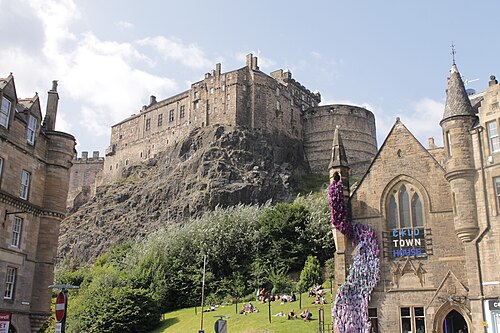 Edinburgh CastleRestored · prime 1520
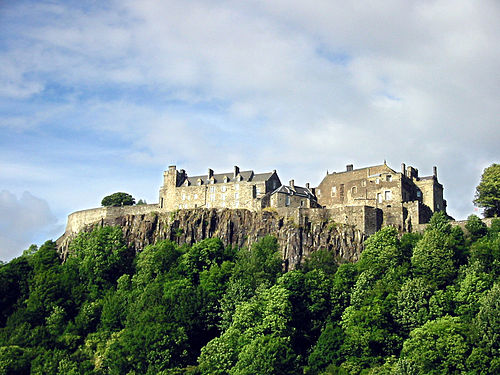 Stirling CastleRestored · prime 1542
 Glamis CastleStill standing · prime 1900
All castles in Scotland → · Strongest castles in Scotland → · Castles of Europe
Play As Your Clan
Hold a real castle against whatever you choose to send at it, take a ship out in her own service years, or stand at the shoulder of someone the record remembers. The chronicler sets the scene; the deeds are yours.
Notable bearers of the Young name
- Sir James Young Simpson (1811–1870), pioneer of obstetric anaesthesia
- Andrew Young (1885–1971), Borders nature-poet
- Brigham Young (1801–1877), second president of the Church of Jesus Christ of Latter-day Saints, founder of Salt Lake City
- Neil Young (b. 1945), Canadian musician of Scots-Young descent