Brown
also Broun, Browne
Descriptive, the brown one, third most common surname in Scotland.
- Origin
- Grampian & the North-East, Scotland
- Motto
- Floreat majestas
- Famous bearer
- Gordon Brown (b. 1951), Prime Minister
- Register
- Scottish family
The Brown arms, tartan and country

TartanBrown tartanMicheletb · CC BY-SA 4.0 
Coat of armsBroun of Colstoun armsBorne by the Colstoun line, one branch of the name rather than all of it.Czar Brodie · CC BY-SA 3.0


- Tartan: The checked cloth the family is known by.
- Coat of arms: Granted to an individual and inherited down that one documented line. These are the arms of particular families of the name, not of everyone who shares the surname.
What is the Brown clan tartan?
One Brown sett is recorded, and it is the swatch above. A sett is the block of coloured bands the cloth is built from, repeated in both directions; the whole plaid is that one square enlarged.
Brown is a north-eastern name, and Aberdeenshire and Moray sit across the Highland line (Gaelic up the straths, Scots along the coast), so the tartan story runs both ways at once. Highland dress was proscribed from 1746 until 1782, and when it returned it returned as ceremony rather than everyday cloth. The surname-to-sett map was fixed after that break, by the Bannockburn weavers’ pattern books, the royal visit to Edinburgh in 1822, and the Vestiarium Scoticum of 1842, and whether the Browns wore tartan before it depended on which side of the line the branch farmed. Nobody polices any of it. Wearing the Brown sett declares allegiance to the name, not descent from any particular line of it.
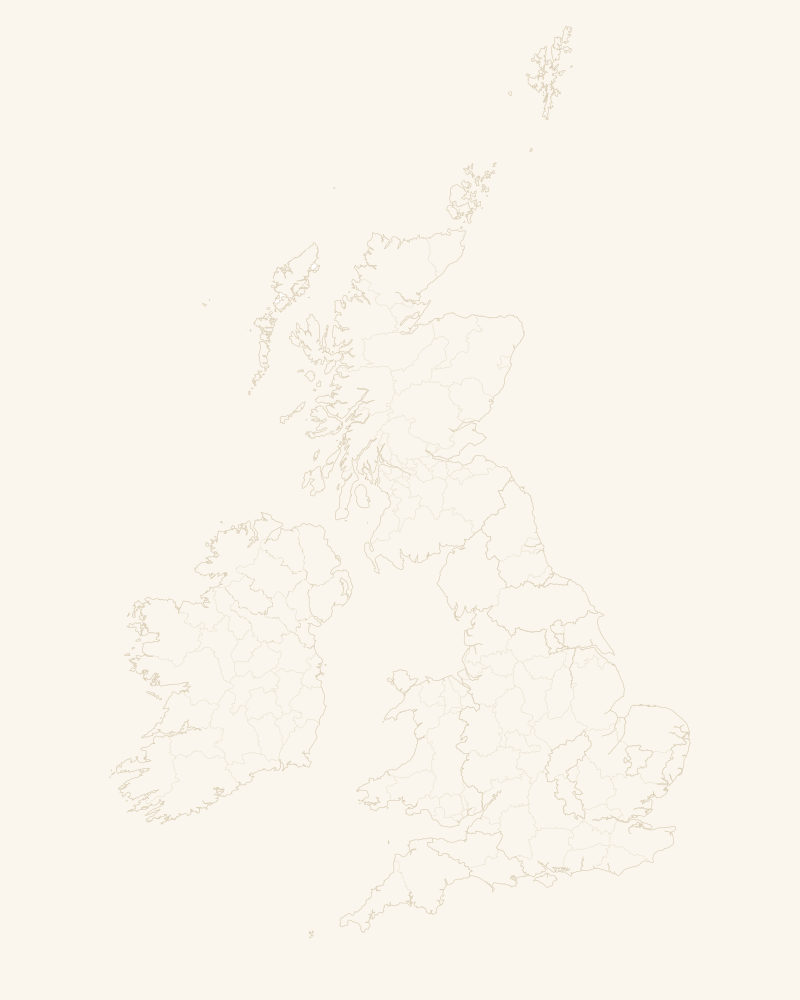
This name is thick on both sides of the border, so the map shows the whole of Britain and Ireland with every region it touches highlighted. It is a regional pattern for the surname, not proof that your branch lived in each place.
CoreHistoric reach
The seat of Brown
Seat vacantChief
No one leads the Brown community yet. When the movement opens, you can stand for its leadership, or help elect whoever does.
Current mission
No shared goal set yet. Once Brown has leadership, it sets the public focus: a restoration, a gathering, a real-world project that helps its own.
The Brown clan is being rebuilt. Join the waiting list for the movement today, and you help decide who leads it and what it does.
Help rebuild the Brown clan →Motto
Floreat majestas
“Let majesty flourish”
What does the Brown name mean?
Descriptive, the brown one. Old English brūn, denoting hair or complexion. A simple personal byname applied identically across the Germanic and Romance languages of Europe: Bruno in Italian, Braun in German, Le Brun in French. As a Scots surname Brown took the spelling Broun in older record-keeping; the Anglicised Brown dominates from the 18th century onward.
The history of Brown
The brown man in the parish
Brown belongs to the third great class of European surname. Not a trade like Smith, not a father's name like Jones, but a description of the man himself. The root is Old English brun, through Middle English broun and alongside Old French brun, applied for the colour of a man's hair, a dark complexion, or the cloth he habitually wore. Onomastics calls these cognominal surnames, the broadest class of all: appearance, temperament, habit, anything a neighbour could point at.
No lesser origin than a trade. The University of the West of England's four-year study of British and Irish surnames, finished in 2016, catalogued 45,602 names, over 90 per cent native to Britain and Ireland, and found Brown among the commonest in the United Kingdom. Richard Coates, who led it, placed the name exactly here: "names where the origin describes the original bearer such as Brown, Short, or Thin". In Scotland it stands third, behind Smith and Wilson.
How a nickname hardened into an inheritance
A byname is not yet a surname, and the difference is everything. Gaelic Scotland kept the older, living system into recent memory, showing the machinery before names froze. Raibeart Bhan, "fair Robert", was a Robert with light-coloured hair; Dòmhnall na Cluaise had lost an ear in a fight. Each name described one living body, needed no clerk, and died with him. His son earned his own.
The written record catches the moment description stopped dying with the man. The early spellings still carry the definite article, the giveaway that a clerk is describing rather than naming: Richard Brun, le Brun le mercer between 1111 and 1138; William le Brun in 1169; John le Browne as late as 1318. Beside them the article is already falling away: Agnes Broun in 1296, John Brown of Stamford in Lincolnshire in 1312. That dropped word is the whole event. By 1400 most English families and most of Lowland Scotland carried a hereditary surname, and Brown had stopped meaning a brown-haired man and started meaning his grandchildren.
Why every language in Europe produced this name at once
A trade name needs a trade and a patronymic needs a naming custom, but a colour needs nothing at all. Every language has the word, every settlement had a dark man in it, and so the name was made independently in a hundred places that had never heard of each other. Brown is Braun in German, Bruno in Italian, Le Brun in French, Donn in Gaelic, not one name that travelled but one habit of speech running in parallel. The same logic made Moreno in Spanish and Schwartzkopf in German, and set Brown in English beside the record's other colour bynames: Black, White, Grey, Reid or Read.
The root ran deeper than the surname. Old Norse had the byname Brunn, uncommon in England after 1066. On the Continent the related name Bruno was borne by the Dukes of Saxony from the 10th century or earlier, and by Bruno of Cologne, 1030 to 1101, founder of the Carthusian Order.
The Brouns of Colstoun and the lilies of France
The surname is first recorded in East Lothian, early and near the top of society. Sir David Le Brun witnessed the laying of the foundation of Holyrood Abbey in 1128, having given lands to the abbey in return for prayers said for the health of his son. The name is thin but real in the oldest Scottish archive: the People of Medieval Scotland project surveys more than 8,600 records from 1093 to 1314, and lists 26 Brouns and 14 Browns.
Out of East Lothian came the chiefly house, the Brouns of Colstoun, who held royal favour and who claim descent from the royal house of France. The only evidence offered is the coat of arms itself: Gules, a chevron between three fleur-de-lis or, under the motto Floreat majestas, "let majesty flourish". Three gold lilies are suggestive, but they are not a charter, and no document has ever carried the descent back to France. The rest stands on firmer ground: marriages into the Scottish nobility including the chiefly house of Clan Hay, Sir John Brown of Fordell commanding the royalist army at Inverkeithing in 1651, Patrick Broun of Colstoun created a Baronet of Nova Scotia in 1686, and the chiefship held today by Sir Wayne Broun of Colstoun, 14th Baronet.
Third commonest name in Scotland, and not one family
Most Browns are not descended from Colstoun. A descriptive byname arises wherever there are people, so the name grew independently in every parish from Caithness to Galloway, thickest today in the north-east and the central belt, and again across the Northumberland and Yorkshire belt, where clerks wrote it without consulting Aberdeen. To carry the name is to inherit that whole story, not to be a cadet of one castle.
Four tartan setts carry the name, but Scottish clan tartans generally date from the 19th century, when clan societies and tartan manufacturers drew up sept lists tying as many surnames as possible to a clan, historical connection or not. The older rule was looser than the myth anyway: the Scottish Parliament's act of 1587 described followers depending on chiefs "by pretence of blood or place of their dwelling".
Two further routes fed the name, both contested. The historian Black asserted that Browns of Celtic origin might descend from the brehons, the native judges: Scottish Gaelic Mac-a-Bhruithainn is built on a root close to the word for judge and sounds much like Scots Broun. Separately, Gaelic Donn simply means brown, and the Mac A Brehon family of County Donegal have anglicised as Brown or Browne since about 1800.
The stone the name is cut into
Carsluith Castle in Galloway was held by the Browns from the 16th century, their arms carved above the door beside a date beginning 156-, and Bruntsfield House in Edinburgh was the other seat of the Brouns. Tower houses and burgh mansions, not earldoms: that is the truer shape of the name.
The Browne spelling carried further. Sir Thomas Browne, Sheriff of Kent, took Betchworth Castle by marriage and rebuilt it as a fortified house in 1448. In Ireland, Sir Valentine Browne became ancestor of the Earls of Kenmare at Ross Castle, the Brownes who became Marquesses of Sligo built Westport House and held it until 2017, and Ashford Castle was granted around 1670 to the Brownes, Barons Oranmore. Lielstraupe Castle was sold in 1780 to Georg Graf Browne, Governor General of Livonia.
What the Browns did with the name
John Brown of Haddington, 1722 to 1787, was the great Scottish biblical commentator of his century, his Self-Interpreting Bible still being reprinted in the 20th. Robert Brown, a Montrose minister's son, sailed as naturalist aboard the Investigator to chart the coasts of Australia, named the cell nucleus, and observed the restless motion of pollen grains in water that still carries his name. Thomas Brown of Edinburgh made his name in philosophy, Sir Crum Brown in chemistry.
George Mackay Brown of Stromness, 1921 to 1996, was the great Orcadian poet of the post-war era, and John Brown, 1826 to 1883, Highland servant and confidant of Queen Victoria, was one of the most talked-about commoners of the 19th century. And James Gordon Brown, born in Kirkcaldy in 1951, was Chancellor of the Exchequer from 1997 to 2007 and Prime Minister from 2007 to 2010; like his Kirkcaldy predecessor Adam Smith, his trade was the political economy of a small nation governing a much larger one. A stranger's remark about a man's hair now sits on a Bible commentary, a law of physics, a body of Orkney poetry and a British premiership.
Champions of the Brown name
The bearers whose lives are inseparable from this surname. Each has their own page, biography, achievements, geography, connection to the family.
Also found in
The Brown name has substantial historical presence beyond Scotland. See it on England.
Historic Places, Rebuilt
Explore the streets and seats the Brown name knew, rebuilt with AI as they stood in history.
Historic Places, Rebuilt · New
John Brown's shipyard on launch day for the Queen Mary, the great hull on the ways, the cranes and the cloth-capped crowd.
Historic Places, Rebuilt · New
The castle on its crag, St Giles' crown spire, and the closes tumbling to the Cowgate.
Historic Places, Rebuilt · New
The merchant city on the Clyde on the eve of mass emigration, the Cathedral, the Trongate, and the Broomielaw where the ships left.
Historic Places, Rebuilt · New
Scotland's ecclesiastical capital at its peak, the great cathedral, the bishop's castle on the sea, and the new university.
Castles the Brown held
Strongholds this name held for a decade or more, look one up, or rebuild it to explore.
- Ashford Castle, County Mayo
Granted to the Browne family, Barons Oranmore, around 1670.
- Ross Castle
Leased to Sir Valentine Browne, ancestor of the Earls of Kenmare, the castle long associated with the Brownes of Killarney.
- Westport House
Family seat of the Brownes, Marquesses of Sligo, from its 18th-century building until the estate's sale to the Hughes family in 2017.
- Betchworth Castle
Passed by marriage to Sir Thomas Browne, Sheriff of Kent, who rebuilt it as a fortified house in 1448.
- Carsluith Castle
Held by the Browns from the 16th century; their arms are carved above the door with the date 156-.
- Lielstraupe Castle
Sold in 1780 to Georg Graf Browne, Governor General of Livonia.
Castles that share the Brown name
The same name on the map, look one up, see what it looked like in its prime, and recreate it to explore.

All castles in Scotland → · Strongest castles in Scotland → · Castles of Europe
Play As Your Clan
Hold a real castle against whatever you choose to send at it, take a ship out in her own service years, or stand at the shoulder of someone the record remembers. The chronicler sets the scene; the deeds are yours.
Notable bearers of the Brown name
- Gordon Brown (b. 1951), Prime Minister
- George Mackay Brown (1921–1996), Orcadian poet
- John Brown (1722–1787), biblical commentator
- John Brown (1826–1883), Highland servant and confidant of Queen Victoria
Stories of Brown
John Brown beside Victoria
1864Prince Albert died at Windsor on the fourteenth of December 1861. Queen Victoria, forty-two years old, withdrew from public life and spent the next forty years a widow in mourning. From the autumn of 1864 the man who, more than any other, brought her out of the deepest of her seclusion was a Highland gillie of the Balmoral estate, John Brown of Crathie, son of a small farmer of Crathienaird, brought south by the household to be the queen's outdoor servant. He stayed in her service until his death in 1883. The court hated him for it, the Cabinet ministers patronised him, the press lampooned him as "the queen's stallion" in print so coarse that the Lord Chamberlain pulled it. The Queen of England wrote, in her journal of the day his obituary went to the papers, that her trust in him had been complete; that no one had ever done more for her than he had; and that in any society or any country he would have been counted a man.
Read the story →
John Brown at Harpers Ferry
1859On the night of Sunday the sixteenth of October 1859, John Brown, fifty-nine years old, the Connecticut-born, Ohio-raised abolitionist of the Scots-Irish Brown family of New England (descended on the male side from a Cromwellian-Scots Brown emigrant of the 1660s to Connecticut), led a raiding party of twenty-one men (sixteen white, five Black) down from a rented farmhouse at Kennedy Farm on the Maryland-Virginia border into the federal armoury at Harpers Ferry in western Virginia, on the confluence of the Potomac and the Shenandoah rivers. The plan was to seize the armoury arsenal (the US Army's principal weapons depot in the Upper South, containing about a hundred thousand muskets and rifles), to distribute the arms to the local enslaved Black population of the surrounding plantations of Loudoun and Jefferson counties, and to provoke a general slave rebellion that would, on Brown's theological reading, sweep south through the Appalachian Mountains and end the institution of slavery in the United States. The raid was militarily a failure within thirty-six hours: the Virginia and Maryland militia gathered through the afternoon of the seventeenth and surrounded the armoury engine-house in which Brown and the surviving raiders were holding hostages; the federal force under Colonel Robert E. Lee of the US Army (the future Confederate commander, then a serving US Army officer) arrived overnight and took the engine-house at dawn on the eighteenth with a twelve-marine assault under Lieutenant J. E. B. Stuart. Ten of Brown's party were killed; Brown himself was wounded but taken alive. The political consequence of the raid was, by every careful judgment of US Civil War historiography, the trigger of the eighteen-month sequence of political events (the 1860 election of Lincoln on a free-soil platform; the December 1860 secession of South Carolina; the formation of the Confederacy in the February 1861 Montgomery convention) that produced the American Civil War of April 1861. Brown was tried at Charles Town, Virginia, on the twenty-fifth of October 1859 for treason, murder and conspiracy to incite insurrection. He was convicted on the second of November and hanged at Charles Town on the second of December 1859.
Read the story →
Frequently asked
What does the surname Brown mean?
Where does the Brown family come from?
Where did the Brown family historically hold territory?
Is Brown Scottish or English?
How old is the Brown surname?
What is the Brown family known for?
What is the Brown motto?
What does "Floreat majestas" mean in English?
Is there a Brown family crest or coat of arms?
What is the Brown clan tartan?
Who is the most famous Brown?
Who are some famous Browns?
What stories are told about the Brown family?
What is the story of John Brown beside Victoria?
Is Broun the same family as Brown?
Is Browne the same family as Brown?
Where is the Brown surname found today?
What does the Clan Rising page for the Brown family cover?
Who is the head of the Brown family today?
Neighbouring clans
- NapierInventors of logarithms and Celtic earls of Lennox.
- SmithThe forge surname, the most common occupational name in Scotland and the world.
- WilsonSon of Will, second most common surname in Scotland, behind Smith.
- ThomsonSon of Thomas, the Lowland Scots form, no 'p', distinguishing it from English Thompson.