England · Ruin
Betchworth Castle
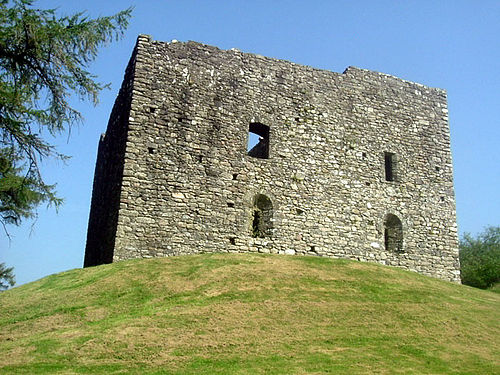
Betchworth Castle is the mostly ruined remains of a medieval fortified stone house on a sandstone spur above the River Mole in Surrey, England. Once rebuilt and adapted at several dates from the 14th to the 18th centuries, it later fell into partial demolition and ruin and is now a scheduled monument with public foot access.
Its prime
1450
Today
Ruin
As it stood in 1450
What Betchworth Castle looked like in its prime.
Set on a sandstone spur above the west bank of the River Mole, the castle in its mid-15th-century prime presented as a continuous stone mansion with battlemented gables, projecting oriel windows and clustered chimneys along a varied roofline; compact corner blocks rise two storeys, with coursed local sandstone walls, mullioned window openings and an articulated main façade facing lawns that slope down to the river.
Its story
The story of Betchworth Castle.
Domesday Manor to Stone Castle, 1086-1379
Betchworth, or Beechworth among other forms, was the seat of the manor of West Betchworth, held by Richard de Tonbridge at the time of the Domesday Book in 1086. The first fortress on the sandstone spur above the western bank of the River Mole was an 11th-century earthwork raised by Robert Fitz Gilbert. The manor was granted in 1373 to Richard FitzAlan, Earl of Arundel, and it was his son Sir John FitzAlan, Earl Marshal of England, who turned it into a stone castle in 1379.
The Brownes of West Betchworth, 1448-1691
The castle passed by marriage to Sir Thomas Browne, Sheriff of Kent and Treasurer of the Household, who in 1448 rebuilt it as a fortified house. The Brownes held it for more than two centuries; the last male of the line to own Betchworth was Sir Adam Browne, 2nd Baronet, who died in 1690. His daughter and sole heir Margaret married William Fenwicke in 1691.
Margaret Fenwicke, Abraham Tucker and Henry Peters, 1691-1827
In 1725 Mrs Margaret Fenwicke of Betchworth Castle left £200 to buy lands, to provide for apprenticing children and for small dowries for maidservants "born in Betchworth and living seven years in the same employment", any surplus going to the poor. Abraham Tucker, author of The Light of Nature Pursued and A Picture of Artless Love, lived at his Betchworth Castle estate until his death in 1774, and is commemorated by a plaque in St Martin's church, Dorking.
Alterations were made in 1705 by an unknown architect and again in 1799 by Sir John Soane. Henry Peters bought the castle in 1798 and spent considerable money renovating it into a comfortable family home, living there with his wife Charlotte Mary Morrison and their twelve children until his death in 1827.
Henry Thomas Hope, the Deepdene Estate and Malden's Ruin, 1834-1911
Peters's children did not inherit; the castle was bought by David Barclay, and in 1834 by the banking dynasty co-heir Henry Thomas Hope, who added it to his Deepdene estate and demolished part of it to reuse the building material elsewhere. Outshone by a newer and bigger house in larger grounds, it was abandoned in the 1830s, and with no permanent tenant the remainder fell gradually into ruin and came to be treated as a folly.
Writing in 1911, the historian and topographer H. E. Malden judged from a print in Watson's Memoirs that the mid-15th-century mansion "must have been extremely picturesque with its battlemented gables, clustered chimneys and oriel windows, standing among lawns and gardens descending to the Mole". By his day the ivy was disintegrating the walls and the arch of a fireplace was almost the only architectural feature left.
Grade II Listing to a £1 Sale, 1951-2022
The ruin was listed on 28 November 1951 in the lowest category of listed architecture, Grade II, and is also a scheduled monument. A signposted route of public access on foot across Betchworth Park Golf Course was created in 2005, and the ruin now forms part of the Deepdene trail with free access, though the whole structure is ringed by sturdy railings because of unstable subterranean cellars. In 2008 Mole Valley Council, which owned the castle, sold it for £1 to a local man, Martin Higgins, who undertook to conserve the structure and grounds with financial support from English Heritage, the Surrey Historic Buildings Trust and the district council alongside his own and other private funds, so that the public could be admitted. Visitor numbers rose from 7,000 a year in 2008 to an estimated 28,000 in 2022.
Step inside
8 places to explore in 1450.
The record describes 8 distinct spots at Betchworth Castle, including 2 interiors: fireplace arch (interior), subterranean cellars (entrance). Create your own photoreal reconstruction and explore every one, more scenes means more rooms, more angles, and more of the place to stand in.
Build Your Own Castle
Recreate Betchworth Castle with AI to explore it.
The artist rebuilds it as it stood in 1450, a photoreal reconstruction that belongs to you alone. Pay with coins, no subscription needed.
Recreate this castle →Defend this castle →Whose castle
Clans who held Betchworth Castle.
The families that held Betchworth Castle for a decade or more across its history, follow a name to its clan.
FitzAlan
Granted to Richard FitzAlan, Earl of Arundel, in 1373; his son Sir John FitzAlan turned it into a stone castle in 1379.
Passed by marriage to Sir Thomas Browne, Sheriff of Kent, who rebuilt it as a fortified house in 1448.
Henry Peters bought Betchworth in 1798 and lived there until his death in 1827.
Hope
Henry Thomas Hope bought the castle in 1834 for his Deepdene estate and demolished large parts of it.
Nearby