
Ireland · Still standing
Ross Castle
Caisleán an Rois
Ross Castle is a late 15th-century Irish tower house and keep on the edge of Lough Leane in Killarney National Park, County Kerry. Built by the O'Donoghue chiefs and later associated with the Browne family, it comprises a tall rectangular tower surrounded by a square bawn with round corner towers and defended entrances.
Its prime
1490
Today
Still standing
As it stood in 1490
What Ross Castle looked like in its prime.
A tall rectangular stone tower house rising from a square bawn with curtain walls and round corner towers, built of pale grey rubble and ashlar-quoins. The tower has diagonal square bartizans on opposite corners and a crenellated parapet with machicolations over the entrance and rear wall. Narrow vertical arrow-slit windows puncture the lower levels, while larger windows appear high on the tower; the complex sits at the grassy edge of Lough Leane with a flat parapet roofline.
Its story
The story of Ross Castle.
The O'Donoghues Mór and the Coming of the Brownes
Ross Castle was built in the late 15th century on the edge of Lough Leane by the local ruling clan, the O'Donoghues Mór (Ross), and it remains the ancestral home of the Chiefs of Clan O'Donoghue. The tower house is typical of the strongholds of Irish chieftains of the Middle Ages: a keep with square bartizans on diagonally opposite corners, originally ringed by a square bawn with round towers at its corners, the fourth floor reserved as the sleeping and living quarters of the chieftain and his family.
Ownership changed hands during the Second Desmond Rebellion of the 1580s, passing to the MacCarthy Mór, who leased the castle and its lands to Sir Valentine Browne, ancestor of the Earls of Kenmare.
A Strange Ship on Lough Lein
During the Irish Confederate Wars, Ross was amongst the last castles to surrender to Oliver Cromwell's Roundheads. Lord Muskerry of the MacCarthys held it against Edmund Ludlow, who marched on Ross with 4,000 foot-soldiers and 200 horse, yet it was by water that he attacked the stronghold, which was only taken when artillery was brought by boat via the River Laune.
The Irish had a prophecy that Ross could never be taken until a warship could swim on the lake: an unbelievable prospect: "Ross may all assault disdain / Till on Lough Lein strange ship shall sail." Ludlow's guns, arriving by water, made the verse come true.
Exile of the Brownes and the Barracks Years
At the end of the wars the Brownes were able to show that their heir had been too young to take part in the rebellion, and they retained the lands, erecting a mansion house near the castle by about 1688. Their adherence to King James II after the Glorious Revolution sent them into exile, however, and Ross became a military barracks, remaining one until early in the 19th century. The Brownes never returned to live at Ross, building Kenmare House near Killarney instead.
A long line of governors commanded the garrison, from Pierce Ferriter, who held the post until 1652, through Colonel Richard Hedges in the years around 1705 to 1714, to Lieutenant-General Sir Henry Johnson, governor from 1801 until 1835.
O'Donoghue Beneath the Lake
Legend holds that O'Donoghue leapt (or was sucked) out of the window of the grand chamber at the top of the castle and disappeared into the waters of the lake along with his horse, his table and his library, and that he lives on in a great palace at the bottom of the lake, keeping a close eye on everything he sees. The castle itself is a national monument of Ireland, standing in Killarney National Park and open to the public seasonally with guided tours under the Office of Public Works.
Step inside
11 places to explore in 1490.
The record describes 11 distinct spots at Ross Castle, including 6 interiors: front entrance anteroom (yett), ground floor / storage, second floor, attendants' quarters and more. Create your own photoreal reconstruction and explore every one, more scenes means more rooms, more angles, and more of the place to stand in.
Build Your Own Castle
Recreate Ross Castle with AI to explore it.
The artist rebuilds it as it stood in 1490, a photoreal reconstruction that belongs to you alone. Pay with coins, no subscription needed.
Recreate this castle →Defend this castle →Whose castle
Clans who held Ross Castle.
The families that held Ross Castle for a decade or more across its history, follow a name to its clan.
O'Donoghue
Built in the late 15th century by the O'Donoghues Mór; ancestral home of the Chiefs of Clan O'Donoghue.
Passed to the MacCarthy Mór during the Second Desmond Rebellion of the 1580s; Lord Muskerry later held it against Ludlow's army.
Leased to Sir Valentine Browne, ancestor of the Earls of Kenmare, the castle long associated with the Brownes of Killarney.
From the archive
Ross Castle on paper: the measured plan and period views.
The survey plan and photographs below are the ground truth this page's reconstructions are checked against, drawn and photographed while the castle was still a working garrison. Every image is public-domain or openly licensed, with its source named.
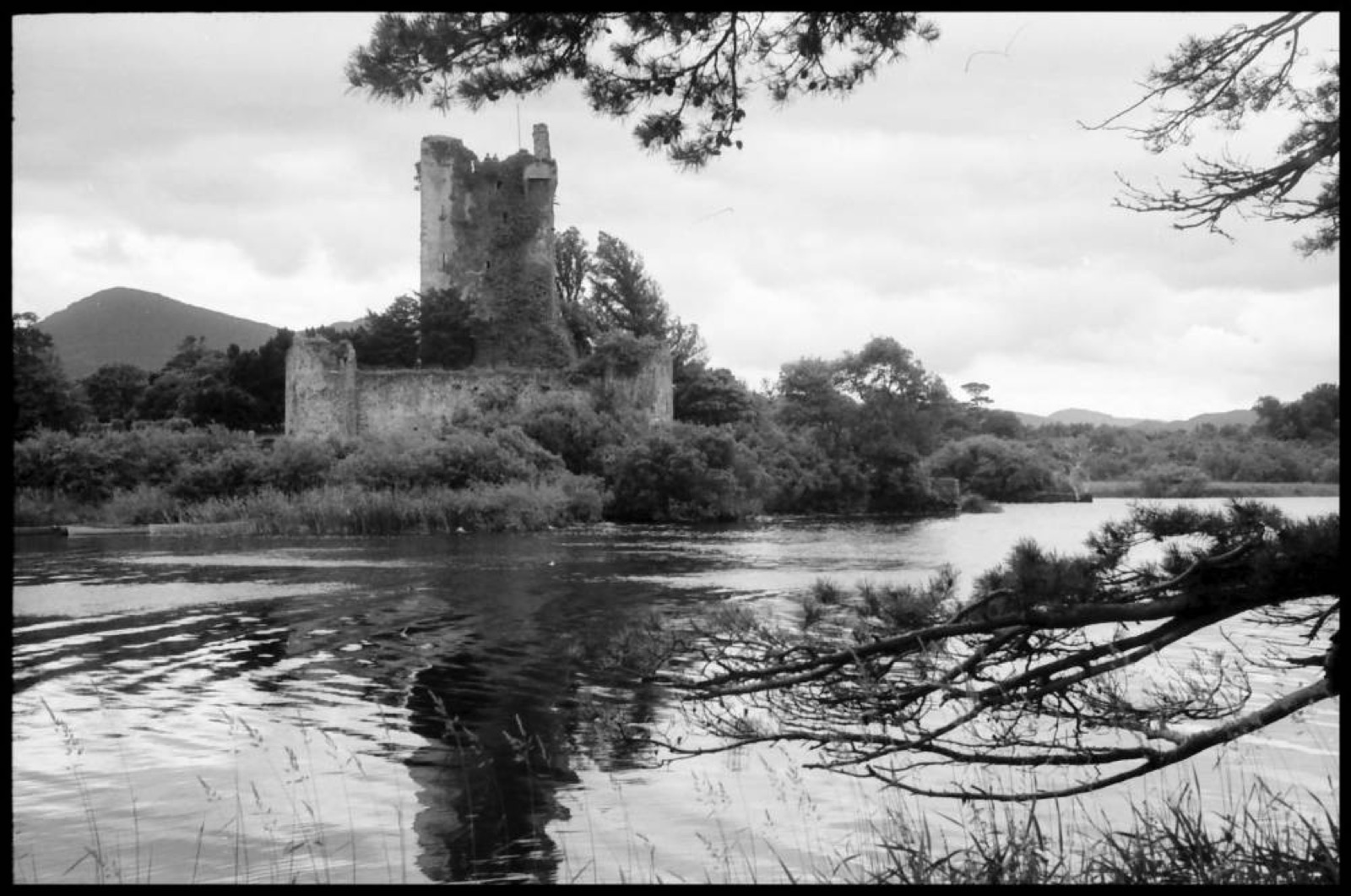
Killarney: Ross Castle, vom gegenüberliegenden Ufer
· State Archives of Baden-Württemberg (via Europeana)
CC BY


