Clan Napier
Inventors of logarithms and Celtic earls of Lennox.
- Origin
- Lothian & Edinburgh, Scotland
- Motto
- Sans tache
- Famous bearer
- John Napier of Merchiston (1550–1617), inventor of logarithms
- Register
- Scottish clan
The Napier arms, crest badge, tartan and country

Crest badgeClan member crest badge - Clan NapierCeltus · CC BY-SA 3.0 
TartanTartan NapierUnknown author Unknown author · OGL v1.0 
Coat of armsArms of Napier of Middle Marsh, of PunknollBorne by the Punknoll line, one branch of the name rather than all of it.Aergia · CC BY-SA 4.0 
Coat of armsArms of Napier (same arms as Earl of Lennox)Borne by the Earl of Lennox: the ennobled line of the name, not the name at large.Around the Worls · CC BY-SA 4.0


.png)
- Crest badge: The chief's crest inside a belt and buckle: the badge a clansman wears to show whose following he is in.
- Tartan: The checked cloth the family is known by.
- Coat of arms: Granted to an individual and inherited down that one documented line. These are the arms of particular families of the name, not of everyone who shares the surname.
What is the Napier clan tartan?
One Napier sett is recorded, and it is the swatch above. A sett is the block of coloured bands the cloth is built from, repeated in both directions; the whole plaid is that one square enlarged.
Napier is a Lowland name, and Lowland families did not wear Highland dress; the 1746 proscription that broke the tradition in the north took nothing from them, because there was nothing there to take. The Napier sett is a 19th-century assignment, made when tartan stopped being Highland and became Scottish and fixed by the Bannockburn weavers’ pattern books, the royal visit to Edinburgh in 1822, and the Vestiarium Scoticum of 1842. Nobody polices any of it. Wearing the Napier sett declares allegiance to the name, not descent from any particular line of it.
The seat of Clan Napier
Seat vacantChief
No one leads the Clan Napier community yet. When the movement opens, you can stand for its leadership, or help elect whoever does.
Current mission
No shared goal set yet. Once Clan Napier has leadership, it sets the public focus: a restoration, a gathering, a real-world project that helps its own.
The Napier clan is being rebuilt. Join the waiting list for the movement today, and you help decide who leads it and what it does.
Help rebuild the Napier clan →Motto
Sans tache
“Without stain”
What does the Napier name mean?
From the occupational 'naperer', keeper of the linen in the royal household. Tradition links the family to the old Celtic Earls of Lennox.
The history of Clan Napier
Linen, 'nae peer', and the first men in the charters
The British surname comes from Middle English and Old French napier, nappier, a derivative of Old French nappe, "table cloth". A naperer was the servant answerable for the washing and storage of a medieval household's linen, and the name could equally mark a man who sold or produced table linen. The earliest recorded bearers are a Peter Napier in the Winton Domesday of 1148, Ralph le Naper between 1167 and 1171, and Reginald le Nappere in 1225. In Scotland there is little evidence that the household office was ever much used, and Scottish tradition preferred a grander beginning.
In 1625 Sir Archibald Napier of Merchiston, the first Lord Napier, laid an affidavit before the College of Heralds setting out that beginning. A battle had gone hard with the Scots, he wrote, and the line was breaking when Donald, a son of the Earl of Lennox, pulled his father's standard from its bearer and carried the Lennox men back onto the enemy. Afterwards the king told the assembled company, "Ye have all done well but there is one amongst you who hath Na peer," and ordered Donald to change his name from Lenox to Napier, granting him the lands of Gosford and lands in Fife. Archibald named Alexander II as the probable king and added that his own old evidences called the family "Lenox alias Napier".
The tale is likely apocryphal, built to lift a name that otherwise stood level with Draper. What the heralds could not argue with was the shield. The original Napier arms, argent, a saltire engrailed between four roses gules, barbed vert, sit strikingly close to the arms of Lennox, and the Lennox descent is the claim the family never let go of. The motto that rides above them, Sans tache, without stain, is the whole boast in two words.
The Lennox charter and eighteen generations at Kilmahew
The first certain appearance of the name in Scotland is a charter of Malcolm, Earl of Lennox, granted some time before 1290, in which John de Naper received lands at Kilmahew in Dunbartonshire; a John de Napier is on record in a land charter of 1280. The lands took their name from the patron saint Mochta. John assisted in the defence of Stirling Castle in 1303, and a descendant of the house was made Governor of Edinburgh Castle in 1401. The family built the castle at Kilmahew in the 16th century and held the estate for eighteen generations, until 1820.
That long Dunbartonshire line ran on into the age of iron. Its later members included Robert Napier, remembered as the "Father of Clyde Shipbuilding", and the Napiers of the engineering firm Napier and Son, so the same rent roll that begins with a Lennox charter before 1290 ends among the shipyards of the Clyde.
The ending itself was untidy. In 1694 the estate passed to George Maxwell of Newark and Tealing, who took the name of his maternal grandfather, John Napier of Kilmahew, and then died without legitimate children as the last of that name; the Napier of Kilmahew arms survive only as a quartering in the arms of Noble of Ardmore. An illegitimate daughter, Jean Smith, successfully claimed the estate, which was sold to Alexander Sharp in 1820 in repayment of gambling debts. James Burns of neighbouring Bloomhill bought it in 1839, and the Archdiocese of Glasgow acquired the ruins and their grounds in 1948.
Two provosts of Edinburgh and a tower at Merchiston
The Edinburgh branch began in trade. Alexander Napier, the first Lord of Merchiston, was a prominent merchant in the burgh who amassed a fortune, served as Provost of Edinburgh, and in 1436 obtained the charter for the lands of Merchiston that gave the family its designation for the next five centuries.
His son, Sir Alexander Napier, was also Provost of Edinburgh and climbed higher still. He was wounded rescuing the widow of James I of Scotland and her second husband, Sir James Stewart, after rebels had taken them. James II made him Comptroller of the Royal Household in 1440 and Vice Admiral of Scotland in 1461, and he served as administrator, diplomat and member of the Scottish Parliament before his death in about 1473 or 1474.
Around 1454 Alexander Napier, 2nd Laird of Merchiston, raised the tower that still carries the name, on ground his father had secured before 1438. It is an L-plan house with its wing thrown out to the north, and an unusually elaborate main entrance set at second-floor level in a tall recess that once held a drawbridge: a merchant's fortune spent on a soldier's front door. Merchiston Tower remains the seat of Clan Napier.
Heirs lost at Sauchieburn, Flodden and Pinkie
The next John Napier married a daughter of the Earl of Lennox who was executed in 1444, which put a claim to the earldom within the family's reach. He never pressed it. He was killed at the Battle of Sauchieburn in 1488.
His heir Alexander and his grandson were both killed at Flodden in 1513, and another Napier heir fell at Pinkie Cleugh in 1547.
The laird who counted, born at Merchiston in 1550
John Napier was born in Merchiston Tower in 1550, into a house that already had a Sir Archibald Napier (1534-1608) in it, a Scottish landowner and official who was master of the Scottish mint. John took the estate and turned it into a workshop. He devised the system of logarithms that transformed calculation, and it is for that, more than for anything his family did with land or office, that the name is known outside Scotland.
Logarithms were only the most durable of his projects. He designed a hydraulic screw for clearing water out of coal pits, built an early calculating device, and set down conceptual war machines on paper. He died in 1617, and his tower kept his name so thoroughly that the university now built around it carries it too.
Montrose's kin, exile, and a barony carried by daughters
John Napier was succeeded in 1617 by his son Archibald, created 1st Lord Napier, a politician and judge who had already accompanied James VI and I to London in 1603 to claim his new throne. Archibald married a daughter of the fourth Earl of Montrose and sister of James Graham, 1st Marquess of Montrose, and as brother-in-law to the king's captain he carried the Napiers into the royalist camp for the whole of the Scottish Civil War. He died in 1645. His only son, Archibald, 2nd Lord Napier, was forced into exile and died in the Netherlands in 1660.
Archibald, 3rd Lord Napier, saw the male line failing and petitioned the Crown for a new patent extending the succession to female heirs. The title duly went sideways: to Thomas Nicolson, 4th Lord Napier, the only child of his eldest sister; then to his aunt Margaret Napier, wife of John Brisbane, Secretary to the Admiralty in the reign of Charles II; then to her grandson Francis, 6th Lord Napier, born Francis Scott, who took the name and arms of Napier with the barony. The chief's arms today quarter Napier with a differenced Scott coat, added when the family absorbed the Scott baronetcy of Thirlestane.
One branch went abroad entirely. Christopher Naper, in Portugal Cristóvão Naper, served John IV of Portugal in the wars against Spain. His son Francisco Naper was Governor of Abrantes, and a grandson, Francisco Naper de Lencastre, captained the naus of India twice, governed the Nova Colónia of Rio de Janeiro and died unmarried at the taking of Valencia de Alcántara on 8 May 1705.
Culcreuch, Fintry, and the tower bought back
Culcreuch, a rectangular tower house of three storeys and an attic under a parapet and slate roof, stands near the village of Fintry. It had been the seat of Clan Galbraith from 1320 until 1624, when it was sold to a cousin, Alexander Seton of Gargunnock, to settle a debt. From 1699 it was the home of the Barons of Culcreuch, and the Napiers held it five generations. The north and east extensions they built after 1721 were matched carefully to the original tower, and the house keeps an 18th-century Chinese Bird Room. In 1796 it was sold to Alexander Spiers of Glasgow, who put a cotton mill and a distillery into Fintry.
Merchiston itself was lost and recovered more than once. The Napiers sold the tower in 1659 to Ninian Lowis, whose family kept it until 1729; Francis, 6th Lord Napier, bought it back in 1752, and it was sold again in 1772 and passed through several further hands. Let afterwards to Merchiston Castle School, it gained a castellated Gothic extension since removed, and it now stands at the centre of Edinburgh Napier University's Merchiston campus, a corridor running straight through the old castle to link the buildings around it. Lauriston Castle in Edinburgh is another house owned by the name.
Sind, the Cape, and the engineers of the Clyde
Three grandsons of the sixth Lord Napier served throughout the Napoleonic Wars, and the name stayed in uniform long after. General Sir Charles Napier conquered Sind in India, now part of Pakistan, and his statue still stands in Trafalgar Square in London. George Thomas Napier (1784-1855) was a British Army officer and Governor of the Cape; General Sir William Francis Patrick Napier (1785-1860) was a British Army officer and military historian; Sir Charles Napier (1786-1860) was a Scottish admiral of the Royal Navy.
The civil side of the same century belonged to machinery. Robert Napier (1791-1876) was the Scottish marine engineer remembered as the father of Clyde shipbuilding; David Napier (1785-1873) was a Scottish precision engineer and David Napier (1790-1869) a Scottish marine engineer; James Robert Napier (1821-1879) was a Scottish engineer and the inventor of Napier's diagram; and Montague Stanley Napier (1870-1931) was an English maker of automobile and aircraft engines.
Others took the name into libraries and glasshouses. Macvey Napier (1776-1847) was a Scottish lawyer who edited the Encyclopaedia Britannica; Mark Napier (1798-1879) was a Scottish historian; James Napier (1810-1884) was a Scottish chemist and antiquarian; and Duncan Napier (1831-1921) was a Victorian botanist and herbalist.
Magdala: four hundred miles in, and four hundred miles back
Robert Cornelis Napier was born at Colombo in Ceylon on 6 December 1810, son of Major Charles Frederick Napier of the Scottish Napier family and his wife Catherine. His father died of wounds before the boy was a year old. Educated in England and at the East India Company's military seminary at Addiscombe, he was commissioned into the Bengal Engineers in 1826 and went out to India at eighteen, to a service that built as readily as it fought: irrigation canals on the Ganges and the Jumna, the roads and cantonments of the new hill stations, bridges and siege-works.
He was present at Mudki and Ferozeshah in 1845 and severely wounded at the second, directed the siege-works at Mooltan and fought at Gujrat in 1849, the battle that ended Sikh power in the Punjab. In 1857 he was chief engineer in the relief of Lucknow under Outram and Sir Colin Campbell and was wounded again in the final capture of the city, and he commanded a division in the China war of 1860. By the mid-1860s he was a lieutenant-general with a reputation as the most complete soldier in India, a man who counted his transport and his water before he counted his guns.
In 1867 the Emperor Tewodros II of Abyssinia imprisoned the British consul and a number of European missionaries and officials in his mountain fortress of Magdala. Napier was given the rescue, and the problem was not the fighting but the four hundred miles of mountain between the captives and the sea. He solved it as an engineer: landing at Zula on the Red Sea coast late in 1867, he built a harbour with piers, a condensing plant for fresh water and a railway running inland from the beach, then pushed a supply road up through the passes for some thirteen thousand troops and a baggage train that included elephants to carry the guns.
On 10 April 1868 he broke Tewodros's army on the plateau of Aroge below the fortress, his rockets and breech-loading rifles scattering the assault for the loss of barely twenty British wounded and not one man killed. On 13 April his troops stormed the gates of Magdala; Tewodros, refusing to surrender, took his own life as the assault came in. Napier freed the prisoners, destroyed the fortress and its guns, then turned his whole army round, marched it the four hundred miles back to the sea and re-embarked it without leaving a garrison or claiming a yard of ground. It was held up at once as a model of a limited expedition exactly executed: a rescue, not a conquest.
He was created Baron Napier of Magdala, given the thanks of both Houses of Parliament and a pension, and went on to be Commander-in-Chief in India and then Governor of Gibraltar. He was made a field marshal in 1883 and Constable of the Tower of London in 1887. He died in London on 14 January 1890 and was buried in St Paul's Cathedral.
Champions of the Napier name
The bearers whose lives are inseparable from this surname. Each has their own page, biography, achievements, geography, connection to the family.
Historic Places, Rebuilt
Explore the streets and seats the Napier name knew, rebuilt with AI as they stood in history.
Castles the Napier held
Strongholds this name held for a decade or more, look one up, or rebuild it to explore.
- Culcreuch Castle
Held by the Napier family for five generations; they built the north and east extensions after 1721.
- Merchiston Tower
Built for Alexander Napier around 1454 and seat of Clan Napier; held by the family for most of five centuries, reacquired by the 6th Lord Napier in 1752.
- Kilmahew Castle
The Napiers held Kilmahew from the Lennox grant of about 1290, built the castle in the 16th century, and kept the estate for 18 generations until the line ended in the early 18th century.
The castles of the homeland
The great strongholds of the homeland, look one up, see what it looked like in its prime, and recreate it to explore.
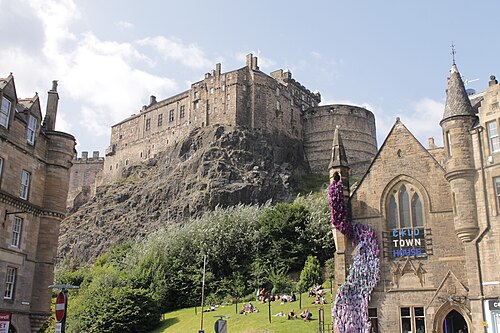 Edinburgh CastleRestored · prime 1520
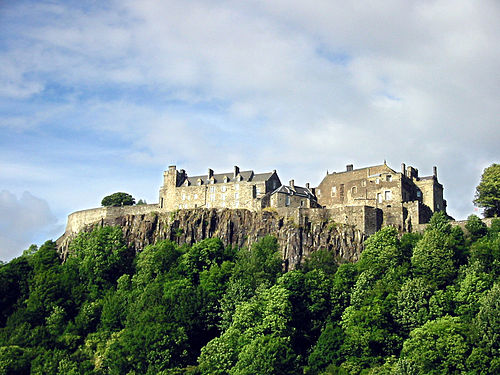 Stirling CastleRestored · prime 1542
 Glamis CastleStill standing · prime 1900
All castles in Scotland → · Strongest castles in Scotland → · Castles of Europe
Play As Your Clan
Hold a real castle against whatever you choose to send at it, take a ship out in her own service years, or stand at the shoulder of someone the record remembers. The chronicler sets the scene; the deeds are yours.
Notable bearers of the Napier name
- John Napier of Merchiston (1550–1617), inventor of logarithms
Stories of Clan Napier
Frequently asked
What does the surname Napier mean?
Where does the Napier family come from?
Is Napier Scottish or Irish?
How old is the Napier surname?
What is the Napier family known for?
What is the Napier motto?
What does "Sans tache" mean in English?
Is there a Napier family crest or coat of arms?
What is the Napier clan tartan?
Who is the most famous Napier?
What stories are told about the Napier family?
What is the story of Logarithms at Merchiston?
Where is the Napier surname found today?
What does the Clan Rising page for the Napier family cover?
Who is the head of the Napier family today?
Neighbouring clans
- SmithThe forge surname, the most common occupational name in Scotland and the world.
- BrownDescriptive, the brown one, third most common surname in Scotland.
- WilsonSon of Will, second most common surname in Scotland, behind Smith.
- ThomsonSon of Thomas, the Lowland Scots form, no 'p', distinguishing it from English Thompson.