Scotland · Ruin
Kilmahew Castle
Kilmahew Castle is a former 16th‑century Scottish tower house near Cardross in Argyll and Bute, later altered in the 18th and 19th centuries. It stands on the Kilmahew estate beside Kilmahew Burn and is now a ruin within the larger estate that includes St. Peter's Seminary and walled gardens.
First raised
1290
Its prime
1870
Today
Ruin
As it stood in 1870
What Kilmahew Castle looked like in its prime.
A four‑storey rectangular stone tower house rising above lower attached ranges, built of rough local rubble with mortar and areas of dressed stone around openings. The main tower has vertically aligned narrow windows and a pronounced arched ground‑floor entrance; 18th/19th‑century gothic alterations add a lower wing with pointed‑arch windows and decorative stonework. The building sits on a wooded riverside slope beside Kilmahew Burn, with continuous external walls and an intact roofline at its prime.
Its story
The story of Kilmahew Castle.
The lands of Kilmahew, named for the patron saint Mochta, were granted to the Napiers by Malcolm, Earl of Lennox, around 1290. The castle itself was built in the 16th century by the Napier family, who held the estate for 18 generations, a line whose later members included Robert Napier, the "Father of Clyde Shipbuilding", and the Napiers of the engineering firm Napier & Son.
In 1694 the estate passed to George Maxwell of Newark and Tealing, who took the name of his maternal grandfather, John Napier of Kilmahew, but died without legitimate children as the last of the name; the Napier of Kilmahew arms survive only as a quartering in the arms of Noble of Ardmore. An illegitimate daughter, Jean Smith, successfully claimed the estate, and it was sold to Alexander Sharp in 1820 in repayment of gambling debts.
James Burns of neighbouring Bloomhill acquired the estate in 1839. The Archdiocese of Glasgow bought the ruins and surrounding estate in 1948, the grounds later held St Peter's Seminary, and in 2020 The Kilmahew Education Trust acquired the castle as part of the 140-acre Kilmahew Estate.
Step inside
5 places to explore in 1870.
The record describes 5 distinct spots at Kilmahew Castle, including the full exterior approach. Create your own photoreal reconstruction and explore every one, more scenes means more rooms, more angles, and more of the place to stand in.
Build Your Own Castle
Recreate Kilmahew Castle with AI to explore it.
The artist rebuilds it as it stood in 1870, a photoreal reconstruction that belongs to you alone. Pay with coins, no subscription needed.
Recreate this castle →Defend this castle →Whose castle
Clans who held Kilmahew Castle.
The families that held Kilmahew Castle for a decade or more across its history, follow a name to its clan.
The Napiers held Kilmahew from the Lennox grant of about 1290, built the castle in the 16th century, and kept the estate for 18 generations until the line ended in the early 18th century.
From the archive
Kilmahew Castle on paper: the measured plan and period views.
The survey plan and photographs below are the ground truth this page's reconstructions are checked against, drawn and photographed while the castle was still a working garrison. Every image is public-domain or openly licensed, with its source named.
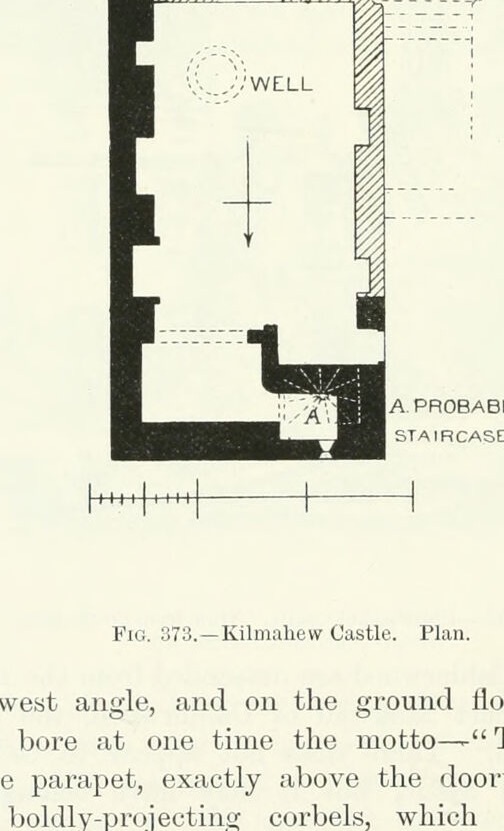
Fig. 373. Kilmahew Castle. Plan.
1889 · MacGibbon & Ross, vol. 3 (1889)
Public domain
Nearby