
Stadium · Scotland · Still standing
Ibrox Stadium
Ibrox Stadium is a large football stadium on the south bank of the River Clyde in Glasgow, Scotland, and the home ground of Rangers Football Club. The ground combines a listed red-brick Main Stand by Archibald Leitch with three later rectangular all-seated stands to form a modern stadium.
First raised
1899
Its prime
1997
Today
Still standing
As it stood in 1997
What Ibrox Stadium looked like in its prime.
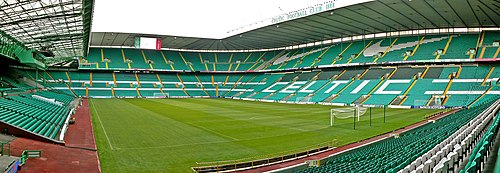
Ibrox in its prime (1997) is a large rectangular all-seated football stadium formed by four steep stands. The south Main Stand shows a long red-brick façade with Archibald Leitch criss-cross balcony detailing beneath a modern glass-and-steel upper frontage. The remaining stands are banks of blue seating under wide cantilevered roofs; advertising hoardings encircle a tightly striped green pitch, with floodlight and scoreboard structures punctuating the roofline and turnstiles at concourse level.
Its story
The story of Ibrox Stadium.
From Kinning Park to the New Ibrox, 1872–1899
Rangers played their first match in May 1872 on Glasgow Green and settled at the Clydesdale cricket ground in Kinning Park, leaving in February 1887 when the landlords hinted at developing the site. Later that year Rangers moved to the Ibrox area, onto a site immediately east of the present stadium; the first match there, on 20 August 1887, was an 8–1 defeat by Preston North End before a crowd of over 15,000, abandoned after 70 minutes when spectators invaded the pitch. Rangers formed a limited company to fund a replacement ground, opening the new Ibrox Park with a 3–1 win over Hearts on 30 December 1899.
The Terracing Collapse and Its Aftermath, 1902–1910
The new ground held 40,000, laid out on the Scottish pattern of the day: an oval track, a pavilion and one stand. Rangers built a terrace for 36,000 behind the western goal to a design by Archibald Leitch, wooden planks bolted to an iron framework, with a similar structure at the east end taking capacity to 75,000.
The Govan Burgh Surveyor passed the terracing in March 1902, though newspapers reported it unstable. On 5 April, shortly after the kick-off of a Scotland v England match watched by 68,114, one section "collapsed like a trap door": about 125 people fell 50 feet through a gap of some 20 square yards. Twenty-five were killed and 517 injured. No public inquiry was held and no cause was agreed; the timber supplier was tried for culpable homicide and acquitted, and the design was also blamed. Rangers removed the wooden terraces, cutting capacity to 25,000, and hired Leitch again; his earth slopes took Ibrox to 63,000 by 1910.
Royal Occasions and a Record Crowd, 1917–1939
King George V and Queen Mary came to Ibrox Park on 17 September 1917 to thank Glasgow and Clydeside for their war work: before 100,000 people, four-fifths of them women munitions workers, nurses and other war workers, the King awarded three Victoria Crosses, 46 Military Medals and 33 Military Crosses in the first public investiture held in Scotland. A new Main Stand with Leitch's criss-cross balcony and red-brick facade opened on 1 January 1929, seating 10,000 above a standing enclosure. At George VI's suggestion the opening ceremony of the 1938 Empire Exhibition was held at Ibrox, his speech broadcast to the nation and the Empire on 3 May before 146,000 spectators. On 2 January 1939 an Old Firm league match drew 118,567, the record attendance for any league match played in Britain.
Stairway 13, 1961–1975
Stairway 13, the exit from the East Terracing nearest Copland Road subway station, was steep and often overcrowded. Two fans died there in September 1961 when a barrier collapsed, and further crush injuries followed in 1967 and 1969. After the Old Firm game of 2 January 1971, which ended 1–1 with a late Colin Stein equaliser, 66 people died of asphyxiation in another crush there. A public inquiry discounted the early story that fans who had left early turned back at the roar for the goal, establishing that the crowd had been travelling in one direction when the crush happened.
The inquiry and the compensation cases found Rangers inept in their administration and complacent after the incidents of the 1960s. The disaster also showed that no established safety standards existed. The Guide to Safety at Sports Grounds was published in 1973, and the Safety of Sports Grounds Act 1975 cut the capacity of Ibrox to 65,000.
Rebuilt, Renamed and Sold, 1977–2024
Willie Waddell visited West German grounds during the 1974 World Cup and held that steep terracing and exits such as Stairway 13 had to be replaced. Plans by the architects Miller Partnership, published in November 1977 and modelled on Borussia Dortmund's Westfalenstadion, swept away the bowl of terracing for three all-seated stands and kept only the Main Stand. The Copland Road stand went up from 1978, its Broomloan Road twin a year later, and the 10,300-capacity Govan Stand completed the scheme in 1981 at a cost that rose from an estimated £6 million to £10 million. The rebuilt ground opened with an Old Firm match on 19 September 1981.
The Main Stand facade was listed Category B in 1987. Gareth Hutchison's Club Deck, a third tier over the Main Stand, opened for a league match against Dundee United in December 1991. The ground was renamed Ibrox Stadium when the renovations finished in 1997. Rangers became insolvent in February 2012, and in June the stadium and the club's other assets were sold to a new company run by Charles Green. Rangers own the ground and play there; a statue of Walter Smith was unveiled outside the Copland Road Stand on 25 May 2024, and capacity rose to 51,700 that September.
Step inside
6 places to explore in 1997.
The record describes 6 distinct spots at Ibrox Stadium, including 4 interiors: pitch: halfway line, govan stand: upper tier (behind goal), copland road: seating row and more. Create your own photoreal reconstruction and explore every one, more scenes means more photos, more angles and more of the immersive experience.
Build Your Own Castle
Recreate Ibrox Stadium with AI to explore it.
Rebuilds stop at 1945, so the artist raises this site as it stood in 1939, not today's building, as a photoreal reconstruction that belongs to you alone. Pay with coins, no subscription needed.
Recreate Stadium to Explore →Nearby
Castles within reach of Ibrox Stadium.


Landmarks within reach of Ibrox Stadium.


More landmarks of Scotland


Explore the city


