Thomson
also Thompson, MacThomas
Son of Thomas, the Lowland Scots form, no 'p', distinguishing it from English Thompson.
- Origin
- Fife, Scotland
- Motto
- Deo juvante invidiam superabo
- Famous bearer
- James Thomson (1700–1748), poet (The Seasons, Rule Britannia)
- Register
- Scottish family
The Thomson arms, crest badge, tartan and country

Crest badgeClan member crest badge - Clan MacThomasSodacan · Public domain 
TartanMacTavish Thompson Thomson 1906 TartanThe pattern as it was recorded in 1906.Matt898 · CC BY-SA 4.0 
TartanMacTavish Thompson Thomson 1880 TartanThe pattern as it was recorded in 1880.Matt898 · CC BY-SA 4.0 
Coat of armsMacThomas of Finegand armsBorne by the Finegand line, one branch of the name rather than all of it.Czar Brodie · CC BY-SA 3.0 
Coat of armsArms of Thomson, Baron KelvinBorne by Baron Kelvin: the ennobled line of the name, not the name at large.MostEpic · CC BY-SA 4.0


- Crest badge: The chief's crest inside a belt and buckle: the badge a clansman wears to show whose following he is in.
- Tartan: The checked cloth the family is known by.
- Coat of arms: Granted to an individual and inherited down that one documented line. These are the arms of particular families of the name, not of everyone who shares the surname.
What is the Thomson clan tartan?
Two records of the Thomson sett are shown above, taken in 1880 and again in 1906. They are not rival claims to be picked between; they are different records, and different weaves, of the same family cloth. A sett is the block of coloured bands the cloth is built from, repeated in both directions; the whole plaid is that one square enlarged.
Thomson is a Lowland name, and Lowland families did not wear Highland dress; the 1746 proscription that broke the tradition in the north took nothing from them, because there was nothing there to take. The Thomson sett is a 19th-century assignment, made when tartan stopped being Highland and became Scottish and fixed by the Bannockburn weavers’ pattern books, the royal visit to Edinburgh in 1822, and the Vestiarium Scoticum of 1842. Nobody polices any of it. Wearing the Thomson sett declares allegiance to the name, not descent from any particular line of it.
CoreHistoric reach
The seat of Thomson
Seat vacantChief
No one leads the Thomson community yet. When the movement opens, you can stand for its leadership, or help elect whoever does.
Current mission
No shared goal set yet. Once Thomson has leadership, it sets the public focus: a restoration, a gathering, a real-world project that helps its own.
The Thomson clan is being rebuilt. Join the waiting list for the movement today, and you help decide who leads it and what it does.
Help rebuild the Thomson clan →Motto
Deo juvante invidiam superabo
“With God's help I shall overcome envy”
What does the Thomson name mean?
Son of Thomas. Lowland Scots patronymic, distinct from the English Thompson by the absence of the intrusive 'p'. The Gaelic equivalent, MacTavish, from Mac Tamhais, preserves the same patronymic in the Highlands. Where the Welsh form is Thomas (without the 's') and the English form Thompson (with the 'p'), the Scots form Thomson is the orthographic giveaway of a Lowland Scots origin.
The history of Thomson
The Scots spelling that never took the p
Thomson means son of Thomas, and in Scotland the spelling is the evidence. The Lowland Scots form carries no intrusive 'p'; that letter belongs to the English Thompson, a separate name. In the Gaelic Highlands the same patronymic survives in two clan forms anglicised as Thomson: MacTavish, from Mac Tamhais, out of Argyll, and MacThomas out of Angus, Aberdeenshire and Perthshire. The Welsh settled on Thomas without the final 's', and a French Thomson, first documented in Burgundy, shortens Thom[as]son.
Independent Lowland and Border traditions produced the surname on their own, and each tradition is genealogically distinct. The reason the name multiplied faster than any bloodline is administrative: in Gaelic practice a clan surname belonged to the descendants and dependants of a named ancestor, not to everyone on clan ground, and only when a non-Gaelic-speaking administration began recording the Highlands were clan surnames applied to whole populations at once.
Tomaidh Mòr takes his people over the Grampians
The eastern Highland strand begins with a Gaelic-speaking Highlander called Thomas, known as Tomaidh Mòr. The clan's own account makes him a grandson of William Mackintosh, seventh chief of Clan Mackintosh and eighth chief of the Clan Chattan confederation, living in the fifteenth century; a rival tradition makes him a son of the eighth Mackintosh chief and puts him a good deal earlier, about 1380. The descent is disputed, the dispersal is not. Chattan had grown too large to govern as one body, and Thomas took his following out of Badenoch, across the Grampian Mountains, into Glen Shee. There they prospered under phonetic renderings of his name: McComie, McColm and McComas. Edinburgh knew them as Macthomas, and lists them so in the roll of the clans in the Acts of Parliament of 1587 and 1595.
The early chiefs ruled from the Thom, opposite the Spittal of Glenshee on the east bank of the Shee Water, ground also held to be the site of the tomb of Diarmid of the Fingalian saga. It was a small lordship, named in statute and answerable for its own men, and the oldest hard ground the name has in Scotland.
Finegand, the burn of the heads
In about 1600 Robert Mccomie of Thom, the fourth chief, was murdered, and the chiefship passed to his brother, John Mccomie of Finegand. The seat moved with the title, about three miles down the glen to the settlement of Finegand. The name is a corruption of the Gaelic feith nan ceann, the burn of the heads, said to remember tax collectors who were killed and whose heads were thrown into the water.
The seventh chief, John Mccomie, called Iain Mòr, entered Perthshire folklore on the same theme. Tax collectors, particularly those of the Earl of Atholl, seem to have been offensive to him. The Earl hired a champion swordsman from Italy to kill him, and the swordsman was killed by Mccomie instead.
Iain Mòr rides out with Montrose
During the Scottish Civil War of the seventeenth century the clan supported Charles I. Iain Mòr joined James Graham, 1st Marquess of Montrose, at Dundee in 1644. When the royalists took Aberdeen, the chief himself captured Sir William Forbes, sheriff of Aberdeen and commander of the Covenanter cavalry, which is as close to a battle honour as this family's record comes.
The commitment did not outlast Montrose's defeat at Philiphaugh. Iain Mòr withdrew his support and turned to enlarging his estate, buying the Barony of Forter from the Earl of Airlie. The bill arrived after the Restoration of 1660, when Parliament fined Macthomas heavily and Airlie began legal action to recover some of the lands.
Broughdearg, January 1673, and the scattering of a name
Airlie's action succeeded in court. The chief refused to recognise the judgment and went on pasturing his cattle on the disputed ground, so Airlie used his legal right to lease that land to men of Clan Farquharson. The result was a feud. On 28 January 1673 Farquharson of Broughdearg was killed, and two sons of Iain Mòr were killed with him.
The lawsuits that followed crippled the chief. He died in 1676 and his surviving sons were forced to sell the lands. Government proclamations still name the Macthomas chief in 1678 and 1681, but the clan was drifting apart. Some went south into the Tay valley, where they became known as Thomson; others went into Angus and Fife as Thomas, Thom and Thoms. The tenth chief took the name Thomas, then Thoms, settled in northern Fife and farmed successfully. A Highland patronymic became a Lowland surname by the ordinary route of losing a lawsuit.
Provost of Dundee, and a will contested in Edinburgh
The chiefly family did well in Fife, then recrossed the Tay to Dundee, where their interests in property and insurance prospered as the town's population doubled through the eighteenth century. Other clansfolk went north to Aberdeenshire, where William McCombie of Tillyfour, MP, became famous as a breeder of Aberdeen-Angus cattle.
Patrick, the sixteenth chief, became Provost of Dundee in 1847 and bought the Aberlemno estate in Angus. His son George was made one of Scotland's youngest sheriffs in 1870, and left both the estate and a fortune worth some seven million pounds in today's terms to St Magnus Cathedral in Orkney. His heir Alfred, the seventeenth chief, contested the will in a famous Edinburgh court case in 1905 and lost, to the shocked dismay of his family.
The line recovered as a society rather than a lordship. In 1954 Patrick, the eighteenth chief, founded the Clan MacThomas Society; his son Andrew, the nineteenth chief, is recognised by the Court of the Lord Lyon and sits on the Standing Council of Scottish Chiefs. Members gather every three years at Clach Na Coileach, the Cockstane, in Glenshee, under the motto Deo juvante invidiam superabo, with God's help I shall overcome envy.
The Glasgow chair held for fifty-three years
William Thomson was born at 12 College Square East in Belfast on 26 June 1824, son of James Thomson, a self-taught mathematics tutor from County Down who had worked his way into the chair of mathematics at Glasgow. The family moved there when William was eight; his father taught the children from textbooks he wrote himself and put William into the university at ten. At thirteen the boy was reading Fourier's Théorie analytique de la chaleur. He went up to Peterhouse, Cambridge in 1841 at sixteen, came out Second Wrangler in 1845, and spent that summer in Victor Regnault's laboratory in Paris.
He took the chair of natural philosophy at Glasgow in 1846, aged twenty-two, on testimonials from Stokes, Faraday and Liouville, and held it for fifty-three years. His teaching laboratory was the first physics teaching laboratory in Britain and Ireland, and twelve of his students became Fellows of the Royal Society. In 1848 he published On an Absolute Thermometric Scale, defining the scale on which water freezes at 273.15 degrees and nothing lies below zero. In 1851, in section twelve of On the Dynamical Theory of Heat, he gave the first general statement of the second law of thermodynamics: no engine converts heat to work without rejecting some heat to a colder reservoir.
The 1858 telegraph cable from Valentia in Ireland to Heart's Content in Newfoundland failed within weeks, its signalling destroyed by the high voltages the consortium's chief electrician Edward Whitehouse had insisted on. Thomson, brought in as scientific adviser, designed the mirror galvanometer of 1858 and the siphon recorder of 1867 to read a faint signal at the end of two thousand miles of copper under three miles of sea. The Great Eastern expedition of 1866, under his supervision, laid the cable that worked, and he was knighted on her foredeck at Brest that November. He was raised to the peerage as Baron Kelvin of Largs in 1892, the first scientist elevated for his work alone, and in 1907 was buried in Westminster Abbey beside Isaac Newton.
Challenger decks, Scottish drawing boards, Canadian newsrooms
The sciences hold the densest run of Thomsons after him. Thomas Thomson senior (1773-1852) was a Scottish chemist and Thomas Thomson junior (1817-1878) a Scottish botanist. Charles Wyville Thomson (1830-1882) went to sea as chief scientist of the Challenger expedition; Joseph Thomson (1858-1895) was a Scottish geologist and explorer, Robert Thomson (1822-1873) a Scottish inventor. J. J. Thomson (1856-1940), the English physicist who discovered the electron and took the 1906 Nobel Prize in Physics, has this family's own legend to himself.
Elsewhere the name went into buildings, paint and print: Alexander Thomson (1817-1875), Scottish architect; George Thomson (1757-1821), Scottish collector of music; Tom Thomson (1877-1917), Canadian artist. On the Continent it belongs to Carl Gustaf Thomson (1824-1899), the Swedish entomologist, Gaston Thomson (1848-1932), the French politician, and Lodewijk Thomson (1869-1914), the Dutch soldier and politician. Elihu Thomson (1853-1937), an English engineer, founded what became Thomson SA.
The emigrant record runs as long. Charles Thomson (1729-1824) served as secretary of the Continental Congress; Charles Poulett Thomson, 1st Baron Sydenham (1799-1841), became the first Governor of the united Province of Canada. John Turnbull Thomson worked as a British engineer in Singapore and New Zealand. The largest of these lines is Canadian: the family tree of the Barons Thomson of Fleet is headed in its own records by David Thomson (1760-1834) and runs through Roy Thomson, 1st Baron (1894-1976), and Kenneth, 2nd Baron (1923-2006), a Scots patronymic that became the wealthiest family in Canada.
Champions of the Thomson name
The bearers whose lives are inseparable from this surname. Each has their own page, biography, achievements, geography, connection to the family.
Historic Places, Rebuilt
Explore the streets and seats the Thomson name knew, rebuilt with AI as they stood in history.
Historic Places, Rebuilt · New
The castle on its crag, St Giles' crown spire, and the closes tumbling to the Cowgate.
Historic Places, Rebuilt · New
The merchant city on the Clyde on the eve of mass emigration, the Cathedral, the Trongate, and the Broomielaw where the ships left.
Historic Places, Rebuilt · New
Scotland's ecclesiastical capital at its peak, the great cathedral, the bishop's castle on the sea, and the new university.
Historic Places, Rebuilt · New
John Brown's shipyard on launch day for the Queen Mary, the great hull on the ways, the cranes and the cloth-capped crowd.
The castles of the homeland
The great strongholds of the homeland, look one up, see what it looked like in its prime, and recreate it to explore.
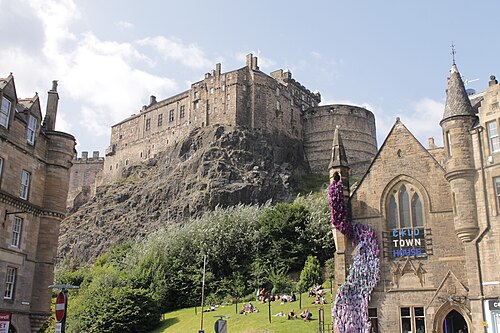 Edinburgh CastleRestored · prime 1520
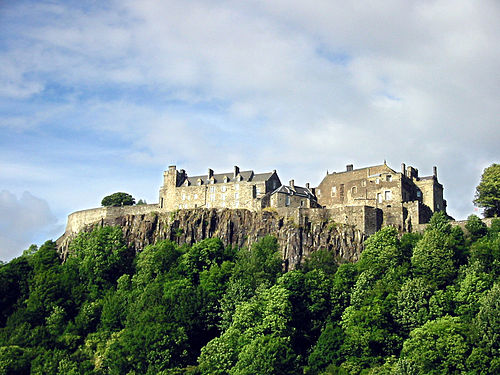 Stirling CastleRestored · prime 1542
 Glamis CastleStill standing · prime 1900
All castles in Scotland → · Strongest castles in Scotland → · Castles of Europe
Play As Your Clan
Hold a real castle against whatever you choose to send at it, take a ship out in her own service years, or stand at the shoulder of someone the record remembers. The chronicler sets the scene; the deeds are yours.
Notable bearers of the Thomson name
- James Thomson (1700–1748), poet (The Seasons, Rule Britannia)
- Lord Kelvin, William Thomson (1824–1907), physicist
- Sir Joseph John (J.J.) Thomson (1856–1940), discoverer of the electron, Nobel Laureate in Physics 1906
- Roy Thomson, 1st Baron Thomson of Fleet (1894–1976), press baron