Clan Elliot
also Eliott, Elliott
One of the great riding clans of the Borders.
- Origin
- The Borders, Scotland
- Motto
- Fortiter et recte
- Famous bearer
- Little Jock Elliot of the Park (d. c.1566), Liddesdale reiver
- Register
- Scottish clan
The Elliot crest badge, tartan and country

Crest badgeClan member crest badge - Clan EliottCeltus · CC BY-SA 3.0 
TartanEliott tartanMicheletb · CC BY-SA 4.0


- Crest badge: The chief's crest inside a belt and buckle: the badge a clansman wears to show whose following he is in.
- Tartan: The checked cloth the family is known by.
What is the Elliot clan tartan?
One Elliot sett is recorded, and it is the swatch above. A sett is the block of coloured bands the cloth is built from, repeated in both directions; the whole plaid is that one square enlarged.
Border families did not wear Highland dress, and no proscription touched them. What was worn on the Elliot ground was the shepherd’s check: the two-colour Border plaid, older than any clan sett and belonging to a district rather than a surname. The Elliot tartan is a later thing: a Highland-style pattern attached to a Border name in the 19th century, when tartan stopped being Highland and became Scottish. Nobody polices any of it. Wearing the Elliot sett declares allegiance to the name, not descent from any particular line of it.
The seat of Clan Elliot
Seat vacantChief
No one leads the Clan Elliot community yet. When the movement opens, you can stand for its leadership, or help elect whoever does.
Current mission
No shared goal set yet. Once Clan Elliot has leadership, it sets the public focus: a restoration, a gathering, a real-world project that helps its own.
The Elliot clan is being rebuilt. Join the waiting list for the movement today, and you help decide who leads it and what it does.
Help rebuild the Elliot clan →Motto
Fortiter et recte
“With strength and right”
What does the Elliot name mean?
Disputed, possibly from a Border place-name or from the Gaelic 'Eilidh'. A reiving, riding clan of the Scottish Borders.
The history of Clan Elliot
Ellot before Elliot: a clan whose papers burned
The Eliotts arrive in the record already formed, a distinct clan with a chief, in the late fifteenth century, and the reason the years before that are dark is a fire: the old castle at Stobs burned in 1712, and every family document but one went with it. What survives of the earlier story is tradition rather than charter, and the clan's own historians say so plainly. The name was first written Ellot, with no i in it at all; the letter that produces the modern spelling arrived only around 1650, so Ellot, Eliott and Elliott are one family in three centuries of handwriting.
Where the name came from is disputed: it has been read as a Border place-name and as a form of the Gaelic Eilidh, and neither reading has closed the argument. Tradition holds that the Ellots came from the foot of Glenshie in Angus and moved south into Teviotdale in the reign of Robert the Bruce, a migration the clan's own account concedes would have been exceptional. By 1400 most families in Lowland Scotland had settled into hereditary surnames, and the first Elliots surface at that moment: an Ellot of Redheugh living in the early 1400s, and John Elwalde of Teviotdale on record in 1426.
Why a new lord of Liddesdale needed a tested kindred
In 1320 William de Soulis, one of the most powerful nobles in Scotland, was convicted of treason against Robert the Bruce and imprisoned for life. His lands of Liddesdale, and with them the great fortress of Hermitage, were made over to the king's illegitimate son Robert Bruce, Lord of Liddesdale. A frontier lordship of that importance could not be held by charter alone; it had to be held by men, and a loyal, tested kindred settled on the ground is precisely what such a lord would have needed. That requirement, more than any pedigree, gives the Angus tradition its credibility.
Whatever brought them, the Elliots were in Liddesdale to stay, and the seat of their chiefs was Redheugh. In 1476 Robert Ellot of Redheugh appears as the tenth chief, and from that point the formal history of the name begins. In 1470 Robert Ellot had built a strong tower on a cliff above the ford on Hermitage Water, a position chosen for what it commanded: the crossing.
That tower was one of roughly a hundred strong towers dotted through Liddesdale which belonged to the Ellots and which they shared with the Armstrongs, the neighbouring riding clan. A hundred towers in one dale is not decoration. It is the shape of a society in which every family of consequence kept a defensible stone house, because the alternative was to lose the herd and the roof in a night.
Flodden, Melrose, and what a riding surname was
The chief of the name fell with his king at Flodden in 1513. The clan's own account names him Robert Ellot, the thirteenth chief; another line of the family record gives James, the fifteenth. The two traditions disagree about the man and agree about the loss, a fair measure of what the fire at Stobs cost. At the Battle of Melrose in 1526 the Eliotts turned out in support of Scott of Buccleuch, an alliance worth remembering given what followed.
It is easy to read the Border century as lawlessness, and truer to read it as government. The Scottish Parliament's act of 1587 concerning Highland and Border clans addressed itself to the captains, chiefs and chieftains of all clans, and recognised that some followers depended on a chief by pretence of blood or by the place of their dwelling. That is the Elliots exactly: a kindred organised by chiefs, branches, lordship and territorial dependence. On a frontier where two crowns met and neither writ ran cleanly, the kindred was what answered when a man was robbed. The riding surnames of Liddesdale, Elliot and Armstrong among them, were the families strong enough to make that arrangement work.
The feud with the Scotts and the fight at Hermitage
The alliance of 1526 did not hold. In 1565 Scott of Buccleuch executed four Ellots for cattle rustling, a small crime answered with the gallows, and the Borders had a settled expectation of what followed. Three hundred Ellots rode to avenge their kinsmen. The losses were heavy on both sides, and the outcome was terms rather than conquest, which is how most Border feuds ended once both parties had counted the cost.
A second quarrel set the Elliots against James Hepburn, 4th Earl of Bothwell, the future husband of Mary, Queen of Scots. A skirmish around Hermitage Castle left the earl wounded, and the man the Borders attached the story to was Little Jock Elliot of the Park, a Liddesdale rider who died about 1566.
The scale of the reply says what the family was worth. In 1569 a royal force of nearly four thousand men was sent into the Elliot lands and devastated them; crowns did not raise four thousand men against nuisances, but against a kindred that could put its own hundreds into the saddle and wound an earl on its own ground.
After the riding: Ulster, exile, and the Stobs baronetcy
The Union of the Crowns in 1603 ended the Border reivers, and ended them hard. Many were executed, and many Borderers found new lives in Ulster as that province was colonised. Robert Eliott of Redheugh left his broad lands in Liddesdale for exile in Fife, and the arrival of the i about 1650 belongs to those same decades: a family remaking itself for a country in which the old skills no longer paid.
The remaking succeeded through the Stobs branch. In 1666 Sir Gilbert Eliott of Stobs was created a Baronet of Nova Scotia by Charles II, and in 1673 he became chief of Clan Eliott. The 1712 fire that took the old castle and the clan's archive with it fell on a family now landed and secure enough to build again; in 1764 the third Baronet remodelled the old Tower of Stobs into a mansion house.
The third Baronet's second son was George Augustus Eliott, whose four-year defence of Gibraltar from 1779 to 1783 stands among the most celebrated feats in British military history; he was created Lord Heathfield and Baron Gibraltar in 1787.
Minto Crags: the tower on the crag and the bench
A branch of the chief's family acquired the lands of Minto in 1703, and in 1705 Sir Gilbert Elliot acquired Fatlips Castle, a peel tower on the top of Minto Crags above the River Teviot in Roxburghshire. It was built in the sixteenth century by the Turnbulls of Barnhills and had a hard century before the Elliots came to it: in 1545, during the Rough Wooing, the Earl of Hertford burned the place recorded as Mantoncrake, or Mynto Crag.
The tower runs to four storeys and an attic, with a nineteenth-century parapet walk, and in 1897 and 1898 it was adapted as a shooting lodge and private museum. Visitors were long subject to a local ceremony recorded in the plainest terms: every gentleman, by indefeasible privilege, kisses one of the ladies on entering the ruin. Restored twice since, it is protected as a scheduled monument.
The Minto line made its living in law and parliament rather than in the saddle. Sir Gilbert Elliot, 1st Baronet of Minto (c.1650 to 1718), sat in the Parliament of Scotland and served as a judge of the Court of Session under the title Lord Minto. The 2nd Baronet (c.1693 to 1766) was likewise a Member of Parliament and a judge, and the 3rd Baronet (1722 to 1777) a politician, philosopher and poet, a Lord of the Admiralty and Treasurer of the Chamber. Minto House, the seat of the Elliot Earls of Minto, has since been demolished.
The viceroy from the upper Teviot
Gilbert Elliot, eldest son of the 3rd Baronet of Minto, was born at Edinburgh on 23 April 1751 and raised on the Minto estate on the upper Teviot. Sent at twelve to Paris for two years, where David Hume introduced him to the salons of d'Alembert and Holbach, he entered Christ Church, Oxford in 1768, was called to the bar at Lincoln's Inn in 1774, and came into the Commons in September 1776 as Whig member for Morpeth.
He sat in successive Whig oppositions to Lord North and to the younger Pitt, and was the leading lieutenant of his cousin Edmund Burke in the impeachment of Warren Hastings from 1786 to 1795, delivering four of the articles in person on the floor of the Lords. On the formation of the wartime coalition with Pitt in 1794 he was appointed Viceroy of Corsica, governing from Bastia, in alliance with Pasquale Paoli, the only British constitutional kingdom in the Mediterranean; when the British withdrew in October 1796 he took the safe conduct for Paoli to England. He became Baron Minto in 1797 and envoy to Vienna from 1799 to 1801.
Named Governor-General of India in succession to Cornwallis, he took up office at Fort William on 31 July 1807 and held it six years. He opened the British relationship with Ranjit Singh of the Punjab through the Treaty of Amritsar in 1809, took French-held Mauritius and Réunion by amphibious campaign in December 1810, and took Dutch Java in August 1811 under his own command. Advanced to the earldom in 1813, he died at Stevenage on 21 June 1814 on the road home to Minto and was buried at Westminster Abbey. His grandson, the 4th Earl, was Governor-General of Canada from 1898 to 1904.
Flowers of the Forest, and the chief at Redheugh
The name did other work besides governing. Jean Elliot (1727 to 1805) was the Scottish poet who wrote Flowers of the Forest, Archibald Elliot (1761 to 1823) a Scottish architect, and Lady Charlotte Elliot (1839 to 1880) a Scottish poet. Andrew Elliot (1728 to 1797), a British merchant, was the last Governor of New York, Hugh Elliot (1752 to 1830) a British diplomat and colonial governor, and Charles Elliot (1801 to 1875) a Royal Navy officer, diplomat and colonial administrator.
Later bearers carried it further: Daniel Giraud Elliot (1835 to 1915), the American zoologist; Launceston Elliot (1874 to 1930), the British weightlifter; Katharine Elliot, Baroness Elliot of Harwood (1903 to 1994), the British public servant and politician; and Alison Elliot, born in 1948, the Scottish psychologist who in 2004 became Moderator of the General Assembly of the Church of Scotland.
The chiefship went back to where it started. The chief of Clan Eliott is Madam Margaret Eliott of Redheugh, 29th Chief of the Name and Arms of Eliott, daughter of Sir Arthur Eliott, eleventh baronet and twenty-eighth chief; there is no bar on a woman succeeding to a Scottish chiefship, though the baronetcy passed to a male heir. The crest badge worn by clan members is a raised fist holding a sword, encircled by the motto FORTITER ET RECTE, boldly and rightly, which serves well enough for the whole record from Hermitage Water to Gibraltar.
Champions of the Elliot name
The bearers whose lives are inseparable from this surname. Each has their own page, biography, achievements, geography, connection to the family.
Castles the Elliot held
Strongholds this name held for a decade or more, look one up, or rebuild it to explore.
- Fatlips Castle
Acquired by Sir Gilbert Elliot in 1705; his family eventually became the Earls of Minto.
The castles of the homeland
The great strongholds of the homeland, look one up, see what it looked like in its prime, and recreate it to explore.
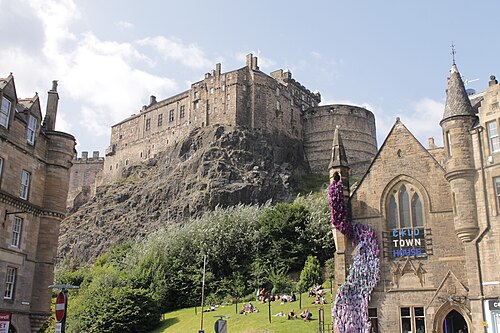 Edinburgh CastleRestored · prime 1520
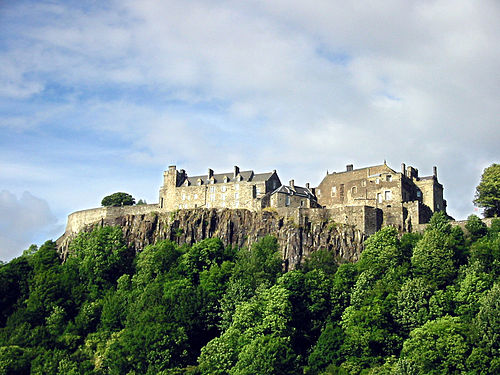 Stirling CastleRestored · prime 1542
 Glamis CastleStill standing · prime 1900
All castles in Scotland → · Strongest castles in Scotland → · Castles of Europe
Play As Your Clan
Hold a real castle against whatever you choose to send at it, take a ship out in her own service years, or stand at the shoulder of someone the record remembers. The chronicler sets the scene; the deeds are yours.
Notable bearers of the Elliot name
- Little Jock Elliot of the Park (d. c.1566), Liddesdale reiver
- George Augustus Eliott, Lord Heathfield, defender of Gibraltar
Stories of Clan Elliot
Frequently asked
What does the surname Elliot mean?
Where does the Elliot family come from?
Is Elliot Scottish or Irish?
How old is the Elliot surname?
What is the Elliot family known for?
What is the Elliot motto?
What does "Fortiter et recte" mean in English?
Is there a Elliot family crest or coat of arms?
What is the Elliot clan tartan?
Who is the most famous Elliot?
Who are some famous Elliots?
What stories are told about the Elliot family?
What is the story of Little Jock Elliot at Hermitage Water?
Who were the Elliot family's rivals?
Is Eliott the same family as Elliot?
Is Elliott the same family as Elliot?
Where is the Elliot surname found today?
What does the Clan Rising page for the Elliot family cover?
Who is the head of the Elliot family today?
Rivals and allies
Neighbouring clans
- CockburnA border clan of jurists and queen's men.
- ReidThe red one, descriptive Scots surname, dense in the Lothians and the Borders.
- WatsonSon of Wat, the Lowland patronymic that produced both the steam engine and Sherlock Holmes's friend.
- YoungDescriptive, the younger, sister surname to Vaughan in Wales and Óg in Ireland.