Watson
Son of Wat, the Lowland patronymic that produced both the steam engine and Sherlock Holmes's friend.
- Origin
- The Borders, Scotland
- Motto
- Insperata floruit
- Famous bearer
- Sir Robert Watson-Watt (1892–1973), inventor of operational radar
- Register
- Scottish family
The Watson arms and country

Coat of armsWatson of Croslatt armsBorne by the Croslatt line, one branch of the name rather than all of it.Czar Brodie~commonswiki · CC BY-SA 4.0 
Coat of armsWatson of Saughton armsBorne by the Saughton line, one branch of the name rather than all of it.Czar Brodie · CC BY-SA 3.0


- Coat of arms: Granted to an individual and inherited down that one documented line. These are the arms of particular families of the name, not of everyone who shares the surname.
CoreHistoric reach
The seat of Watson
Seat vacantChief
No one leads the Watson community yet. When the movement opens, you can stand for its leadership, or help elect whoever does.
Current mission
No shared goal set yet. Once Watson has leadership, it sets the public focus: a restoration, a gathering, a real-world project that helps its own.
The Watson clan is being rebuilt. Join the waiting list for the movement today, and you help decide who leads it and what it does.
Help rebuild the Watson clan →Motto
Insperata floruit
“It has flourished unexpectedly”
What does the Watson name mean?
Son of Wat, diminutive of Walter. The Scots patronymic added the genitive 's' in the English fashion. Wat and Watt both took up Scots surname duty (Watt of the steam engine, Watson of the great Lowland surname pool); the longer form Watherston preserves the place-name register.
The history of Watson
The Cranstonriddel entail of 1384
In 1384 Robert II re-granted the lands of Cranstonriddel to William Watson, with an entail to his heirs male and, failing them, to the heirs of Alexander de Moravia. It is the earliest Crown act to fix the name to Lowland ground. Twenty-three years later the same William Watson of Cranston took a Crown charter of Traquair and Shillinglaw, which he had bought from the Maitlands, and in 1409 the Maitlands granted the annual-rents of Griestoun in Peeblesshire to Marion de Craigie and her son William Watson.
Around those charters the name turns up in the ordinary business of the Lowlands rather than in battle. A John Watson held lands in Edinburgh in 1392. Thomas Watson of Stenhous was party to an inquest near Falkirk in 1426. The Moray records name a Sir Donald Watsone in 1493. Within a century of the Cranstonriddel grant the name is already scattered from Peeblesshire to the Moray Firth, carried by feuars, burgesses and churchmen rather than by a war-band.
That scatter is built into the name. Watson is a patronymic, son of Wat, the Scots pet-form of Walter, so the 1384 charter binds one family and not the name: every Wat in Scotland could father a Watson, and the diminutive was embedded deeply enough in medieval Scots to throw off Watt alongside it. The Cranston, Stenhous and Moray bearers can therefore stand in the same generation with no common ancestor between them, and no single Watson kindred ever formed to hold them together.
Willow ground a mile south of Corstorphine
The historic seat is Saughton in Midlothian, west of Edinburgh. The name, anciently Salectuna, most likely comes from the Scots sauch, a willow, which may in turn descend from Gaelic saileach. It first appears in 1128 among the lands King David I gave to his new foundation at Holyrood, granted as the town of Sauchton and its several divisions. The Watsons came to it as tenants of an abbey rather than as conquerors of a barony, and at one point lost it entirely: the family were dispossessed of the lands for a hundred years before Holyrood resumed ownership.
The recovery is dated. In 1537 Robert, Commendator of Holyrood Abbey, granted a charter of feu farm of six oxengates of the town and lands of Saughton, in the Regality of Broughton, in favour of Janet Stenhope, relict of Richard Watson of Saughton, in liferent, and his son James Watson in fee. Richard Watson is recorded as proprietor of Saughton House in the same year. That single abbey concession made the Watsons lairds of the ground the chiefly line would be measured against for the next three centuries.
Old Saughton House stood a mile south of Corstorphine and passed down through Richard Watson's descendants until James Watson, grandfather of the last chief, bought Cammo House in 1741 for £4,252 10s and renamed it New Saughton. W. Traquair Dickson, a solicitor who later owned the old house, recorded that a good many alterations had been made about the end of the seventeenth or early in the eighteenth century, when the Watsons of Saughton were wealthy and prominent people. The house burned in 1918 and was demolished; a school and then a housing estate took the site.
The chiefship that ended in a countess's marriage
David Watson of Saughton (1637-1685) was apprenticed to Harry Osburn, admitted to the Society of Writers to Her Majesty's Signet on 1 June 1655, and served as the society's Treasurer from 1662 to 1682. In 1672 he recorded the chiefly arms: argent, an oak-tree growing out of a mount in base proper, surmounted of a fess azure. The oak rising through a blue band has stood for the name ever since, and the motto beneath it, Insperata floruit, it has flourished unexpectedly, suits a family that got its land back from an abbey after a century out of it.
John Philip Wood's Antient and Modern State of the Parish of Cramond named Charles Watson of Saughton chief of the name in Scotland, printed ten years before Charles died in 1794. His son James Watson Esq. of Saughton (1781-1823) matriculated arms with supporters in 1818, entered as Chief of the name in Scotland and as descended in the direct male line from Richard Watson of Saughton, proprietor of those lands in A.D. 1537. The abbey feu charter was still doing duty as proof of descent nearly three hundred years after it was sealed.
James was the last chief the Court of the Lord Lyon recognised. His direct line closed when his daughter Helen Watson married Sholto John Douglas, 18th Earl of Morton, and the succession carried out of the name. Under Scots law a name group without a chief recognised through the Lord Lyon holds no standing as a noble incorporation, which leaves Watson an armigerous clan to this day. The Clan Watson Society has since run a campaign to trace surviving heirs of the Saughton line, and by the nineteenth century Watsons were in any case substantial landowners across Edinburgh and Midlothian without needing one.
Tyne hart, tyne al: the Watson Mazer
The Watson Mazer is the earliest in the sequence of Scottish standing mazers: a maple wood bowl with a silver-gilt band, resting on a silver stem and an inscribed trumpet-shaped foot, carrying the arms of David Watson of Saughton. A hallmark may relate to the goldsmith Adam Leys, and chemical analysis places the piece in the early sixteenth century. Round the foot runs TYNE GEIR TYNE LITIL TYNE HONOVR TYNE MUCKIL TYNE HART TYNE AL: lost wealth lost little, lost honour lost much, lost heart lost all. It is displayed in the Silver Treasury on level 5 of the Scotland Galleries in Edinburgh.
Five further Watson arms were recorded between 1672 and 1675, and they show where the name's money actually was: the Watsons of Croslatt, the Watsons of Glentarkie near Strathmiglo in Fife, Alexander Watson bailie of Dundee, Andrew Watson merchant in Aberdeen, and Andrew Watson merchant in Peterhead. Three of the five are east-coast burgh men rather than landed lairds. Within a generation of the chiefly matriculation the name had registered itself in the counting-houses of the ports as firmly as in the charter chests.
From the barony of Muirhouse to the first survey of Scotland
The Watsons of Damhead bought the barony of Muirhouse from the Hunters some time after 1697 and registered arms as the Watsons of Muirhouse in 1722; Lieutenant-Colonel Robert Watson sold Muirhouse on to William Davidson in 1776. In the years between purchase and sale that one branch produced the most consequential Scottish Watson of the eighteenth century.
Major-General David Watson (1704-1761), son of Robert Watson of Muirhouse and reckoned of the old Saughton stock, served as an officer of the Royal Engineers through the War of the Austrian Succession and the Jacobite rising, and was present at Culloden. His lasting work came after the fighting. He is remembered above all for his contribution to the first Ordnance Survey of Great Britain: a soldier who had campaigned over ground nobody had mapped, insisting the ground be mapped.
Charles Hope Watson (1786-1836), son of Charles Watson of Saughton and younger brother of the last chief, appears on the Trafalgar Roll as an eighteen-year-old midshipman aboard HMS Defence under Captain George Johnstone Hope. He served as a lieutenant in the frigate Unité under Captain Patrick Campbell when she took three Italian brigs in the Adriatic in 1808, and on promotion to captain commanded the 18-gun cruiser Arachne and the 28-gun Atholl-class frigate Talbot.
Coal at Earnock, stock in Glasgow, a Rembrandt at Braco
George Watson, a merchant in Edinburgh, registered arms in 1739 and left the endowment that founded George Watson's College. Recent research has established that part of that fortune was acquired in the transatlantic slave trade, which the school's own name now carries with it. The nineteenth century wrote its industry into the same heraldic register: John Watson of Neilsland matriculated in 1871, bought and combined the Neilsland and Earnock estates in 1871 and 1873 into roughly 2,000 acres of Lanarkshire coal ground, and was created first baronet of Earnock in 1895.
Sir James Watson of Broomknowe, arms registered in 1872, was Glasgow's first stockbroker, Lord Provost of the city from 1871 to 1874, and knighted in 1874. William Watson registered arms in 1880 in the year he was ennobled as Baron Watson of Thankerton, having served as Solicitor General for Scotland from 1874 to 1876 and Lord Advocate from 1876 to 1880 while sitting as member for Glasgow and Aberdeen Universities; sworn of the Privy Council in 1878, he went on to the Judicial Committee, where Scottish appeals met the empire's.
Other branches went further out. The Watsons of Shielhill and Terpersy, seated at Shielhill House near Kirriemuir in Angus and also of Tipperty near Aberdeen, were represented by Lieutenant-General Archibald Watson, colonel of the 1st Bengal Cavalry. William Livingstone Watson, arms 1887, joined the East India merchants, took up astronomy and bought Ayton House in Perthshire. James Watson of Langley House became High Sheriff of Buckinghamshire in 1881. Sir Remy Watson of Braco Castle in Perthshire, arms 1903, acquired Rembrandt's Anna and the Blind Tobit, which his son Denis sold to the National Gallery in 1926.
Rockingham, the royal castle a Watson bought outright
The English line took a castle the Crown had built. Rockingham, a former royal castle and hunting lodge in Rockingham Forest near Corby, where a council of church and state met in 1095 over episcopal appointments, presents a strong east-facing gatehouse of two large semicircular D-towers flanking a portcullis-guarded passage, fronting a rectangular plan of stone curtain walls around halls and housing. Sir Edward Watson, founder of the dynasty, took the lease from Henry VIII, and his grandson Lewis Watson, successively knight, baronet and baron, bought the freehold of castle and lands from the Crown.
The Civil War caught them holding it. In 1643 Rockingham was captured by the Parliamentarian general Henry Grey, 1st Earl of Stamford, and Lewis Watson was forced out of his own walls. The family came back and the place settled into a civil residence: Lewis's grandson, already Baron Rockingham, was created Earl of Rockingham and Viscount Sondes in 1714. The earldom was extinguished in 1746 and the estate passed to a cousin, Lewis Monson, who changed his name to Watson and was made Baron Sondes in 1760. With Lees Court at Sheldwich the principal seat, Rockingham was left unaltered, which is why the medieval fabric survived.
Sept lists, the Watt kin group and a tartan of 1932
In Scotland the name is claimed as a sept by two clans at once. Clan Buchanan's claim runs through the MacWatties of Luss, a cadet branch of the Buchanans of Leny; Clan Forbes rests its claim on the large Watt kin group long settled on Forbes lands in Aberdeenshire. The Clan Watson Society has worked with both societies over that double use, which is less a contradiction than an artefact of how sept lists were made.
Those lists mostly date from the nineteenth century, when clan societies and tartan manufacturers drew up rosters linking as many surnames as possible to a clan, so that anyone without a clan name of their own could feel entitled to a tartan. Patronymics from common personal names were the easiest catch of all, and the practice ran wide: Miller was made a sept of MacFarlane, Taylor of Cameron, Mason of Sinclair. A name as numerous as Watson could be attached in two directions at once without either attachment being wrong.
The Watson tartan is itself a twentieth-century design, drawn in 1932 by the Rev. Mhuir Watson and recorded with the Scottish Register of Tartans. The sheer scale of the name is why one was wanted: the National Records of Scotland put Watson 19th among Scottish surnames in 2021, and it stood 46th in England in 2015. It is a Lowland patronymic that outgrew every branch which ever registered arms for it, and which no chief has spoken for since 1823.
Champions of the Watson name
The bearers whose lives are inseparable from this surname. Each has their own page, biography, achievements, geography, connection to the family.
- Robert Watson-Watt
The Brechin engineer descended in the male line from James Watt, who in February 1935 tracked an RAF bomber by reflected radio waves over Daventry, and went on to build the Chain Home radar that won the Battle of Britain.
- James Watson
The Chicago-born molecular biologist whose collaboration with Francis Crick at the Medical Research Council Cavendish Laboratory in Cambridge from October 1951 to February 1953 produced the discovery of the double-helix structure of deoxyribonucleic acid, the foundational result of modern molecular biology and the central single discovery of twentieth-century biological science.
Historic Places, Rebuilt
Explore the streets and seats the Watson name knew, rebuilt with AI as they stood in history.
Historic Places, Rebuilt · New
The castle on its crag, St Giles' crown spire, and the closes tumbling to the Cowgate.
Historic Places, Rebuilt · New
Scotland's ecclesiastical capital at its peak, the great cathedral, the bishop's castle on the sea, and the new university.
Castles the Watson held
Strongholds this name held for a decade or more, look one up, or rebuild it to explore.
- Rockingham Castle
Held by the Watsons since Sir Edward Watson acquired the lease from Henry VIII; his grandson Lewis bought the freehold from the Crown.
The castles of the homeland
The great strongholds of the homeland, look one up, see what it looked like in its prime, and recreate it to explore.
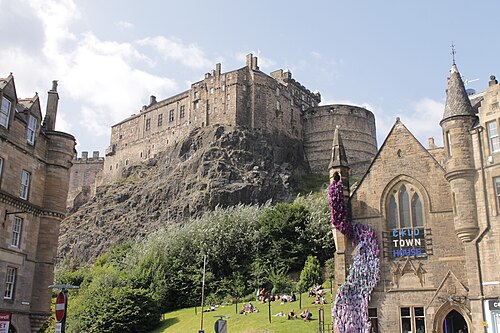 Edinburgh CastleRestored · prime 1520
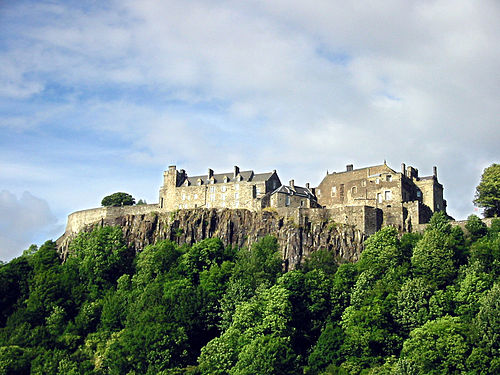 Stirling CastleRestored · prime 1542
 Glamis CastleStill standing · prime 1900
All castles in Scotland → · Strongest castles in Scotland → · Castles of Europe
Play As Your Clan
Hold a real castle against whatever you choose to send at it, take a ship out in her own service years, or stand at the shoulder of someone the record remembers. The chronicler sets the scene; the deeds are yours.
Notable bearers of the Watson name
- Sir Robert Watson-Watt (1892–1973), inventor of operational radar
- James D. Watson (b. 1928), molecular biologist, co-discoverer of the DNA double helix
- Patrick Heron Watson (1832–1907), Edinburgh surgeon, namesake of Conan Doyle's Dr. Watson
- Tom Watson (b. 1949), American golfer, Scots-Watson descent