England · Still standing
Rockingham Castle
Rockingham Castle is a medieval stone castle and former royal hunting lodge on elevated ground in Northamptonshire, England. Its most prominent feature is a twin D-tower gatehouse with a central arched passage, and the castle is contained within a rectangular plan of stone curtain walls surrounding domestic buildings and a bailey.
First raised
1000
Its prime
1270
Today
Still standing
As it stood in 1270
What Rockingham Castle looked like in its prime.
A strong stone gatehouse with two large semicircular (D-shaped) towers flanking a central vaulted arched entrance dominates the east face; the towers rise two storeys and end in a battlemented parapet. The curtain wall of pale, weathered oolitic limestone extends left and right from the gate, enclosing a rectangular plan. The gate passage is a through-vault with a drop arch and would have housed a portcullis and wooden doors. The castle sits on an open, slightly elevated grassy slope above the Welland Valley.
Its story
The story of Rockingham Castle.
William II's Stone Castle and the Council of 1095
William the Conqueror ordered a wooden motte-and-bailey castle built at Rockingham in the 11th century, shortly after the Norman conquest, on elevated ground commanding the Welland Valley. Within three decades William II replaced it in stone, adding a keep to the large motte and enclosing the outer bailey with a curtain wall, and the castle was used as a royal retreat through the Norman and Plantagenet periods, with nearby Rockingham Forest especially good for the hunting of wild boar and deer. In 1095 a church-and-state council was held at the castle to address the question of episcopal appointments; it was attended by William II and Anselm, Archbishop of Canterbury, and failed to reach a resolution.
Henry III's Gatehouse and the Last Royal Visit
Henry III strengthened the castle in 1270 with a twin D-tower gatehouse, its two large semicircular towers flanking a portcullis-guarded passage. Less than a century later Edward III became the last monarch to visit Rockingham while it was possessed by the Crown, and by the late 15th century the castle had fallen into disrepair.
The Watsons, the Earl of Stamford's Capture, and the 1646 Slighting
Sir Edward Watson, founder of the Watson dynasty, acquired the lease of the decayed castle from Henry VIII, and parts of it were later replaced with a Tudor house with gardens, the former royal castle becoming a hunting lodge for the nobility. His grandson Lewis Watson (successively knight, baronet and baron) acquired the freehold of the castle and its lands from the Crown. In the 1640s, during the English Civil War, Rockingham was garrisoned by royalist troops, who fought several small skirmishes with Parliamentary forces. In 1643 the Parliamentarian general Henry Grey, 1st Earl of Stamford, captured the castle, and Lewis Watson was temporarily forced to leave. Its remaining walls were slighted in 1646, and in the later 17th and 18th centuries Rockingham returned to being a civil residence.
Earls, Barons and a Divided Inheritance, 1714–1967
Lewis Watson's grandson, also Lewis and already Baron Rockingham, was created Earl of Rockingham and Viscount Sondes in 1714. The earldom was extinguished on the death of the 5th Baron in 1746; the Rockingham barony passed to a cousin, Thomas Watson-Wentworth, created Marquess of Rockingham later that year, while the estate itself passed to another cousin, Lewis Monson, who took the Watson name and became Baron Sondes of Lees Court in 1760. Lees Court became the principal family seat, so Rockingham Castle remained unaltered through this period. The estates diverged in 1836, when Lewis Richard Watson, 3rd Baron Sondes, died unmarried; Rockingham then passed to his brothers the Reverend Henry Watson and Richard Watson in turn, and on to Richard's sons, until, on the death of the Reverend Wentworth Watson in 1925, it went to his great-nephew Sir Michael Culme-Seymour, who transferred it in 1967 to his nephew, Commander Michael Saunders Watson.
Step inside
7 places to explore in 1270.
The record describes 7 distinct spots at Rockingham Castle, including 2 interiors: gate passage (through-vault), interior chamber of a d-tower. Create your own photoreal reconstruction and explore every one, more scenes means more rooms, more angles, and more of the place to stand in.
Build Your Own Castle
Recreate Rockingham Castle with AI to explore it.
The artist rebuilds it as it stood in 1270, a photoreal reconstruction that belongs to you alone. Pay with coins, no subscription needed.
Recreate this castle →Defend this castle →Whose castle
Clans who held Rockingham Castle.
The families that held Rockingham Castle for a decade or more across its history, follow a name to its clan.
Held by the Watsons since Sir Edward Watson acquired the lease from Henry VIII; his grandson Lewis bought the freehold from the Crown.
From the archive
Rockingham Castle on paper: the measured plan and period views.
The survey plan and photographs below are the ground truth this page's reconstructions are checked against, drawn and photographed while the castle was still a working garrison. Every image is public-domain or openly licensed, with its source named.
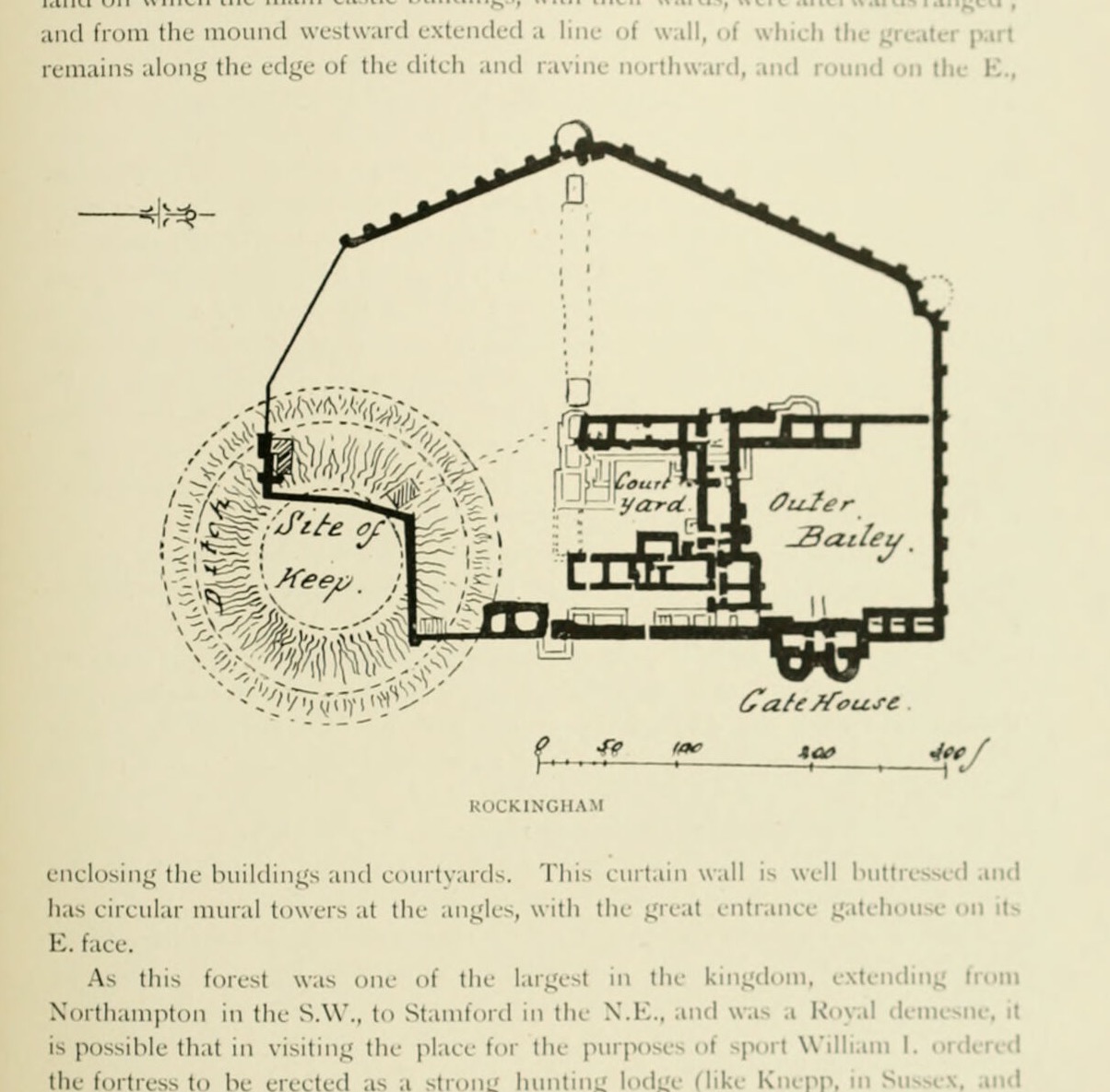
ROCKINGHAM
1897 · J. D. Mackenzie, The Castles of England, vol. 1 (1897)
Public domain
Nearby