England · Ruin
Donnington Castle
Donnington Castle is a medieval castle founded in 1386 near Newbury, Berkshire. Largely demolished following the English Civil War, only its three-storey gatehouse survives today; the site is a scheduled monument cared for by English Heritage.
First raised
1386
Its prime
1516
Today
Ruin
As it stood in 1516
What Donnington Castle looked like in its prime.
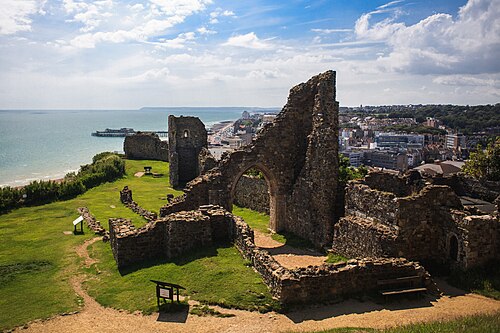
A tall, three-storey rectangular gatehouse of flint-and-limestone rubble stands on a low grassy mound, crested by a crenellated parapet and flanked on its right by a cylindrical corner tower; the gatehouse has a large arched central entrance fitted with an iron grille/portcullis and narrow, irregularly placed window and arrow-slit openings. The surviving masonry shows coursed ashlar dressings and rough rubble, and low modern walls trace the footprint of the vanished curtain walls and towers.
Its story
The story of Donnington Castle.
The Abberburys and Richard II's Licence, 1292–1398
The manor of Donnington had belonged to the Abberbury family since 1292. Sir Richard Abberbury the Elder, chamberlain to Anne of Bohemia, built the castle in 1386 under a licence granted by Richard II, a roughly rectangular enclosure with a round tower at each corner. In 1398 the castle was sold to Thomas Chaucer, son of the poet Geoffrey Chaucer, as a residence for his daughter Alice, who later became Duchess of Suffolk.
The Suffolk Dukes and the Crown, 1398–1603
William de la Pole, Duke of Suffolk, made Donnington his occasional residence and considerably enlarged the buildings, but the family fell out with the Tudor monarchs and the castle became royal property. In 1514 it was given to Charles Brandon, 1st Duke of Suffolk, who appears to have stayed there in 1516; by the time it returned to the Crown in 1535 the structure was in a state of decay. Henry VIII, Edward VI and Elizabeth I each visited, in 1539, 1552 and 1568.
In 1590 Elizabeth I granted the keepership to Elizabeth Cooke, Lady Russell, the first woman in England to hold such a title; in 1600 she gave the castle and surrounding manor to Charles Howard, 1st Earl of Nottingham, who took possession in September 1603; Russell disputed his rights.
Sir John Boys's Eighteen-Month Siege, 1643–1646
By 1643 the castle was owned by the family of the Parliamentarian John Packer, secretary to George Villiers, Duke of Buckingham, but after the First Battle of Newbury it was taken for Charles I and held by the royalist governor Sir John Boys, whose men enhanced the defences with earthworks in a star shape to provide gun emplacements. Parliamentarians laid siege in October 1644 and the garrison held out for eighteen months; with the king's permission, Boys surrendered in April 1646 and was allowed to leave with all his men.
Parliament's Demolition Order, 1646
That year Parliament voted to demolish Donnington. Only the three-storey gatehouse, crested with battlements, was left standing; the star-shaped earthworks added during the Civil War can still be seen around it.
Step inside
8 places to explore in 1516.
The record describes 8 distinct spots at Donnington Castle, including 1 interior: gatehouse entrance passage (interior). Create your own photoreal reconstruction and explore every one, more scenes means more rooms, more angles, and more of the place to stand in.
Build Your Own Castle
Recreate Donnington Castle with AI to explore it.
The artist rebuilds it as it stood in 1516, a photoreal reconstruction that belongs to you alone. Pay with coins, no subscription needed.
Recreate this castle →Defend this castle →Whose castle
Clans who held Donnington Castle.
The families that held Donnington Castle for a decade or more across its history, follow a name to its clan.
Abberbury
The Abberburys owned the manor of Donnington from 1292; Sir Richard Abberbury the Elder built the castle in 1386, and it was sold in 1398.
Chaucer
Bought in 1398 by Thomas Chaucer, son of the poet Geoffrey Chaucer, as a residence for his daughter Alice, later Duchess of Suffolk.
de la Pole
William de la Pole, Duke of Suffolk, made Donnington an occasional residence and enlarged it, before the family fell out with the Tudors and lost the castle to the Crown.
Nearby