England · Restored
Shrewsbury Castle
Shrewsbury Castle is a red sandstone castle on a hill in the neck of the River Severn meander above Shrewsbury, Shropshire. The building combines a crenellated rectangular keep-like block with an outer curtain wall and today houses a regimental museum and functions as a civic landmark.
First raised
1070
Its prime
1995
Today
Restored
As it stood in 1995
What Shrewsbury Castle looked like in its prime.
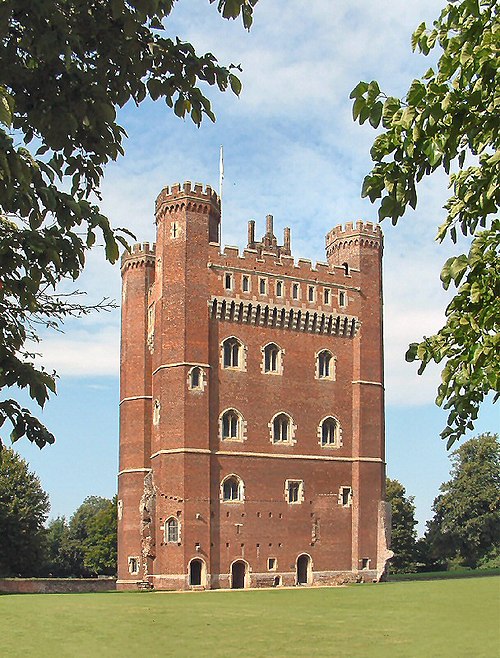
A compact rectangular block of warm red sandstone with a continuous crenellated parapet and a single flagpole on the roof; the main façade has a row of tall pointed-arch (lancet) windows in the first-floor line with smaller square mullioned windows at attic level. A stone stair rises on the right to an arched wooden entrance, while the lower ground has a line of small arched basement openings. A low battlemented curtain wall runs leftward, and the whole sits on a trimmed grassy terrace with flowerbeds.
Its story
The story of Shrewsbury Castle.
Roger de Montgomery's Base Against Wales, from c. 1067
William I ordered a castle built on the site around 1067, and Roger de Montgomery greatly extended it around 1070 as a base for operations into Wales, an administrative centre, and a defence for the town, which the loop of the River Severn otherwise protected. Town walls were later added, radiating out from the castle and surrounding the town, in response to Welsh raids; little of them now remains beyond a small section and a single tower, Town Walls Tower, which is in the care of the National Trust.
Stephen's Siege and Llywelyn's Brief Hold, 1138–1215
At the start of the civil war between King Stephen and the Empress Matilda, the castle was held by William Fitz Alan, lord of Oswestry and Clun, on Matilda's behalf. After a short siege in 1138, Stephen took the castle and had the surviving garrison hanged from the battlements. In 1215 it was briefly held by Llywelyn the Great, Prince of Wales.
Decline, the 1643 Siege from Wem, and Telford's Repairs
With the end of the Welsh wars around 1300 the castle fell into decay and its military role faded; it became a domestic residence during the reign of Elizabeth I and passed to the ownership of the town council around 1600. It was extensively repaired in 1643 during the Civil War and was briefly besieged by Parliamentary forces from Wem before surrendering. Sir Francis Newport acquired it in 1663, and after 1780 Thomas Telford carried out further repairs on behalf of Sir William Pulteney, MP for Shrewsbury, to designs by the architect Robert Adam.
From Council Chambers to the Regimental Museum, 1924–2019
The Shropshire Horticultural Society bought the castle from its then owner, Lord Barnard, and gave it to the town in 1924; it served as Shrewsbury's Borough Council chambers for more than 50 years. In 1985 it was restructured internally to house the Shropshire Regimental Museum, moved from Copthorne Barracks and other local sites. On 25 August 1992 the museum was attacked by the IRA, causing extensive damage to the collection and to parts of the castle; Princess Alexandra officially reopened it on 2 May 1995, and in 2019 it was rebranded as the Soldiers of Shropshire Museum.
Finds from the 2019 and 2020 Digs
Excavations by Shropshire Council and the University of Chester in 2019 found the remains of the original ditch surrounding the motte of c. 1067, along with a range of medieval pottery and two arrowheads or crossbow-bolt heads. Work in 2020 failed to locate St Michael's chapel but recovered evidence of what was described as "high-status feasting", including the bones of a pike and possibly a swan.
Step inside
7 places to explore in 1995.
The record describes 7 distinct spots at Shrewsbury Castle, including 1 interior: soldiers of shropshire museum interior. Create your own photoreal reconstruction and explore every one, more scenes means more rooms, more angles, and more of the place to stand in.
Build Your Own Castle
Recreate Shrewsbury Castle with AI to explore it.
The artist rebuilds it as it stood in 1995, a photoreal reconstruction that belongs to you alone. Pay with coins, no subscription needed.
Recreate this castle →Defend this castle →Nearby