
England · Restored
Tattershall Castle
Tattershall Castle is a mid-15th-century brick castle in Tattershall, Lincolnshire, dominated by a tall Great Tower set within concentric moats and wards. Built and expanded by Ralph Cromwell, the surviving Great Tower, gatehouse, wards and moat define a largely intact medieval domestic fortress now cared for by the National Trust.
First raised
1231
Its prime
1431
Today
Restored
As it stood in 1431
What Tattershall Castle looked like in its prime.
A rectangular plan of fired brick rising from an inner island ward, the composition dominated by a tall, square Great Tower with four corner turrets and crenellated battlements and a roof gallery. The tower has separate ground-level entrances and a visible spiral turret; the inner ward is surrounded by an inner moat and an outer moat beyond it, with an external gatehouse and Middle Ward approached by a bridge. To the north-east stands a separate guardhouse; south of the tower are brick foundations of service buildings that project into the moat.
Its story
The story of Tattershall Castle.
Robert de Tattershall's Foundation and Cromwell's Brick Rebuilding
Tattershall Castle began as either a stone castle or a fortified manor house, built by Robert de Tattershall in 1231. In the 15th century Ralph Cromwell, 3rd Baron Cromwell and Treasurer of England, largely rebuilt it in brick and greatly expanded it; tree-ring dating indicates that construction was under way between 1406 and 1431. Brick castles are less common in England than stone or earth and timber buildings, and there was plenty of stone available nearby, but Cromwell chose brick: about 700,000 bricks went into a castle that has been described as "the finest piece of medieval brick-work in England". Of his castle, the 130-foot Great Tower and moat still remain.
A Mansion Masquerading as a Fortress
The castle's three state rooms are thought to have been splendidly fitted out, the chambers heated by immense Gothic fireplaces with decorated chimney pieces, and it has been said that the place was an early domestic country mansion masquerading as a fortress. Its basement, used to store spices and other kitchen items, is believed to have served as a prison during the Civil War.
Confiscation, the Earls of Lincoln and the Fortescues, from 1456
Cromwell died in 1456 and the castle was initially inherited by his niece, Joan Bouchier, but was confiscated by the Crown after her husband's death, remaining in royal ownership from Edward IV to Henry VIII. Sir Henry Sidney recovered it in 1560 and sold it to Lord Clinton, later Earl of Lincoln; it stayed with the Earls of Lincoln until 1693, then passed to the Fortescues and fell into neglect.
Curzon's Rescue of the Fireplaces, 1910–1914
The castle was put up for sale in 1910 with its greatest treasures, the huge medieval fireplaces, still intact; when an American bought them they were ripped out and packaged up for shipping. Lord Curzon of Kedleston stepped in at the eleventh hour to buy the castle, determined to get the fireplaces back, and after a nationwide hunt they were found in London and returned. He restored the castle between 1911 and 1914; the Flemish tapestries in the great hall of the Audience Chamber were bought by him.
Heritage Law and the Gift to the National Trust, 1913–1925
The experience of Tattershall led Curzon to push for heritage protection law in Britain, enacted as the Ancient Monuments Consolidation and Amendment Act 1913. The castle was gifted to the National Trust on his death in 1925, and it has been counted among the three most important surviving brick castles of the mid-15th century in the United Kingdom.
Step inside
12 places to explore in 1431.
The record describes 12 distinct spots at Tattershall Castle, including 8 interiors: parlour (ground floor of great tower), basement (kitchen storage), hall (first floor of great tower) and more. Create your own photoreal reconstruction and explore every one, more scenes means more rooms, more angles, and more of the place to stand in.
Build Your Own Castle
Recreate Tattershall Castle with AI to explore it.
The artist rebuilds it as it stood in 1431, a photoreal reconstruction that belongs to you alone. Pay with coins, no subscription needed.
Recreate this castle →Defend this castle →Whose castle
Clans who held Tattershall Castle.
The families that held Tattershall Castle for a decade or more across its history, follow a name to its clan.
Tattershall
Robert de Tattershall built the first stone castle or fortified manor house here in 1231.
Largely rebuilt in brick and greatly expanded by Ralph Cromwell, 3rd Baron Cromwell, Treasurer of England, in the 15th century.
Clinton
Sold to Lord Clinton, later Earl of Lincoln, after 1560; held by the Earls of Lincoln until 1693.
Fortescue
Passed to the Fortescues after the Earls of Lincoln's tenure ended in 1693.
From the archive
Tattershall Castle on paper: the measured plan and period views.
The survey plan and photographs below are the ground truth this page's reconstructions are checked against, drawn and photographed while the castle was still a working garrison. Every image is public-domain or openly licensed, with its source named.
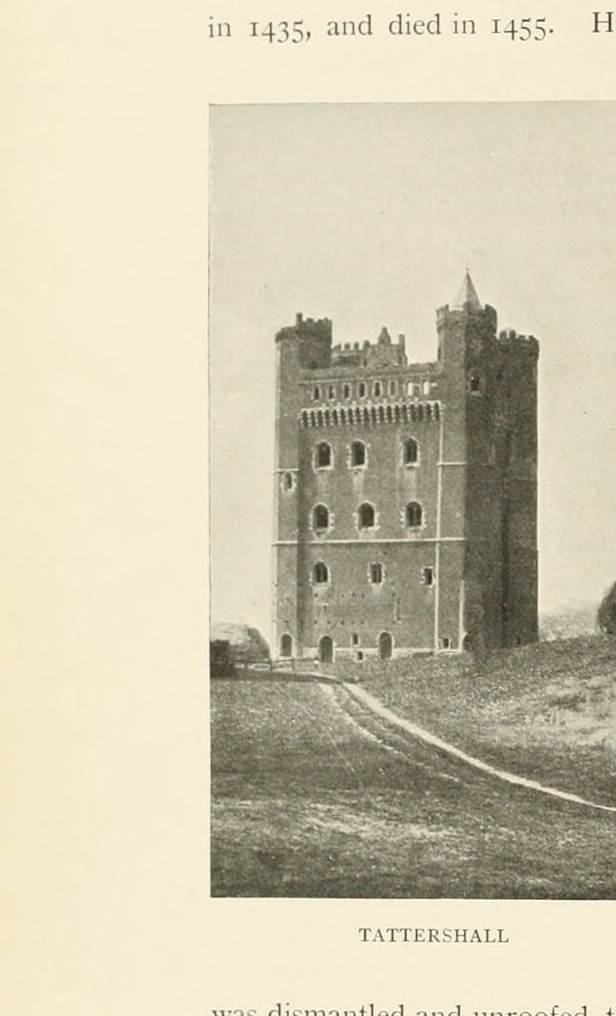
TATTERSHALL
1897 · J. D. Mackenzie, The Castles of England, vol. 1 (1897)
Public domain
Nearby


