
England · Partial ruin
Cooling Castle
Cooling Castle is a 14th-century quadrangular castle in Cooling, Kent, built in the 1380s for the Cobham family. Its plan comprises two walled wards of unequal size arranged side-by-side within a figure-of-eight moat system. The castle was designed to be defended with gunpowder weapons and retains a prominent outer gatehouse, curtain walls and several towers amid largely ruined fabric; a later farmhouse and outbuildings occupy part of the outer ward today.
First raised
1380
Its prime
1385
Today
Partial ruin
As it stood in 1385
What Cooling Castle looked like in its prime.
A low-profile, stone quadrangular castle composed of two unequal walled wards set side-by-side within a figure-of-eight moat and ditches; the larger outer ward to the east, the smaller inner ward on a higher mound to the west. The outer gatehouse adjoins the road and presents two semi-circular stone towers about 12 m high with machicolations and crenelations flanking an arched gateway (c.3 × 5 m). Horseshoe-shaped corner towers project from the outer curtain; the inner curtain stands 3–6 m high with two surviving corner towers c.7 m.
Its story
The story of Cooling Castle.
John de Cobham's Gunpowder Castle, 1379–1385
In 1379, during the Hundred Years' War, a French raid devastated towns and villages along the Thames Estuary. John de Cobham, 3rd Baron Cobham, whose family had acquired the manor of Cooling in the mid-13th century, appealed to the Crown for licence to fortify his manor and received permission in February 1380; the building work was complete by 1385. Surviving records show the prominent gatehouse built by local labour under several master masons, among them Thomas Crompe, William Sharnall and Thomas Wrek, with the king's master mason Henry Yevele taking a supervisory role. It was the earliest English castle designed for the use of gunpowder weapons by its defenders: Cobham's instructions to his masons required "x arket holes de iii peez longour et tout saunz croys", ten holes for arquebuses, of perhaps three feet length, and all without cross-slits.
The layout was unusual, perhaps dictated by the marshy ground it stood on: within an 8-acre perimeter, two walled wards of unequal size sat side by side, each raised on its own mound within a figure-of-eight system of moats and ditches, the moat around the inner ward perhaps up to 20 metres wide. An attacker would have had to take the larger outer ward, entered through its twin-towered gatehouse, before reaching the inner one.
From Cobham to Oldcastle
Cobham fell out of royal favour shortly after the castle was finished and was exiled for a time, though he later returned and died at Cooling in 1408. His granddaughter Joan inherited the estates and married four times; her last husband, Sir John Oldcastle, was executed in 1417 for his part in the Lollard heresy. The Cobham title remained intact, but Cooling itself passed down the female line to other families.
Wyatt's Rebellion, January 1554
Cooling saw action only once. In January 1554 Sir Thomas Wyatt, opposing Queen Mary's engagement to Philip II of Spain, raised an army of some 4,000 men and captured two cannon from the army of Thomas Howard, 3rd Duke of Norfolk, at Strood before turning on Cooling: perhaps for personal reasons, since its occupant was his uncle, George Brooke, 9th Baron Cobham. Contemporary reports give Cobham just eight men, armed with "only four or five handguns, four pikes and some blakbylls". The defenders surrendered on 30 January after eight hours of siege and bombardment that badly damaged the castle.
Wyatt proceeded to London, where he was defeated and executed for treason. Cobham and his son were imprisoned in the Tower of London on suspicion of having deliberately failed to defend the castle, but were soon released and allowed to return to their estates. Cooling was never rebuilt; the Cobhams abandoned it and lived thereafter at Cobham Hall, and it fell into disrepair.
A Farmhouse Among the Ruins
The castle remained in the Cobhams' ownership until the 18th century. Between 1650 and 1670 Sir Thomas Whitmore built a farmhouse within the outer ward, since much altered; the musician Jools Holland now lives there, and a 17th-century timber-framed barn nearby serves as a wedding venue.
Step inside
8 places to explore in 1385.
The record describes 8 distinct spots at Cooling Castle, including 2 interiors: gate passage between towers, vaulted undercroft under the great chamber. Create your own photoreal reconstruction and explore every one, more scenes means more rooms, more angles, and more of the place to stand in.
Build Your Own Castle
Recreate Cooling Castle with AI to explore it.
The artist rebuilds it as it stood in 1385, a photoreal reconstruction that belongs to you alone. Pay with coins, no subscription needed.
Recreate this castle →Defend this castle →Whose castle
Clans who held Cooling Castle.
The families that held Cooling Castle for a decade or more across its history, follow a name to its clan.
Cobham
Built in the 1380s by John de Cobham, 3rd Baron Cobham, whose family had acquired the manor of Cooling in the mid-13th century.
Brooke
George Brooke, 9th Baron Cobham, was the castle's occupant at Wyatt's siege of 1554.
From the archive
Cooling Castle on paper: the measured plan and period views.
The survey plan and photographs below are the ground truth this page's reconstructions are checked against, drawn and photographed while the castle was still a working garrison. Every image is public-domain or openly licensed, with its source named.
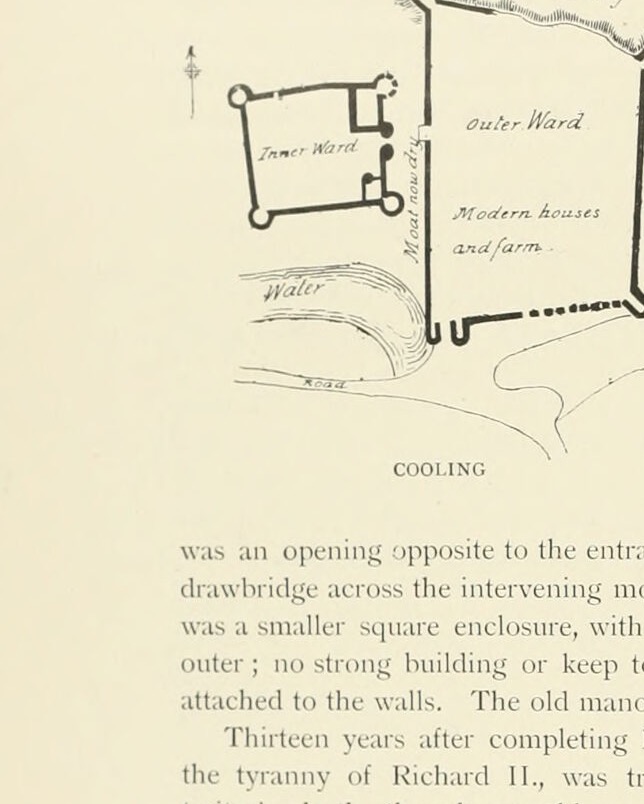
COOLING
1897 · J. D. Mackenzie, The Castles of England, vol. 1 (1897)
Public domain
Nearby


