
England · Restored
Allington Castle
Allington Castle is a medieval stone castle in Allington, Kent, developed from a 13th-century fortified manor into a compound with domestic ranges and towers. The site has a surrounding moat, an irregular curtain wall with six round towers, a gatehouse on the north-west side and surviving domestic ranges including the Penchester Lodgings and a long gallery. It is a Grade I listed, privately owned residence restored in the 20th century.
First raised
1279
Its prime
1530
Today
Restored
As it stood in 1530
What Allington Castle looked like in its prime.
An irregular parallelogram plan of light grey stone curtain walls punctuated by six round towers of varying diameters; the largest, four-storeyed Solomon's Tower, projects from the south‑west corner. A gatehouse stands on the north‑west side within the curtain wall. Domestic ranges sit against the west and east curtains (the Penchester Lodgings to the west and the banqueting/Great Hall to the east). The castle is surrounded by a broad water-filled moat crossed by an entrance bridge and approached through a barbican beyond the moat.
Its story
The story of Allington Castle.
The Anarchy Castle and Stephen de Pencester's Licence, 1135–1492
The first castle at Allington was an unauthorised fortification raised during the Anarchy by William de Warenne, 2nd Earl of Surrey, in the reign of King Stephen. As an adulterine castle it had no royal sanction, and Henry II ordered it slighted in 1174, one of at least 21 castles the king demolished, according to the historian Sidney Painter. A small, unfortified manor house replaced it.
The present castle was built on the site between 1279 and 1299 by Stephen de Pencester, Lord Warden of the Cinque Ports, under a licence to crenellate granted by Edward I. It was more residence than fortress: its early and extensive use of brick may reflect Pencester's own interest in a brickyard in Essex. Over the following two centuries, as it passed through the Cobham family, it grew into a fortified compound with six round towers of varying sizes along its curtain wall.
The Wyatts and the Rebellion of 1554
Sir Henry Wyatt, a prominent supporter of Henry Tudor, acquired the castle in 1492. He divided its courtyard with a new two-storey range containing what may have been one of the first long galleries built in England, and added a half-timbered block for kitchens and stables. Henry VII visited during Wyatt's tenure, and Henry VIII came three times, in 1527, 1530 and 1536: reportedly so concerned for his safety while staying in the castle's north-east tower that he had its single entry, a spiral staircase, blocked with a dry stone wall each night he was there. Cardinal Wolsey visited in 1527 and Katherine Parr in 1544.
Wyatt's son, the poet Sir Thomas Wyatt, was born at the castle in 1503. In 1554 his own son, Sir Thomas Wyatt the Younger, forfeited Allington after his rebellion against Queen Mary failed: the plotters had held their first meeting there before marching on London, and many of the defeated rebels were afterwards imprisoned in the castle. Sir Thomas was executed, and the surviving Wyatts emigrated to America.
Fire, Persecution and Near-Demolition, 1568–1895
Granted in 1568 to John Astley, Elizabeth I's Master of the Jewel House, who never lived there, the castle began a long decline. A fire in the later 16th century destroyed most of the Great Hall and the north-east wing; an early 17th-century lessee, John Best, pulled down the battlements and added a half-timbered gabled second storey to the east and west wings in place of the fire-damaged parts. The Bests were Catholic and kept a private chapel in a room of the east tower, a priest hole still in the gatehouse lodge marks the persecution Catholics then faced.
Sir Robert Marsham, 2nd Baron Romney and a descendant of the Wyatts, bought the castle in 1720 but likewise never lived there; J. M. W. Turner sketched its decay in 1798. A second fire in the early 19th century destroyed the top of the Long Gallery, and Charles Marsham, 5th Earl of Romney, came close to demolishing what remained until opposition from local residents, notably the Rector of the nearby church of St Lawrence, stopped him. By then the castle was totally ruined, the Penchester wing quarried for building materials and the ground-floor remnants of the Long Gallery converted into a pair of farmhouses.
Conway's Restoration and the Return to Private Hands, 1895–1999
A London barrister, Dudley Falke, began restoring the ruin after renting it in 1895, but the work proved too expensive for his means. In 1905 the mountaineer and cartographer Sir Martin Conway bought the freehold and spent thirty years rebuilding it with the architects W. D. Caroe and Philip Tilden, drawing on his own and his wife's wealth. The gatehouse, the Penchester range and the Long Gallery were restored before the First World War; the Great Hall followed by 1927 and the north-east wing by 1932.
Restoration work had ceased for lack of funds by the time Conway died in 1937 and his daughter Agnes inherited the castle; it was leased from 1936 to 1946 to the politician and architect Alfred Bossom. After Agnes died in 1950, the castle was sold to the Carmelite order from nearby Aylesford Priory, a turn of history, since the Wyatts had dispossessed the Carmelites of that same priory during the Dissolution of the Monasteries. Friars and nuns lived there until 1999, when the castle returned to private hands as the home of Sir Robert Worcester, founder of the MORI polling company.
Step inside
11 places to explore in 1530.
The record describes 11 distinct spots at Allington Castle, including 6 interiors: gatehouse entrance and outer approach, long gallery (upper floor of dividing range), great hall / banqueting hall (east curtain) and more. Create your own photoreal reconstruction and explore every one, more scenes means more rooms, more angles, and more of the place to stand in.
Build Your Own Castle
Recreate Allington Castle with AI to explore it.
The artist rebuilds it as it stood in 1530, a photoreal reconstruction that belongs to you alone. Pay with coins, no subscription needed.
Recreate this castle →Defend this castle →Whose castle
Clans who held Allington Castle.
The families that held Allington Castle for a decade or more across its history, follow a name to its clan.
Cobham
Passed by marriage from Stephen de Pencester's daughter; owned by the Cobham family until 1492.
Wyatt
Acquired by Sir Henry Wyatt in 1492; seized by the Crown from Sir Thomas Wyatt the Younger after his 1554 rebellion.
Marsham
Bought in 1720 by Sir Robert Marsham, 2nd Baron Romney, a descendant of the Wyatts.
From the archive
Allington Castle on paper: the measured plan and period views.
The survey plan and photographs below are the ground truth this page's reconstructions are checked against, drawn and photographed while the castle was still a working garrison. Every image is public-domain or openly licensed, with its source named.

Allington Castle and river, near Maidstone, England-LCCN2002697023
ca. 1890-1900 · Photochrom Prints Collection (via Wikimedia Commons)
Public domain
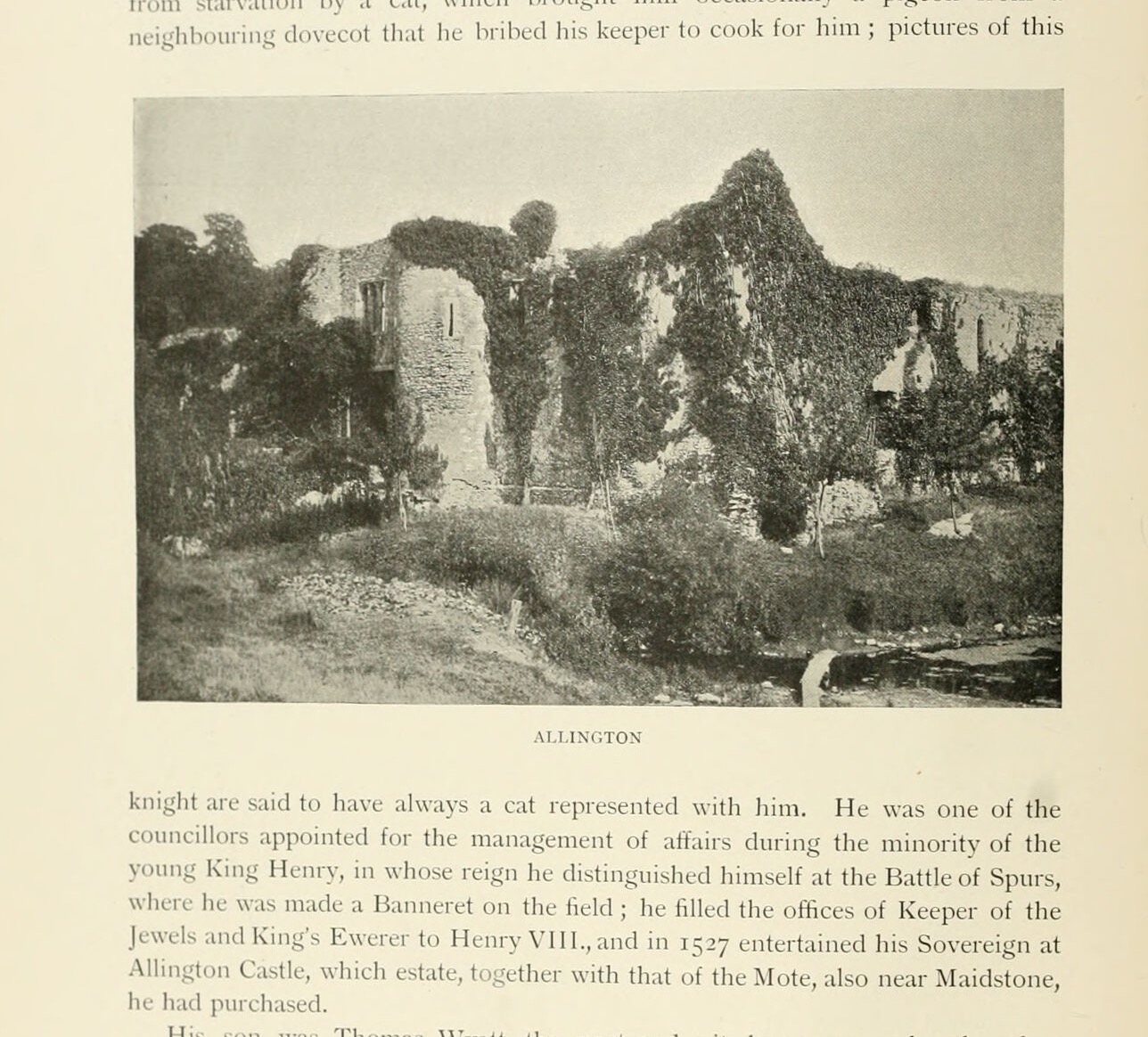
ALLINGTON
1897 · J. D. Mackenzie, The Castles of England, vol. 1 (1897)
Public domain
Nearby


