Palace · England · Still standing
Highclere Castle
Highclere Castle is a Grade I listed country house in Hampshire, England, rebuilt from 1679 and largely remodelled in the 1840s in a Jacobethan/Italianate style by Sir Charles Barry. It is the country seat of the Earls of Carnarvon and stands within Capability Brown parkland. The house, gardens and exhibitions are open to the public at set times.
Its prime
1878
Today
Still standing
As it stood in 1878
What Highclere Castle looked like in its prime.
A broad, rectangular Bath-stone country house with three main storeys and a taller central tower, punctuated by corner towers and slim Italianate turrets. Repeated vertical rows of tall rectangular sash windows, horizontal banding and carved strapwork friezes run across the façades. A crenellated parapet and pinnacled roofline silhouette the skyline; a gravel drive sweeps across clipped lawns into the parkland beyond, with the taller central tower flying a flag.
Its story
The story of Highclere Castle.
From the Bishops of Winchester to the Sawyer-Herbert Inheritance, 749–1692
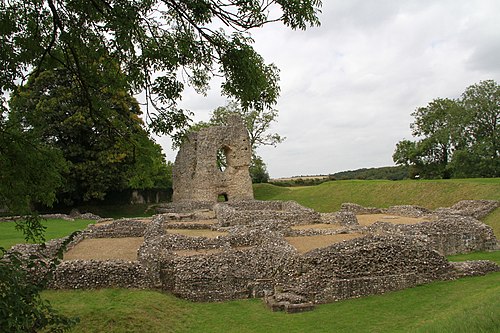
The estate's first written record dates to 749, when an Anglo-Saxon king granted it to the Bishops of Winchester, and it was recorded again in the Domesday Book of 1086. In the late 14th century William of Wykeham, Bishop of Winchester, built a medieval palace and gardens on the site; an itinerary of Edward II has the king staying there, then called Bishop's Clere, with Rigaud of Assier, Bishop of Winchester, on 2 September 1320. During the English Reformation, Edward VI confiscated the property from the Church of England in 1551.
The king granted the estate to the Fitzwilliam family, and it passed through several owners over the following 125 years. In 1679 the palace was rebuilt as Place House by its new owner, Sir Robert Sawyer, Attorney General to Charles II and James II. In 1692 Sawyer bequeathed the house to his only daughter, Margaret, wife of Thomas Herbert, 8th Earl of Pembroke; their son Robert Sawyer Herbert inherited Highclere, began its portrait collection and built its garden temples.
Charles Barry's Jacobethan Rebuilding, 1842–1878
The house remained a square classical mansion, and survived an abortive Greek Revival remodelling by Thomas Hopper for the 2nd Earl, before the 3rd Earl commissioned Sir Charles Barry to rebuild it between 1842 and 1849, while Barry was also at work on the Houses of Parliament. Barry cast the design in the Jacobethan style, faced in Bath stone, adding motifs of the Italianate architecture that had shaped his career and describing the finished style as "Anglo-Italian"; his assistant Thomas Allom gave the saloon its mock-medieval hammerbeam roof.
The exterior of the north, east and south fronts was finished before the 3rd Earl died in 1849 and Barry himself died in 1860, but the interior and the west wing, built as servants' quarters, remained incomplete. The 4th Earl brought in Allom, who had worked under Barry, to finish the interior, and the work was completed in 1878.
Drafting Canadian Confederation, 1866–1867
In the 1860s the 4th Earl of Carnarvon drafted the British North America Act at Highclere alongside John A. Macdonald, who became Canada's first prime minister, together with George-Étienne Cartier and Alexander Tilloch Galt; the three Canadians signed the castle's visitor book in 1866. The 4th Earl presented the act to Parliament in February 1867, and its passage that year gave legal form to Canadian Confederation and established Canada in its present institutional form.
Howard Carter and the Tomb of Tutankhamun, 1907–1923
The 5th Earl, an amateur Egyptologist, sponsored the excavation of nobles' tombs at Deir el-Bahari, Thebes, from 1907 and employed archaeologist Howard Carter in the search for the tomb of Tutankhamun, discovered in 1922. At the start of the First World War a hospital for wounded soldiers opened at Highclere, with Lady Carnarvon helping organise it and working as a nurse. After the 5th Earl's death in 1923, Lady Carnarvon continued to support Carter's team and spent much of her time in Egypt backing the excavations.
Evacuees to Downton Abbey, 1939–2018
During the Second World War the castle housed evacuee children; sections of a downed B-17 Flying Fortress that crashed on the estate are still held at the castle. George Reginald Oliver Molyneux Herbert became the 8th Earl of Carnarvon in September 2001 on his father's death, and the family has since undertaken major repairs, including to the roof, and opened an Egyptian Exhibition in the cellars in 2007 telling the story of the 5th Earl's discovery. After correspondence between the 4th Earl and John A. Macdonald came to light showing eight weeks of near-daily letters over the drafting of the British North America Act, the Canadian High Commissioner to the UK, Janice Charette, planted a maple tree on the lawn on 11 January 2018 in recognition of his role in Canadian Confederation.
The house has been Grade I listed since 1953 and its park and garden Grade I listed since 1984. Highclere became the principal filming location for the ITV/PBS drama Downton Abbey (2010–15) and its subsequent films, bringing international attention; the resulting rise in visitor numbers has funded repairs to the castle's turrets and interior. The house, its Egyptian exhibition and gardens are open to the public for tours through the summer and at other times of year, alongside ticketed events.
Step inside
8 places to explore in 1878.
The record describes 8 distinct spots at Highclere Castle, including 2 interiors: saloon (great hall), west wing servants' quarters. Create your own photoreal reconstruction and explore every one, more scenes means more photos, more angles and more of the immersive experience.
Build Your Own Castle
Recreate Highclere Castle with AI to explore it.
The artist rebuilds it as it stood in 1878, a photoreal reconstruction that belongs to you alone. Pay with coins, no subscription needed.
Recreate Palace to Explore →Whose seat
Families who held Highclere Castle.
The families tied to Highclere Castle across its history, follow a name to its page.
Country seat of the Herbert Earls of Carnarvon; the estate came to Thomas Herbert, 8th Earl of Pembroke, by marriage in 1692.
Sawyer
Robert Sawyer held Highclere, bequeathing the mansion to his daughter Margaret, wife of the 8th Earl of Pembroke, in 1692.
Fitzwilliam
Originally granted to the Fitzwilliam family by the king.
Nearby