Seat of power · England · Restored
New Scotland Yard
New Scotland Yard is the name given to the Metropolitan Police headquarters in London; the current headquarters occupies the redeveloped Curtis Green Building on the Victoria Embankment. The site serves as the administrative centre of the Metropolitan Police Service and houses the force's Crime Museum.
First raised
1829
Its prime
2016
Today
Restored
As it stood in 2016
What New Scotland Yard looked like in its prime.
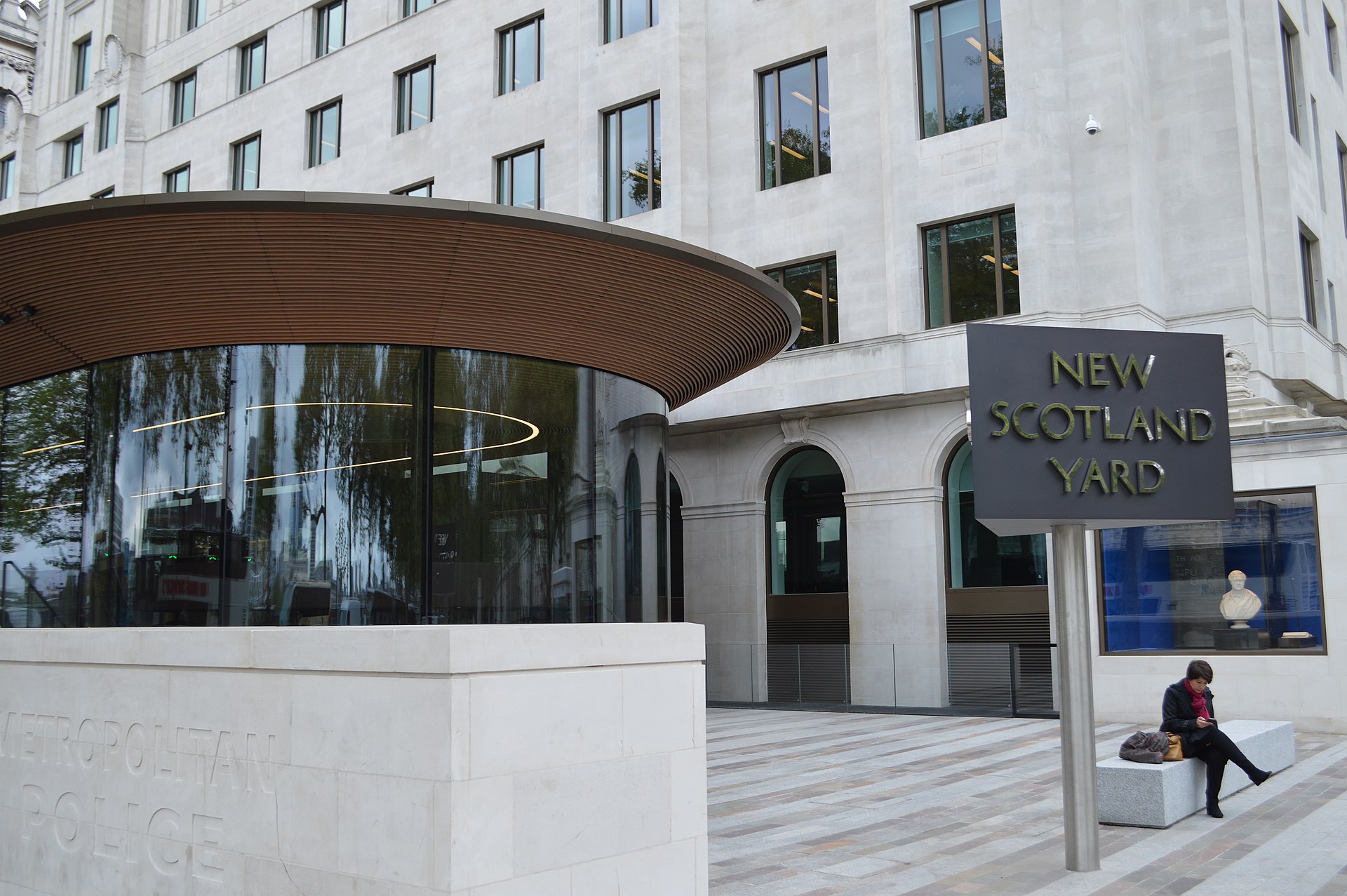
A pale Portland‑stone office block with regular square windows above a ground floor of broad semicircular arched openings, set behind a broad paved plaza. A dark, freestanding rectangular sign reading "NEW SCOTLAND YARD" on a stainless pole marks the entrance. A low, circular glass pavilion with floor‑to‑ceiling curved glazing and a wide wooden soffit roof sits at the plaza edge, its interior ring lighting visible from outside. The setting is a formal stone forecourt with benches and wide approach.
Its story
The story of New Scotland Yard.
Peel's Police Office at 4 Whitehall Place, 1829-1887
Parliament passed the Metropolitan Police Act in 1829, and Robert Peel, helped by Eugène-François Vidocq, picked the site for the new force's headquarters at Whitehall Place. The first two commissioners, Charles Rowan and Richard Mayne, occupied the building along with various officers and staff, in what had previously been a private house. Number 4 backed onto a Westminster street called Great Scotland Yard, and its main public entrance opened there; in time "Scotland Yard" became the common name not only of the building but of the Metropolitan Police Service itself and of the officers, especially detectives, who served in it. The New York Times observed in 1964 that, just as Wall Street had given its name to New York's financial district, Scotland Yard had become the name for police activity in London.
By 1887 the headquarters had spread out of number 4 into neighbouring addresses at 3, 5, 21 and 22 Whitehall Place, together with several stables, one of them at 7 Great Scotland Yard. Buildings fronting the north side of Great Scotland Yard, numbered 8 and 9 and shown on some maps as a police office, had served from 1842 as the central headquarters of the new Detective Branch. They were damaged in a Fenian bomb attack in 1884.
Richard Norman Shaw's Embankment Headquarters, 1888-1940
In the 1880s the force judged that it had outgrown its original site and commissioned the architect Richard Norman Shaw to design a new headquarters on the Victoria Embankment, overlooking the Thames. In 1888, while the building was going up, workers found the dismembered torso of a woman on the site; the case, known as the Whitehall Mystery, was never solved. The police moved in during 1890 and the building took the name New Scotland Yard. The force had by then grown from its initial 1,000 officers to about 13,000, and its increasing size and responsibilities required still more administrators and space: further buildings were completed in 1906 and in 1940, making New Scotland Yard a three-building complex.
The Broadway Tower, 1967-2016
In 1967 the Metropolitan Police consolidated its headquarters out of the three-building Embankment complex and into a newly constructed tower at 8-10 Broadway in Victoria, on a site that also bordered Victoria Street. The Metropolitan Police Authority bought the freehold of 10 Broadway in 2008 for around £120 million, then sold the building in December 2014 to the Abu Dhabi Financial Group for £370 million. Plans for a six-building, mixed-use redevelopment were approved in February 2016; ownership passed formally to the buyer when the force's relocation was completed on 31 October 2016, and demolition began later that year.
Back to the Embankment at Curtis Green, 2013-2017
In May 2013 the Metropolitan Police confirmed that the Broadway building would be sold and the headquarters moved back to the Victoria Embankment, into the Curtis Green Building next door to Norman Shaw's original, which had previously housed the Territorial Policing headquarters. A competition was announced for architects to redesign it. Work on the exterior was completed in December 2015, and staff left 10 Broadway on 31 October 2016. Queen Elizabeth II was to have opened the new New Scotland Yard on 23 March 2017, but the royal opening was postponed that day after the previous day's terrorist attack at Westminster; it went ahead on 13 July 2017.
Like its three predecessors, the Curtis Green headquarters holds the Met's Crime Museum, once known as the Black Museum, a collection of criminal memorabilia founded in 1874 and not open to the public. The first two of Shaw's Embankment buildings survive as a Grade I listed structure, the Norman Shaw Buildings.
Step inside
7 places to explore in 2016.
The record describes 7 distinct spots at New Scotland Yard, including 2 interiors: circular glass reception pavilion, crime museum (black museum) gallery. Create your own photoreal reconstruction and explore every one, more scenes means more photos, more angles and more of the immersive experience.
Build Your Own Castle
Recreate New Scotland Yard with AI to explore it.
Rebuilds stop at 1945, so the artist raises this site as it stood in 1890, not today's building, as a photoreal reconstruction that belongs to you alone. Pay with coins, no subscription needed.
Recreate Seat of power to Explore →Nearby
Castles within reach of New Scotland Yard.


Landmarks within reach of New Scotland Yard.


More landmarks of England


Explore the city


