Stadium · England · Still standing
Old Trafford
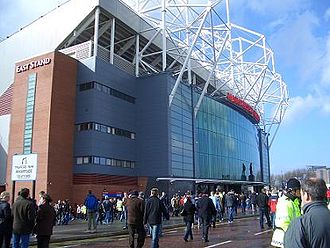
Old Trafford is a large football stadium in the Old Trafford area of Greater Manchester, England, long the home ground of Manchester United. The stadium is a four-sided bowl of stands with cantilevered roofs, hospitality levels and a prominent glazed main stand façade, used for domestic and international football and occasional rugby fixtures.
Its prime
2006
Today
Still standing
As it stood in 2006
What Old Trafford looked like in its prime.
A vast four-sided bowl stadium with continuous multi-tiered red seating and cantilevered roofs supported by white steel trusses. The Main Stand features a tall curved glass curtain wall and club signage, set above a red-brick base and grey cladding. The roof structure rises as exposed white latticework; concrete concourses and glazed private boxes sit behind the seating tiers. The rectangular grass pitch lies enclosed at the centre, with wide access routes and floodlight infrastructure integrated into the roofline.
Its story
The story of Old Trafford.
Davies's New Ground and the Khaki Cup Final, 1909–1939
Manchester United, playing until 1902 as Newton Heath, had outgrown its earlier grounds at North Road and Bank Street, where pitches ranged from gravel to marsh and factory fumes fouled the air. After the club's rescue from near-bankruptcy, chairman John Henry Davies judged Bank Street unfit for a side that had just won the First Division and FA Cup, and in 1909 funded a new stadium on land beside the Bridgewater Canal at Old Trafford. Scottish architect Archibald Leitch designed the ground for 100,000 spectators, but rising costs forced club secretary J. J. Bentley to recommend cutting the capacity to around 80,000 to keep the build near its original £60,000 budget.
The stadium opened on 19 February 1910 with a league match against Liverpool, who won 4–3; Sandy Turnbull scored the first goal at the new ground. Before Wembley Stadium was built in 1923, Old Trafford served as a neutral FA Cup Final venue, hosting the 1911 final replay, won by Bradford City, and the 1915 final between Sheffield United and Chelsea, nicknamed the "Khaki Cup Final" for the many soldiers in its crowd. Its highest-ever attendance, 76,962, was recorded not for a United fixture but for the 1939 FA Cup semi-final between Wolverhampton Wanderers and Grimsby Town.
Destroyed by German Bombing, 1940–1949
At the outbreak of the Second World War the stadium was requisitioned by the military as a depot, though football continued until a German raid on Trafford Park on 22 December 1940 damaged it enough to force a Christmas Day fixture elsewhere. Play resumed on 8 March 1941, but a second raid on 11 March 1941 destroyed much of the ground, including the main stand, and pushed the club's operations into borrowed cold-storage premises. The War Damage Commission granted Manchester United £4,800 to clear debris and £17,478 to rebuild, and for the rest of the war and the years after, United played its home matches at Maine Road, the ground of rivals Manchester City, at an annual cost of £5,000 plus a share of gate receipts. Old Trafford reopened without a roof in 1949; United's first match back, on 24 August, was a 3–0 win over Bolton Wanderers watched by 41,748 people, ending nearly a decade without a league game on the site.
Cantilevers, the 1966 World Cup and the Taylor Report, 1957–1996
Roofs were restored progressively through the 1950s, reaching the Stretford End in 1959, and floodlights installed at a cost of £40,000 allowed United to host evening European matches without borrowing Maine Road; the first floodlit fixture was played on 25 March 1957. With the 1966 World Cup approaching, for which Old Trafford was to stage three group matches, the North Stand's pillared roof was replaced in 1965 with a cantilever design giving every seat an unobstructed view, at a cost of £350,000; the East Stand was rebuilt to the same style in 1973. A 1971 knife-throwing incident led the club to erect the country's first perimeter fence.
The Taylor Report of 1990 forced the conversion of the ground to all-seating, cutting capacity to an all-time low of around 44,000. Rising success prompted a rebuild of the demolished North Stand in time for Euro 1996, a three-tiered structure costing £18.65 million with the largest cantilever roof in Europe.
Biggest Club Ground in Britain, 2000–2025
Second tiers added to the East Stand in January 2000 and the West Stand soon after took capacity to 68,217, making Old Trafford the largest club stadium in England and the United Kingdom; it hosted the 2003 UEFA Champions League final between Milan and Juventus, and, after Wembley's demolition, more England home matches than any other ground between 2001 and 2007. A further expansion between 2005 and 2006 added roughly 8,000 seats, and the stadium's record all-seater attendance, 76,098, was set on 31 March 2007 against Blackburn Rovers. The ground hosted 2012 Olympic football, including the first women's international matches played there, and staged the opening match of UEFA Women's Euro 2022 between England and Austria before 68,871 spectators, the second-highest attendance recorded for women's football in the United Kingdom.
Now owned and operated by Manchester United, the stadium's stands carry the names Sir Alex Ferguson, Sir Bobby Charlton, East and West, and its original 1910 players' tunnel, the only surviving fabric of the pre-war ground, was renamed the Munich Tunnel in 2008 to mark the Munich air disaster. On 11 March 2025 the club confirmed plans to demolish Old Trafford and build a new 100,000-seat stadium designed by Foster and Partners on the same site.
Step inside
8 places to explore in 2006.
The record describes 8 distinct spots at Old Trafford, including 5 interiors: pitchside from main stand (touchline view), stretford end (south stand) behind goal, north stand upper tier and cantilevers and more. Create your own photoreal reconstruction and explore every one, more scenes means more photos, more angles and more of the immersive experience.
Build Your Own Castle
Recreate Old Trafford with AI to explore it.
Rebuilds stop at 1945, so the artist raises this site as it stood in 1911, not today's building, as a photoreal reconstruction that belongs to you alone. Pay with coins, no subscription needed.
Recreate Stadium to Explore →Nearby