England · Partial ruin
Radcliffe Tower
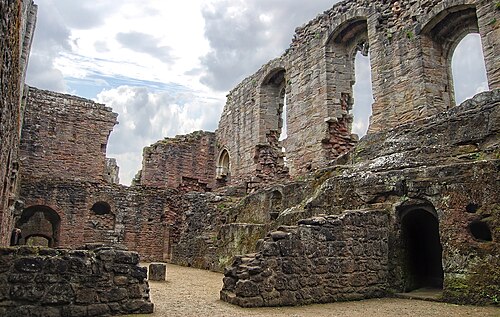
Radcliffe Tower is the surviving tower remnant of a medieval manor house in Radcliffe, Greater Manchester, rebuilt in 1403 by James de Radcliffe. The manor originally comprised a stone-built hall and one or two towers and was licensed to receive crenellations and battlements; the rest of the house was demolished in the 19th century and the shell survives as a scheduled monument and Grade I listed building.
Its prime
1403
Today
Partial ruin
As it stood in 1403
What Radcliffe Tower looked like in its prime.
In its prime the site comprised a stone-built rectangular manor with a long hall attached to at least one projecting tower, all faced in coursed ashlar blocks. Walls rose to a crenellated parapet and battlement walks ran atop the tower and curtain. The ground floor featured a pointed arched main entrance and narrow vertical windows in the tower; larger glazed openings lit the hall. The roofs were pitched and covered with fired roof tiles, set on level parkland with scattered trees.
Its story
The story of Radcliffe Tower.
The Rebuilding of 1403 and the Royal Licence to Fortify
The manor house at Radcliffe was rebuilt in 1403 by James de Radcliffe, lord of the manor. What he raised was a stone-built hall with one or two towers, probably of ashlar blocks. De Radcliffe was granted a royal licence to fortify the site, including the addition of crenellations and battlements.
The House Pulled Down, the Tower Kept
The manor house was demolished in the nineteenth century and only the tower was left, surviving to a height of about 20 feet. For a period it was put to use as a pigsty, before being restored.
Scheduled in 1924, Excavated since 2012
The remains were scheduled as a monument in 1924 and listed Grade I in 1966, and have belonged to Bury Council since 1981. In 2009 plans to restore the shell of the tower were launched with the council's support, as part of a wider project covering Radcliffe E'es, Close Park and the parish church of St Mary. An archaeological excavation was carried out in 1979 and 1980, and digs since 2012, funded by the Heritage Lottery Fund, have uncovered medieval glazed floor tiles, roof tiles and pottery of the fifteenth century.
Step inside
7 places to explore in 1403.
The record describes 7 distinct spots at Radcliffe Tower, including 3 interiors: great hall interior, upper chamber of the tower, area of medieval floor tiles (archaeological interior). Create your own photoreal reconstruction and explore every one, more scenes means more rooms, more angles, and more of the place to stand in.
Build Your Own Castle
Recreate Radcliffe Tower with AI to explore it.
The artist rebuilds it as it stood in 1403, a photoreal reconstruction that belongs to you alone. Pay with coins, no subscription needed.
Recreate this castle →Defend this castle →Whose castle
Clans who held Radcliffe Tower.
The families that held Radcliffe Tower for a decade or more across its history, follow a name to its clan.
Radcliffe
The manor house was rebuilt in 1403 by James de Radcliffe, lord of the manor of Radcliffe, under royal licence to fortify.
Nearby