England · Still standing
Eccleshall Castle
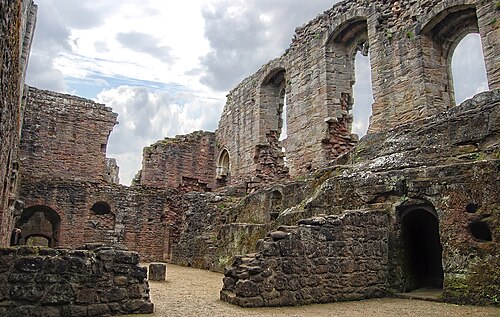
Eccleshall Castle in Eccleshall, Staffordshire, originated as a 13th-century episcopal stronghold and was enlarged in the early 14th century. It was slighted in the Civil War but partly re-used and in 1693 a new bishop's house was built among the medieval fragments. The site remains a private residence and is a Scheduled Ancient Monument and Grade II* listed building.
Its prime
1693
Today
Still standing
As it stood in 1693
What Eccleshall Castle looked like in its prime.
A late 17th-century bishop’s house set within and against the surviving fabric of a medieval castle: compact stone residence with pitched roofs and multiple chimneys abutting irregular medieval masonry. A pronounced, unusual nine-sided stone tower rises from a corner of the older curtain wall. A water-filled moat and a medieval stone bridge cross to the entrance; stretches of low curtain wall and masonry fragments encircle the house, showing a visible seam between older medieval stonework and later 17th-century building fabric.
Its story
The story of Eccleshall Castle.
Bishop Muschamp's Licence and Langton's Castle, 1200–1305
The land at Eccleshall was reputedly granted to St Chad, the medieval bishop of Lichfield. In 1200 King John granted Bishop Geoffrey de Muschamp a licence to crenellate a castle there. The site lay on the main road between the centres of the Lichfield diocese at Chester, Lichfield and Coventry, which made it a convenient diocesan base. In 1305 Bishop Walter Langton, Chancellor of England, replaced the first castle with a larger one.
Blore Heath 1459, Brereton's Guns and the Slighting of 1643
At the outbreak of the Wars of the Roses, Margaret of Anjou, queen consort of Henry VI, took refuge in the castle after the Battle of Blore Heath in 1459. Nearly two centuries later, in June 1643, Sir William Brereton and his Parliamentary forces besieged it, encamped around the church. Their guns caused considerable damage to the walls, but the castle held out, with Bishop Robert Wright sheltering within. When the Parliamentarians finally took it on 30 August, they found that the bishop had died of a heart attack during the siege and that most of the defenders were either drunk or had gone into the town to drink in the taverns.
The castle was slighted to prevent any future use as a stronghold, though enough of the building survived, including an unusual nine-sided tower, the moat walls and the medieval bridge, to be used as a prison for Royalist gentry. The castle and its grounds were confiscated and sold, then bought back again by the diocese.
William Lloyd's House among the Ruins, 1693–1867
The present house, still known as Eccleshall Castle, was built among the ruins in 1693 by William Lloyd, Bishop of Lichfield and Coventry, incorporating fragments of the slighted 14th-century structure, and successive bishops of Lichfield lived in it after him. Sir Walter Scott often stayed there as the guest of Bishop James Cornwallis. The gatehouse was demolished and the moat drained during the 18th century. The last bishop to live in the house was John Lonsdale, who died there in 1867.
A Century of the Carter-Motleys
Eccleshall Castle is now in private hands and closed to the public, though the gardens are occasionally opened for weddings and to raise money for local Eccleshall charities. It has been the home of the Carter-Motley family for more than a hundred years, and the site is protected as a scheduled ancient monument and a Grade II* listed building.
Step inside
7 places to explore in 1693.
The record describes 7 distinct spots at Eccleshall Castle, including 1 interior: tower interior / prison cell. Create your own photoreal reconstruction and explore every one, more scenes means more rooms, more angles, and more of the place to stand in.
Build Your Own Castle
Recreate Eccleshall Castle with AI to explore it.
The artist rebuilds it as it stood in 1693, a photoreal reconstruction that belongs to you alone. Pay with coins, no subscription needed.
Recreate this castle →Defend this castle →Whose castle
Clans who held Eccleshall Castle.
The families that held Eccleshall Castle for a decade or more across its history, follow a name to its clan.
Carter-Motley
The castle has been the home of the Carter-Motley family for more than a hundred years.
Nearby